Showing search results for ''

Hula Valley

Located in the far north of Israel’s Upper Galilee, the Hula Nature Reserve is both a national park and a major wetland within the Middle East region. Home to all kinds of flora and fauna, it is an excellent place for hiking. Moreover, it is by far the best place in Israel to birdwatch, since it lies directly on the Europe-Africa migration route.Unbelievably, up until the 1950s, the reserve was nothing more than a malarial swamp. Once drained and settled, the area was developed agriculturally but it was decided to leave the central lake as it was, and this became the Hula Valley Nature Reserve.Within the reserve, more than 200 species of birds can be spotted, including pelicans, cormorants, egrets, storks, and cranes. The recently developed ‘Agmon ha Hula’ (a result of flooding in the area in the 1990s) means that in the spring and autumn, visitors can see thousands of birds flying overhead (Indeed, keen ornithologists have established an annual Bird Festival here).Hula offers excellent guided tours (with detailed explanations about the birds that reside in the reserve), walking trails, observation points, and telescopes. The white-tailed eagle (which had become extinct in the wild) has been reintroduced at Hula. Moreover, the area is home to herds of water buffalo (whose grazing protects the surrounding environment) and fallow deer. They are best viewed from a floating bridge – 600 meters long - which provides a concealed platform over the lake.Hula also houses a garden shelter for rare plants (such as white water lilies and paper reeds) and restores other endangered species, before returning them to the wild.At the entrance to the reserve, visitors will notice a large grove of eucalyptus trees, most of which were planted in the 1890s. By the smaller grove nearby (planted 70 years later) there is a picnicking and barbeque area. Visitors can also explore the new, state-of-the-art ‘Harper Centre’. This hosts an interactive digital wall (with a live feed of birds in the reserve), a 3D model of the Hula Valley and virtual reality stations where you can imagine you’re a bird in the air. Because the Hula Valley has so much water, with so many springs and large rivers, it is green year-round. Visitors can hike and bike here and, in the summer, go kayaking on the River Jordan. HaTanur, Tel Dan and Banias reserves are also within easy driving distance.To explore Hula Valley, book our Golan Heights private tour.

Amud Stream

Some have called the Amud Stream Nature Reserve the most beautiful stream in Galilee. Nachal Amud (Pillar Stream) or Wadi al-Amud flows from Ramat Dalton in the Upper Galilee to the northwestern part of the Sea of Galilee. It is named after a natural rock formation that resembles a pillar rising out of the water near Kibbutz Hukok.The nature reserve holds natural and archaeological heritage sites. The reserve can be divided into the Upper Amud Stream where the stream flows year-round and the Lower Amud Stream where the stream is seasonal. The reserve is one of the most popular hike destinations in the country where visitors can enjoy rock pools, lush vegetation, wildflowers, and dramatic cliffs.Upper Amud StreamIn the Upper Amud Stream area is the historic Ein Tina police station that was used by British soldiers guarding the stream pumping station. Notice the bullet marks in the concrete structure from the Arab Revolt of 1936-39. The British pumping station on nearby Ein Yakim Stream supplied water to the city of Safed until 1995.There are remains of ancient aqueducts that would have channeled water to flour mills built along the spring. They would also have brought water to irrigate the nearby orchards that have been reconstructed so that visitors can see traditional agricultural methods. At the point where the Amud Stream and Sekhvi Stream meet are glorious shallow pools shaded by tall trees. Lower Amud StreamThe caves in Amud Stream Nature Reserve are the country’s most important prehistoric sites. As you walk along the edge of the stream you can look up to see the opening of a large cave about 30m up the cliffs. Thousands of years ago the water level would have been much higher and flowed alongside this opening. Excavations of the cave have found human remains dating back to the Mousterian culture, 50,000-70,000 years ago.Fossilized human bones were also found in the Skull Cave. A human skull found in the Skull Cave came to be known as the “Galilee Man” and belonged to a man who lived here more than 350,000 years ago. The Lower Amud Stream is where you can see the “Amud”, a 20m-tall limestone pillar. This is also the section of the stream where cliffs offer a nesting site for vultures, kestrels, buzzards, and eagles. The Tsera Lookout Point overlooks the National Water Carrier siphon that crosses the stream over a 150m-deep channel. Hiking in the Amud Stream National ReserveThere are 40kms of marked hike trails in the reserve and maps are available at the reserve entrance. You could take the 5km (2-4 hours) loop trail from the reserve entrance, past the historic British police station, then down into the valley where rocks are covered with moss, ferns, vines, and flowers. Then continuing to the old pump station, an orchard of olive trees and historic flour mill to reach the stream. Here you can wade through pools, see water cascading over rocks, and even swim. The route loops back and you need to make the ascent to the trail-head.If you want a longer walk there is the one-way trail along the river to the pillar that stretches for 13.5km. This is a difficult hike but offers many exciting discoveries along the way. On route you’ll stop at the Yakim Spring to cool off; see waterfalls; an ancient wool mill; stop at the Shechvi Pools; the Seter Spring and the ancient aqueducts. There is a lookout point along the way where you can get a rare view of the Mediterranean Sea and Sea of Galilee at the same time.Te hike Amud Stream, book one of our private Galilee tours.

Dor HaBonim Beach

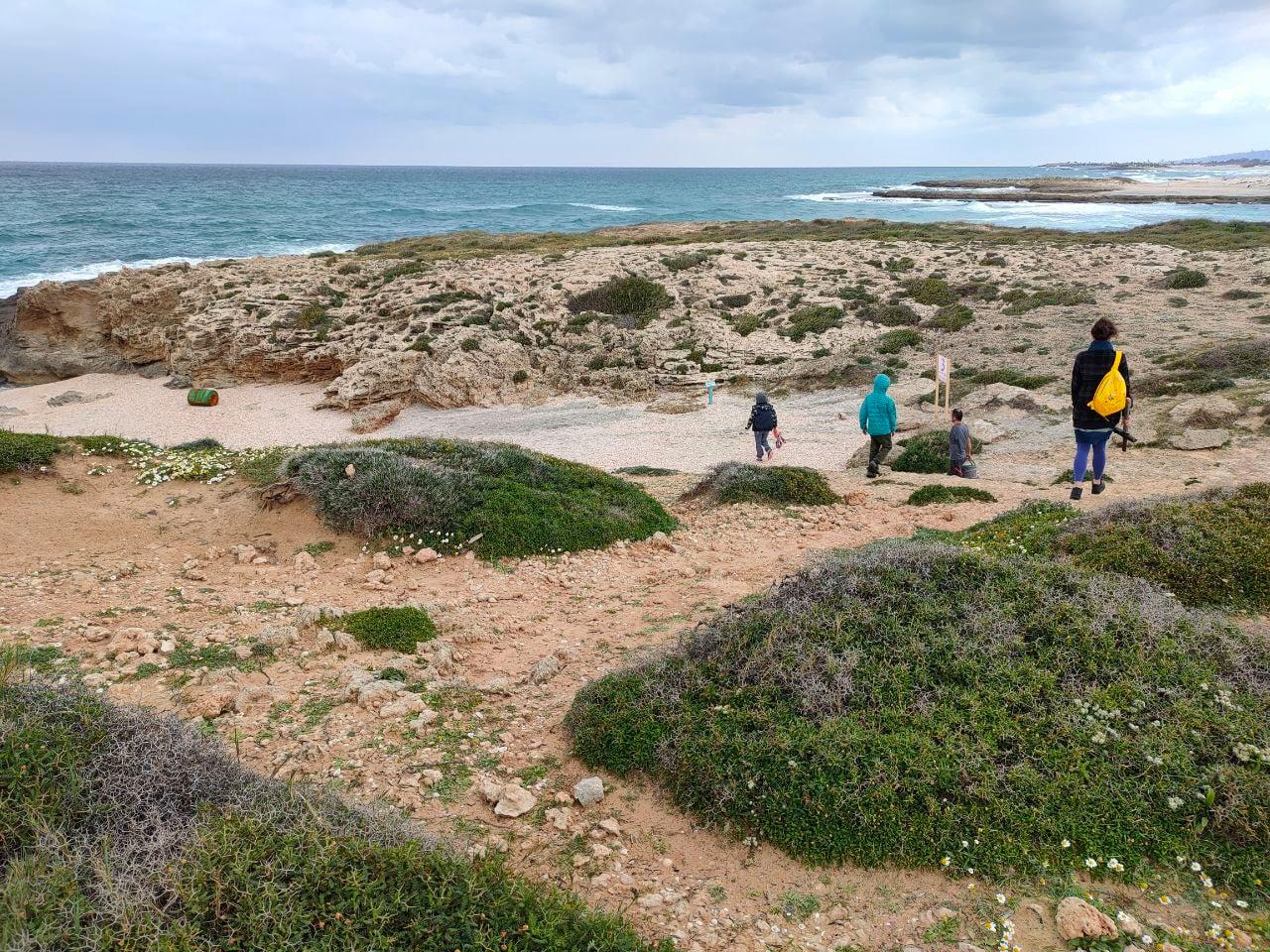
Along Israel’s Mediterranean coast, between Caesarea and Haifa, you’ll find one of the most beautiful beaches in the country. Dor HaBonim (the founding generation) beach nature reserve protects a pristine stretch of the coastline extending for 4.5kms. The beach has various facilities include picnic areas, a first aid station, shade, camping area, showers, and a kiosk. Instead of being one continuous stretch of sand, Dor HaBonim beach has more inlets than any other Israeli beach, natural rock pools, and bays.There is a circular scenic hike trail that connects several stunning beaches and sea lookouts. The trail takes you along the ridge overlooking the water past the Blue Cave, Shell Bay (an inlet lined with a thick layer of shells), and a 20th-century shipwreck. You’ll also see the ancient remains of wells and stone troughs, and Cleopatra Cave (originally man-made but eroded over time). A second trail leads from Kibbutz Nachshonim to HaBonim Beach. Nearby is Tel Dor National Park with the remains of an ancient city and harbor. Seafaring communities inhabited this area for thousands of years. The natural inlets were used for ships docking on the Mediterranean shore. Dor HaBonim Beach Nature Reserve is the ideal family-friendly destination with sea, sun, history, and nature all rolled into one.

Akhziv National Park

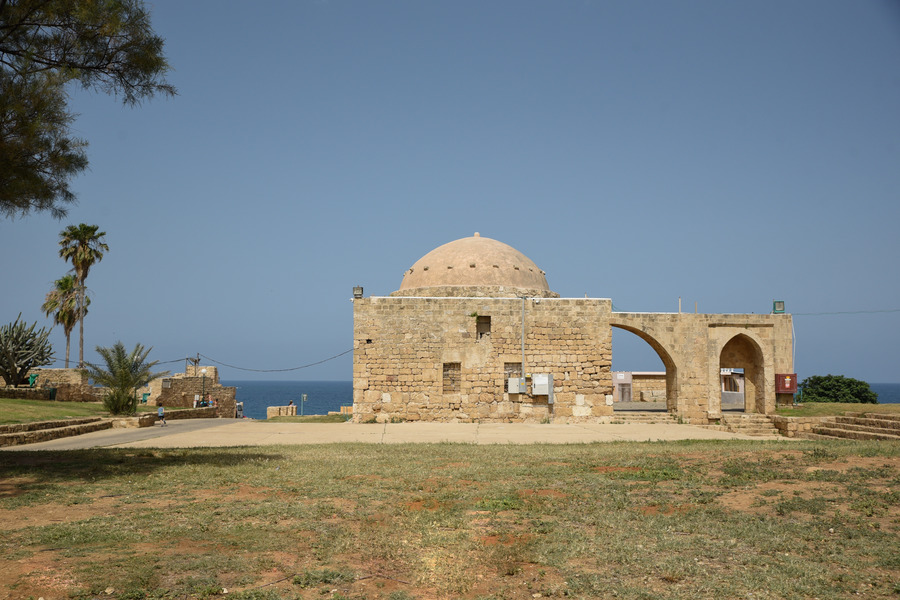
Akhziv lies 5 km north of Nahariya on Israel’s Mediterranean Northwestern coast. The Akhziv National Park is home to one of Israel’s most beautiful secluded beaches and preserves the area's unique marine life as well as archaeological remains. The clear water along this stretch of the Mediterranean coast laps up against a rugged shore and flows into natural rock pools, bays, and lagoons. Beneath the water is a rich world of marine life and kids can spend hours tiptoeing among the rock pools finding small fish, crabs, sea anemones, sea urchins, and seaweed. In the summer sea turtles come out of the water to lay their eggs on the beach. Just off the shore are the Akhziv beach islands of Nahlieli, Akhziv, and Shahaf. The islands are the tips of underwater sandstone ridges. Bird-lovers can spot sea birds nesting on the islands.History of AkhzivThe earliest settlers in Akhziv were in the 18th century BC (Middle Canaanite Period). Akhziv is mentioned in the Bible as a Canaanite town not captured by the tribe of Asher (Judges 1:31). The Phoenicians developed the natural harbor making it an important commercial port. Assyrians conquered the town in 701 BC and stone tombstones have been uncovered from that era. Akhziv is mentioned in the Talmud and Mishna. During the Mishnaic Period (10 - 220 AD) Jewish inhabitants of “Kziv” or “Gziv” were either fishermen and seafarers or engaged in the production of dye from purple and blue sea snails. In the 13th century, Crusaders built a castle called Akhziv Casal Imbert and under the Mamluks, a village was established at Akhziv called Al-Zib. Most of the ruins we see today come from the fortified Crusader city and the Mamluk village. Today Ackziv is a national park best known for its breathtaking coast, lagoons, natural bays, and archaeological remains.Akhziv Beach and National ParkThere are two man-made saltwater lagoons – one shallow and a deep-water pool where visitors can swim. In summer visitors to Akhziv National Park can sleep beneath the stars at the park campground where there are facilities and lighting. Lawns and shady groves extend inland from the shore providing an area for picnics and barbeques. The expansive 6-acre parkland has facilities such as showers, toilets a playground, lifeguard service, and a restaurant. A seafront promenade links the coast of Rosh HaNikra to Akhziv. The northern part of the beach, Banana Beach is known for its loud parties while the campground and Akhziv National Park beach are quieter choices. The only inhabitant of Achziv is an eccentric Israeli who has established a micronation called Akhzivland along the beachfront. He has lived here since 1975 and welcomes visitors to his “country.”Archaeological Remains at AkhzivAmong the interesting artifacts uncovered during excavations at Akhziv were pieces of red glazed pottery made using a special technique. Many of the excavations discovered quarries where stone was acquired for building. There were also pools for fish breeding, storing fish, breeding sea snails for dye production, and salt evaporation. The remains of the Mamluk village stone mosque have been restored and one of the village homes has been turned into a museum.Visiting AkhzivAkhziv is a quiet stretch of beach far from the crowded beaches of Tel Aviv where you can enjoy shallow rock pools, natural and man-made seawater pools, the clear Mediterranean waters, and white sand fringed by cliffs. You can also go fishing from Akhziv and camp overnight. End your day at Ackziv by watching the sunset over the sea.

Ein Afek

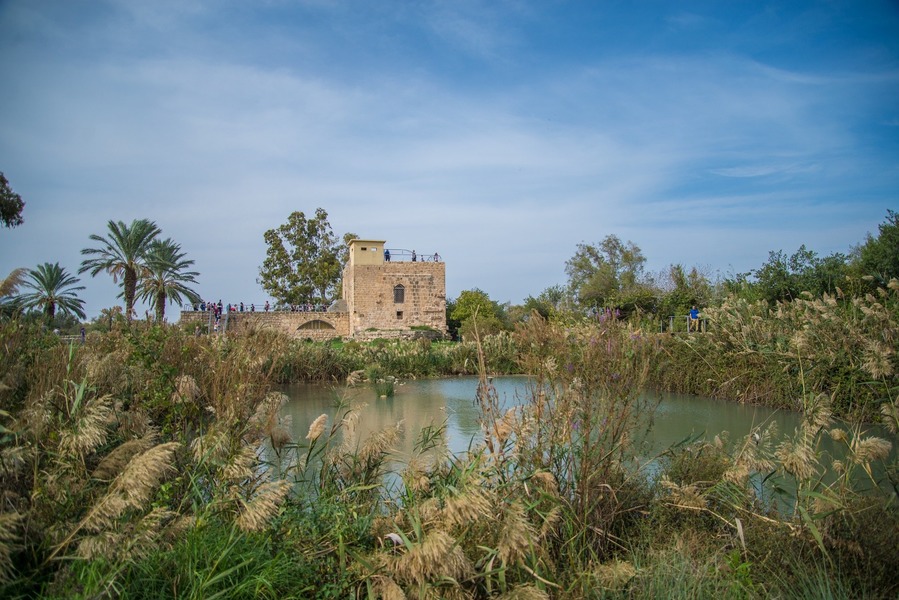
Ein Afek Nature Reserve is located about 20 minutes north of Haifa. Tel Afek became a nature reserve in 1979 to protect the delicate wet habitats around the sources of Naáman River, rare plant life, and archeological remains. It is home to lush swamplands and waterways plus ancient archaeological remains. Visitors can walk across the picturesque bodies of water on floating wooden walkways and follow the Swamp Pathway. This is a unique experience when you are virtually walking on water. Other attractions in the park include the ancient two-story flour mill. The foundations of the mill were built by the ancient Romans and the rest of the structure dates back to the Crusaders. At the visitors center, you can see a display of historic agricultural tools, a short video presentation about the area, and art exhibits. In the southern part of the park is the Tel Afek archaeological mound. Here there are remains from several periods including the biblical town of Aphik, but there are also remains from the Chalcolithic era, Bronze Age, Persian, Greek, Roman, Byzantine, Crusader, and Mamluk era. The park is home to a garden dedicated to endangered and rare indigenous species. There are several observation points where you can get sweeping views across the tranquil surroundings.

Horshat Tal

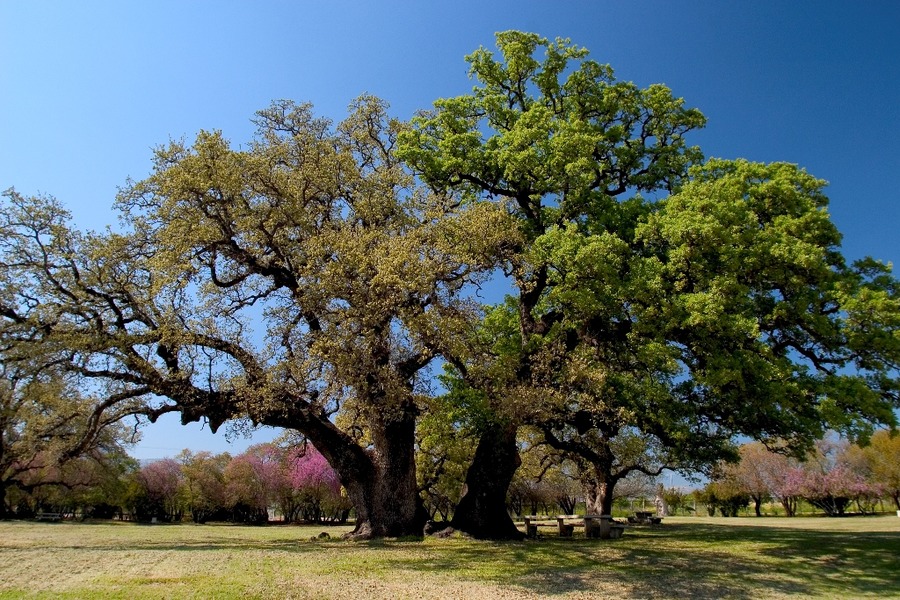
Horshat Tal (Dew Grove) is one of the most popular national parks in Israel.It is spread over 700 dunams of pristine natural land in northern Israel, north of the Hula Valley, near Kibbutz HaGoshrim. The park’s popularity is partly due to the excellent facilities including a camping ground, and rental cabins. Tal Stream flows from the Dan Stream, through the park, and feeds into a swimming pool with water slides. The park has many natural and man-made water channels, as well as She’ar Yashuv Stream that flows through the park. Tal Stream eventually flows into the Jordan River. The park lies in the shadow of Mount Hermon, Israeli’s highest peak. Inspiration for the park’s name was taken from Psalm 133 “Like the dew of Hermon, that comes down upon the mountains of Zion”.History of Horshat TalIn 1968, the national park was established and the nature reserve was declared to protect the 350-400-year-old Valonia oak trees. An Islamic legend tells how ten of Muhammad’s escorts stopped to rest nearby but couldn’t find where to tie their horses. So they stuck their sticks into the ground as tying posts. In the morning the men saw that their sticks had grown to be trees. In Arabic, the trees are called Sejrat el-Asara or the Grove of the Ten. It is possible that the Tal Stream was once a 5th century BC water channel used to transfer water for irrigation. Points of Interest in Horshat Tal National Park and Nature ReserveCampground: The Overnight camp is extremely well cared for and has all the facilities you need for a stay surrounded by nature. The landscape is flat, with natural grass lawns, and there are toilets, showers, a swimming area, fishing ponds, electricity, lighting, a cafeteria, and refrigerated lockers. If you’re not keen on pitching a tent there are wooden cabins and bungalow straw huts for rent. At the southern end of the park, there is an area for caravans, with all the required facilities including electricity, gas, and water. Oaktree Grove: Enjoy the grove of Mount Tabor oak trees linked to the Islamic legend of The Ten. In the past, the oak trees would have grown across the entire Hula Valley. But today only about 240 oak trees remain.Orchid Reserve: Near the oak tree grove you can see a variety of 13 rare species of orchids that grow only in Israel. The reserve was established to nurture and cultivate the flowers.Flora and Fauna: In the oak tree grove you might be able to spot Mesopotamian fallow deer. The deer were once extinct in Israel, but are now raised in the park, and returned to nature. Among the small creatures living in the park are otters that spend their time mainly in the brooks. Horshat Tal is home to a rare species of ant that can only be found in Israel in Horshat Tal and the Banias region. The park is visited by a number of birds including the cattle egret, little egret, spur-winged lapwing, the European bee-eater, the hooded crow, and the rare black kite. In winter there are meadows covered with anemones, and you can also see chamomile, Phoenician rose, spurge, Greek silk-vine, St John’s wort, fen-sedge, and many other fascinating plants.

Hai-Bar Carmel

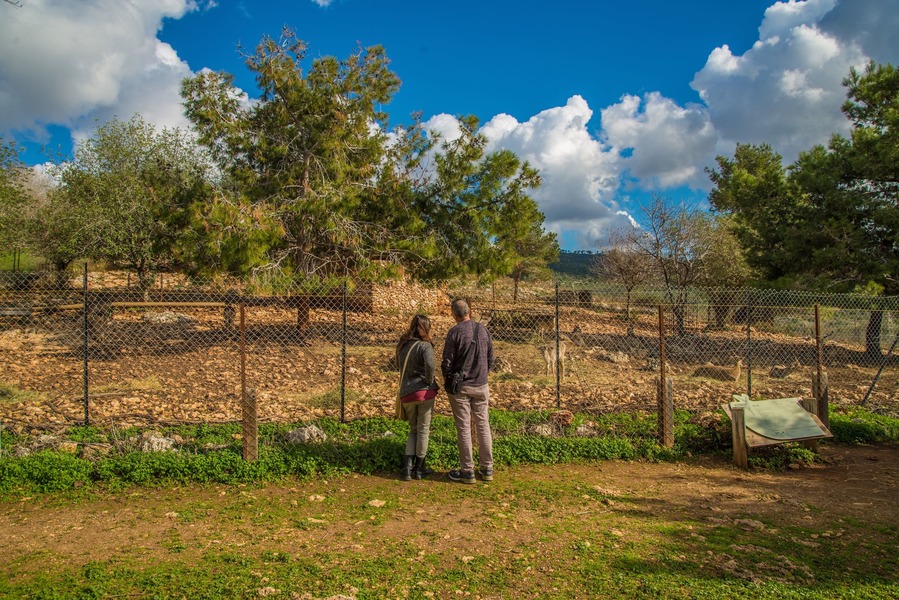
Hai-Bar Carmel Nature Reserve is located among the lush forests of “Little Switzerland” on Mount Carmel that surrounds Haifa. The nature reserve covers 1,500 acres (607 hectares) within the larger Mount Carmel National Park. The reserve is devoted to nurturing endangered species of the region, and where possible, reintroducing them to their natural habitat. The team at Hai-Bar raises breeding cells of species that have become extinct, to reintroduce them into the wild. The Carmel is classified as a biosphere, home to man, animals, agriculture, and nature. A visit to Hai-Bar Carmel lasts about 1.5-2 hours. You can follow the paths through the park and spot wildlife from several observation points.History of Hai-Bar Nature ReserveAbout 150 years ago Mount Carmel was home to deer, panthers, fox, vultures, falcons, owls, and many other species. During the Ottoman period, railway lines were laid, destroying forests and woodlands. With the infiltration of man into the natural environment, animals were hunted, their habitats destroyed by deforestation, and animals were even poisoned to prevent them from disrupting farming, or poisoned by accident. After the establishment of the State of Israel in 1948, efforts were made to preserve the natural woodlands, and protect them. To a large extent, the efforts paid off, and many areas were replanted or naturally rejuvenated. Unfortunately, during the 70s, 80s, and 90s there were several large forest fires. In 1989, and 2010 extensive fires raged across the Carmel destroying vast tracts of forest.Establishment of the Hai-Bar Nature ReserveHai-Bar was the brainchild of Avraham Yoffe (1913-1983), an Israeli army general, member of the Israeli parliament, and director of the Nature Reserves Authority. He dreamed of replenishing the land with its original wildlife. And so, in the 1960s Avraham Yoffe and Uri Tzon established two Hai-Bar locations – Hai-Bar Yotvata, in the desert of southern Israel, and Hai-Bar Carmel near Haifa. The task of breeding endangered animals and animals that no longer exist in Israel began by searching nearby countries for animals that once lived in Israel. Animals were brought from neighboring countries, including four fallow deer that were brought from Iran in the 70s. The deer were flown out of Iran during the Islamic revolution, in a secret rescue operation in collaboration with the Shah of Iran. Today Hai-Bar Carmel is home to the world’s largest herd of fallow deer. In 1996 the first herd of 400 deer was released back into the wild.Points of Interest in Hai-Bar Nature ReserveObservation Balconies: There is an observation balcony facing towards the Carmel coast and mountain range. From here you can see up and down Israel’s Mediterranean coast. A second observation balcony is close to the vulture enclosure and offers views of Galim Stream, woodlands, and the reserve.Flora: The nature reserve has thick Mediterranean woodlands consisting of Jerusalem pine trees, oak trees, and other woodland trees. In winter and spring, you can see many beautiful wildflowers, including the rare black lily.Animals in Hai-Bar Carmel Nature ReservePersian Fallow and Roe Deer: Persian fallow deer and roe deer are part of a program to re-introduce the animals into the wild. The natural habitat of Persian fallow deer is the Galilee, and the Judean Mountains, while roe deer are at home in the Carmel Mountains. It is usually difficult to spot these beautiful creatures in the wild, but at Hai-Bar you can get a close-up view as the deer wander freely.Griffon Vultures: The population of griffon vultures in Israel has declined over the last few years, and they are considered endangered. The birds are bred in the nature reserve, and reintroduced into the wild as part of a special national project called “Taking Israeli Raptors Under Our Wing”. While at Bar-Hai you might spot other raptors including the white-tailed eagle (the largest raptor in Europe and Israel), and Bonelli’s eagle.Mountain Gazelles: These elegant creatures are an endangered species. They are bred at the nature reserve and some of them are released back into the wild. The mountain gazelle can be found from the Golan Heights to the central Negev in the south.Grazing Animals: Bar-Hai is home to wild goats, wild sheep, and other herbivores that live in fenced enclosures.Fire Salamanders: Among the animals that had disappeared from Israel were the Salamanders. Today Bar-Hai has a pond for breeding and recovery of the Salamanders population. Here you can see the creatures coming and going from the water.Getting to Bar-Hai Nature ReserveThe nature reserve is open Sunday to Thursday 8 am - 5 pm and until 4 pm in winter. On Fridays and holidays, Bar-Hai opens until 4 pm - 3 pm. However, Bar-Hai is only open all day in August. The rest of the year the reserve is open only on Saturdays and holidays. Midweek visits can be booked for groups. From Tel Aviv, drive north along the coastal road towards Haifa. Turn inland at Atlit Interchange onto route 721, then north on Highway 4, and return to 721 traveling east. At Damon Interchange take left traveling north on route 672 (Haifa-Ussefiya Road), and turn off about 300 meters south of the entrance to Haifa University, opposite the Grove of the 40. If you’re using Waze, enter “Hai-Bar Carmel Nature Reserve”.

Tel Beer Sheva

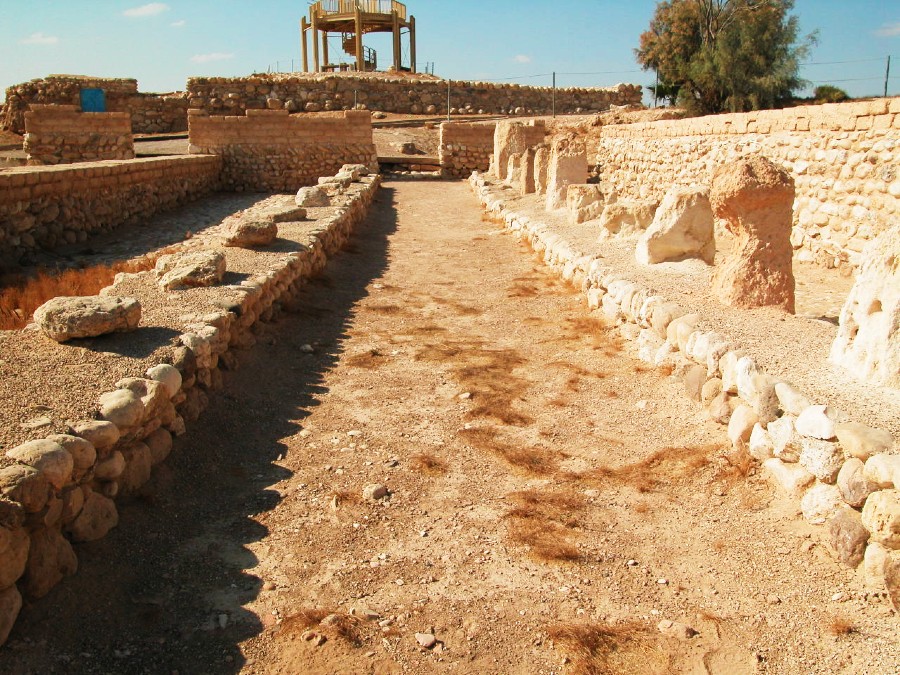
Tel Beer Sheva is an archaeological mound east of the modern city of Beersheba in southern Israel. It was here that the Jewish forefathers, Abraham, Isaac, and Jacob once lived. This biblical site is a UNESCO-listed World Heritage Site together with the tels (archaeological mounds) of Megiddo and Hazor. The sites represent biblical cities of the Israelites and Canaanites.History of Tel Beer ShevaThere is evidence of a settlement at Tel Beer Sheva as early as the 4th millennium BC. 2000 years later, an Iron Age settlement was established by the Israelites who remained at the site for the next 500 years.Archaeological remains from this era include storage pits and stone houses. A new settlement was established here in the 10th-century BC with a community of about 20 households. As part of the Kingdom of Judah(9th-century BC), the settlement grew to be a fortified city surrounded by a 4m-wide wall and with an impressive water system. The city incurred damage from an earthquake and was rebuilt in the 8th-century BC only to be destroyed in 701 BC by invading Assyrians. The city lay in ruins until the Persian period when a fortress and granary were built for soldiers posted here. During the 1st-century AD Herodian period, the fortress was enlarged and a Roman bathhouse was added. The area remained sparsely populated for hundreds of years. The site was used by the Ottomans during World War I as a gathering point for troops set to attack the Suez Canal. In 1917, at the end of WWI, the site was captured by Australian and New Zealand troops en route to Beer Sheva. After extensive excavation and restoration, the site was opened to the public as a national park in the 1990s.Highlights of Tel Beer Sheva National ParkLookout Point: A lookout platform has been constructed on top of the tel which has an elevation of 307m. From here there are views across the archaeological site, and the surrounding cities. Thanks to the height of the tel, the views are magnificent.8th-century BC Altar: See a reconstructed ancient altar that was dismantled during religious reforms implemented by Hizkiyah, King of Judah. The original altar is now on display in the Israel Museum.Well: Tel Beer Sheva has the deepest well in Israel. The ancient well was dug 69-meters down to the level of groundwater outside the city gate.City Gate: An outer gate and main gate can be seen, although the gate watchtowers have not survived. Palace: See the remains of the governor’s palace with an entrance corridor, ceremonial halls, living quarters, kitchen, and storeroom.Storehouse: Archaeologists have uncovered the remains of a 600m² storehouse divided into halls and containing pottery vessels.Ancient Water System: The city had a comprehensive system for bringing water from the Hermon Stream to the city. A 20m-deep shaft was dug deep into the ground. Stairs carved out of the shaft wall allowed residents to descend to a 700m² reservoir cut out of chalk rock. A channel brought water from the floodwaters of the Hermon Stream to the reservoir.

Mamshit National Park

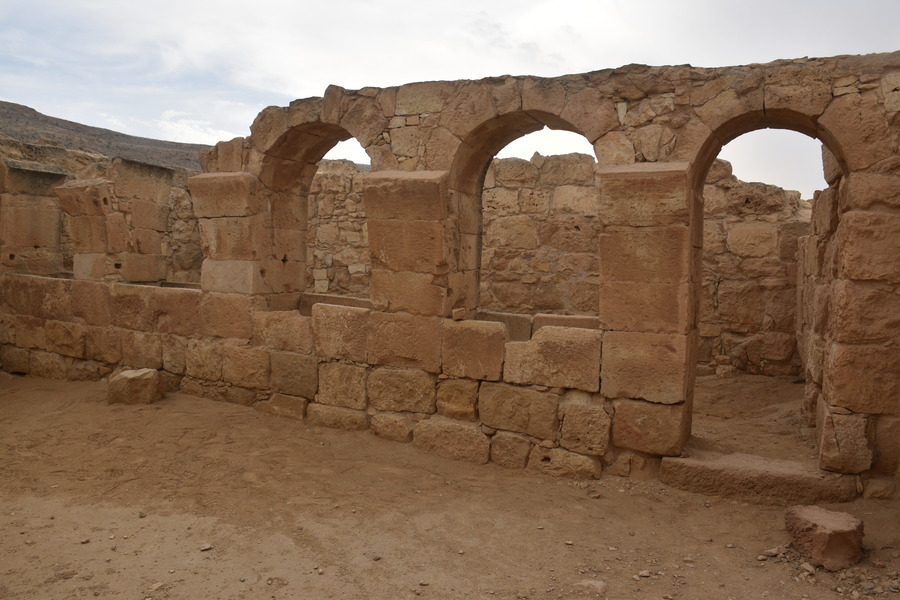
The Mamshit National Park lies in the Negev Desert in Southern Israel. It holds the reconstructed ancient Nabataean desert city of Mamshit (or Mampsis) which was once an important stop on the Incense Road that connected Arabia to Jerusalem. The city was settled in the mid-1st century BC by the Nabataean people and it grew in prosperity becoming one of the richest Nabataean trade posts despite being the smallest of the Negev Desert cities covering 10 acres. Excavations of Mamshit have uncovered entire streets, homes, and public buildings that have been preserved thanks to the dry climate and remote location away from interfering humans. Visitors to the Mamshit National Park can walk through the reconstructed Nabataean city and see entire streets, courtyards, buildings, and terraces that have survived.The Nabatean City of MamshitThe Nabatean Kingdom is best known for the city of Petra in Jordan. It was a powerful force in the region from c. 4th century BC to c.106 AD and dominated the region’s trade routes. Mampsis was one of several trade posts that gave merchant caravans respite from the harsh desert on their journey from the Arabian Peninsula to Jerusalem and even Europe. It was home to luxurious homes unlike any other found in the Nabataean Kingdom. Among the discoveries at Mamshit was an incredible 10,500 silver coins, Greek texts on papyrus, and a 72kg lead ingot. The city thrived under Roman occupation and went on to be a hub for horse-trading and breeding of the renowned Arabian horse. During the Byzantine Era, Mamshit was supported by the ruling authorities as a frontier city and by the 4th century AD, most of the Mamshit residents had converted to Christianity. It was during this period that churches were constructed and a 900m-long fortified wall was built to encompass the settlement. In 527 - 565 AD when the financial support from Rome ran out Mamshit’s prosperity diminished. Over the years occupation of Mamshit was sporadic and the city was finally abandoned in the 7th century. Fast forward to the 20th century and the establishment of the State of Israel. Ben Gurion, who was passionate about the Negev, considered Mamshit as the future capital of the Jewish nation.Visiting Mamshit National ParkOne of the most impressive buildings of Mamshit would have been the luxurious double-story house built on 100m² and surrounded by a courtyard. There is a late Roman-era city gate that would have been part of the city walls. Watchtowers were integrated into the fortified walls to protect the city. The Mamshit city walls feature on the 6th century AD mosaic map found in a church in the town of Madaba, Jordan. Walking among the ruins you can see columns, stone arches, and beyond the city, walls are the remains of two caravan inns where merchants would take rest. The St. Nilus Church with its magnificent mosaic floor stands to the west of the city and the smaller Church of the Saints and Martyrs to the east where human remains were found. At the highest point of the city is the Mamshit Fortress where the British built a police station on the ancient remains. From the elevated police lookout point, there are sweeping views across Mamshit, Mamshit Stream, and the desert. You can also get an overview of the ancient city from the double-story Nabatean tower lookout. Other points of interest within the Mamshit National Park include the city reservoir; Roman bathhouse and the reconstructed Nabatean market street.

Shivta

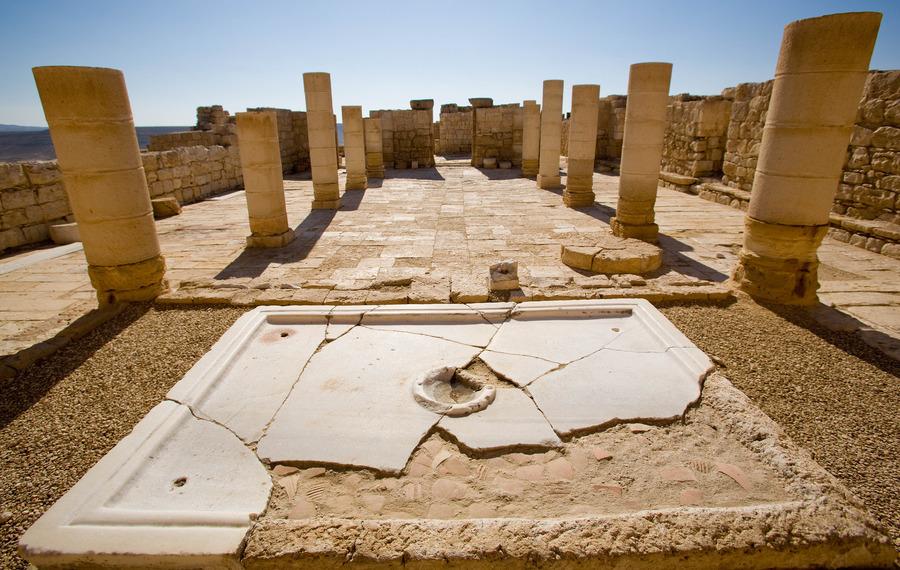
The Shivta National Park encompasses the remains of a Byzantine city in the Negev Desert, in southern Israel just 43km from Beersheba. The Nabataean cities of Avdat, Mamshit, and Shivta along the ancient Incense Route have UNESCO World Heritage status. History of ShivtaThe Shivta National Park contains excavated remains from several periods. The Nabataeans established cities along the Incense Route from Arabia to Europe to service merchant caravans that passed through. Most of the homes uncovered at Shivta were built in the 4th-5th centuries. Christianity spread across the Levant and the Romans were replaced by Byzantines.As trade routes changed, and sea routes opened up, Shivta became less prosperous and trade along the old Incense Route declined. The people turned to farming and the Shivta economy became agriculturally based. The 2,000 residents would provide services and provisions to passing pilgrims and they supplied the monasteries of the Negev. The Muslim conquest in the 7th-century was the beginning of the end for Shivta. And by the 9th-century the city was abandoned.Highlights of the Ancient City of ShivtaNabataean farmlands with irrigation can be seen adjacent to the archaeological remains. And the reconstructed orchard brings to life an ancient farm complete with fruit and nut trees. Roman remains from the 1st century BC can be seen in the southern part of the site. Byzantine structures at Shivta include a large church and two smaller ones as well as wine presses, and homes. The Southern Church was built over a Nabataean ritual building. You can still see remains of the church columns, paving, apses, and baptistry. The Northern Church would have been the largest of the three. The walls have survived to a height of 10-meters and there is an atrium that enters into a large prayer hall. The Governor’s House was a private residence with a tower that would have been 12-meters high, but only 6-meters have survived. This structure would have had three stories. The Muslim-Era Mosque consisted of a hall with two rows of columns, each with three columns. The Western Gate formed the main entrance to the city. The city of Shivta was not surrounded by defensive walls like other ancient cities. But the houses on the city limits were built in a continuous row which formed a city wall. The Stable House is an excavated residence built around an inner courtyard. The Pool House stands near where Shivta’s public pools would have been. The walls were 70cm thick, and the house had a cistern, courtyard, stone-carved decoration, and other interesting features.The Northern City Square would have been the hub of social and commercial activity. The Vaulted House has a preserved stone slab roof with stone vaults. Columbaria stands on the edge of the city. It consists of stone towers that rise 8-10m. Here pigeons were bred for food, messaging, and for the collection of the droppings to be used to improve the soil.

Ein Avdat National Park

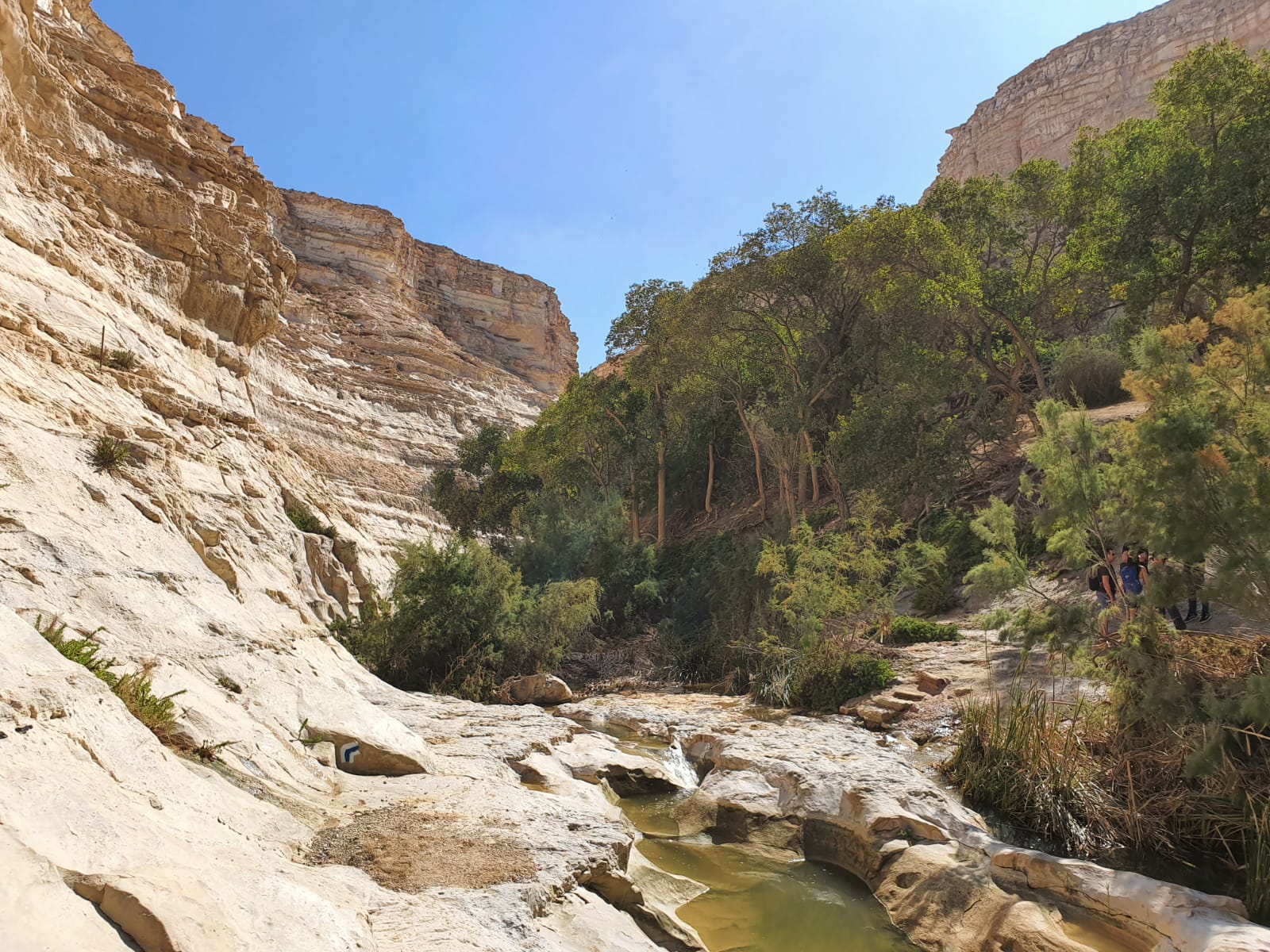
Located in Israel’s Negev desert, Ein Avdat is a deep and narrow canyon surrounded by springs and pools. Set within the Ein Avdat National Park, and deep in the middle of the Zin Valley, it is an extremely popular hiking spot in Israel because of its unique flora and fauna and sheer natural beauty. In Hebrew, ‘ein’ means ‘spring’ and the name Avdat comes from Ovdat, the site of a ruined Nabatean city, located on the ancient Incense Route and used by traders between 1 BCE and 7 CE.White Rocks and Byzantine CavesThere are two entrances to Ein Avdat, the main one being close to Kibbutz Sde Boker, the home (and burial place) of Israel’s first Prime Minister, David Ben Gurion. Walking past the entrance, visitors will immediately notice huge walls of white rock towering above them, surrounded by Euphrates poplar trees. All around is stark scenery and stillness, save for the occasional bird sound. Ein Avdat is also home to a series of caves, that can be seen along the trail - historically, they were places of isolation for monks in the Byzantine era. The area is also home to ibex and birds of prey, particularly griffon vultures, soaring high above.Waterfall and SpringsAbout 20 minutes' walk from the entrance, an extraordinary sight comes into view - a huge waterfall, almost 15 meters high. Pouring down through the canyon, the water settles into a large pool of water, which is 8 meters deep.This large pool (which is also reflective and therefore an excellent spot for photo-taking) is surrounded by rocks made of chalk, lime, and lint. A long piece of rock also divides the pool in half, letting hikers walkthrough. Swimming in the pools is prohibited, however, in order to protect the delicate ecosystem.Ladder RouteFor those more adventurous, there is a more difficult trail named the Ladder Route. To access it, hikers need to climb some steep ladders, along a path cut into the rocks, leading up to the top of the waterfall. This is Ein Mor (in Hebrew, ‘mor’ means ‘myrrh’) and the climb affords wonderful views. However, hikers should note that this cliff path is one-way only, which means you will exit at Ein Avdat’s southern entrance.There are buses running nearby, or hikers can take two cars, and leave one at each entrance). Ein Avdat is best visited in the spring or autumn - in the summer, temperatures can be unbearably hot and in the winter, heavy rains can cause flash floods, which can be extremely dangerous. Entrance to the park is 29 NIS and opening hours are 08.00 to 17.00

Makhtesh Ramon

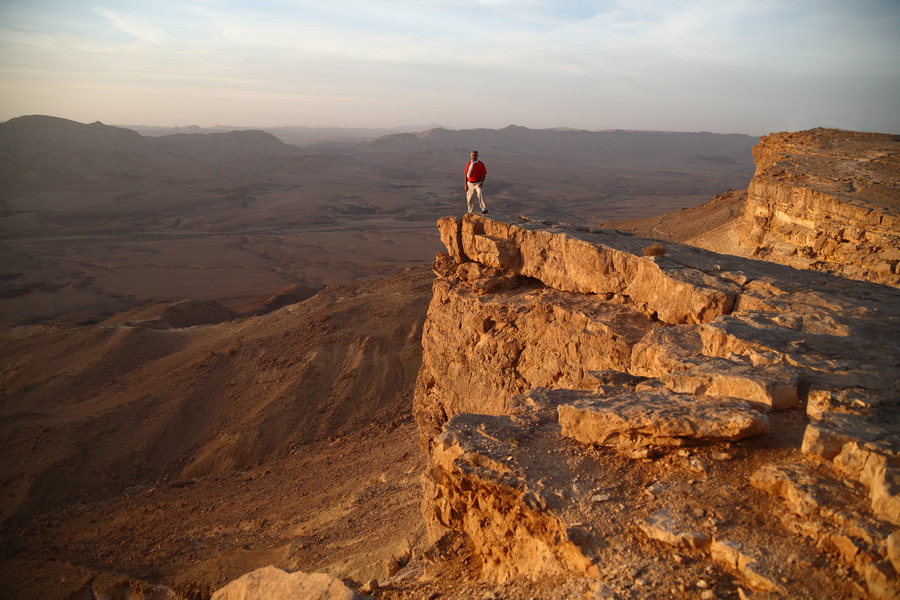
The Ramon Crater or Makhtesh Ramon is one of five craters in the Negev Desert, and the largest erosion crater in the world. Its dramatic rim overlooking the vast depression is one of the most spectacular sights in Israel and a popular stop for travellers heading south towards the Dead Sea. Makhtesh Ramon is located near the sleepy town of Mitzpe Ramon just 2.5 hours south of Tel Aviv. The crater measures about 14km wide by 40km long and is 500m deep at its deepest point. Often described as Israel’s Grand Canyon, the Ramon Crater resembles a Martian landscape. But you can do a lot more than simply look out over the crater. There are a variety of tours, activities and extreme sports to be had.Where Did the Ramon Crater Come from?The Ramon Crater looks like a giant meteor made a dent in the desert, or like the mouth of an extinct volcano, but it is an erosion crater (box canyon or steephead valley). About 90-100 million years ago the sea flooded the Negev depositing layers of limestone rock and trapping soft sand beneath it. Then c.80 million years ago the African and Eurasian continents collided resulting in a geological “fold” and forming the Syrian Arc of mountain ranges from Egypt to Syria, including the Negev range. Gradually the water receded and Mt. Negev’s exposed peak was eroded by climatic forces. The area was flooded again c.40-50 million years ago. As the soft sandstone was eroded layers of ancient rock were exposed. The crater floor deepened at a faster rate than the surrounding walls as more layers of rock were exposed.Geology of the Ramon CraterToday the crater is known for its diverse geological phenomenon. The ancient mountains of Ramon, Ardon, Marpek and Katum border the crater. Geological phenomenon in the crater includes the magma rock Shen Ramon (Ramon’s Tooth); HaMinsara (Carpentry Shop), a group of prism-shaped quartzite stones and the Ammonites Wall, a rocky cliff embedded with fossils and ammonites that lived millions of years ago in the ocean that one covered the Negev. The dry landscape of the crater has one natural water source, the Saharonim Spring at the crater’s deepest point. Thanks to the natural spring the crater is home to abundant wildlife.Modern History of the Ramon CraterSeveral prehistoric sites have been uncovered in the crater including stone walls and mounds. About 2,000 years ago merchants would follow the Incense Route from the Arabian Peninsula, through the Ramon Crater to the north. There are remains of Nabataean trade posts such as Khan Saharonim used by merchants and their caravans as rest stops along the route. Local Bedouin desert dwellers have known about the crater for centuries. Explorers first came across the crater in the 1940s. In the 1950s the crater became the site of several quarries and by 1970 the need to preserve the crater was recognized and the Makhtesh Ramon Nature Reserve was established.Things to Do at the Ramon CraterStart exploring Makhtesh Ramon from the Ramon Crater Mitzpe Ramon Visitors Center where you can learn about the geological formation of the crater and the life of Israeli astronaut Ilan Ramon. The Albert Promenade takes you from the visitors center along a trail on the edge of the crater rim to the Har Gamal observation deck. Star-gazing is a popular activity at the crater, whether you stick to the observation point, go camping overnight or take a star-gazing tour. In the crater, there are opportunities for cycling, off-road jeep safaris, rappelling, mountain biking and hiking. There is a network of hike trails through the crater ranging from short loop trails to challenging treks. One of the popular hike routes is the Ramon Colors Route where you can see exposed colored rocks and sand along the way. There are places in the Ramon Crater area like Me’ever where you can enjoy yoga workshops, meditation and festivals. Sde Boker, Khan Hashayarot offers a Bedouin experience in the desert.

Ein Evrona

Ein Evrona is one of Israel’s hidden gems. Here you can see the untouched salt march south of the Dead Sea and north of Eilat. If you’re lucky, you can also see flamingos wading in the marshy waters. As you drive south along route 90 (Arava Highway) towards Eilat, you’ll pass Ein Evrona (Beer Evrona) on your left. The site lies southeast of Timna Park and the Ramon International Airport. Ein Evrona is an ancient well on the edge of the Evrona salt marsh. At one time, water would rise and overflow, irrigating the surrounding agricultural fields. Today, the level of groundwater has dropped, and the well is dry. In the Bible, Evrona is mentioned as one of the stops made by the Israelites on their journey in the wilderness.Highlights of Ein EvronaObservation Point: A hiking trail leads to the Evrona Observation Point created by the Israel National Parks Authority. There are information boards indicating the direction of the Evrona saltwater ponds, Jordan, and Mount Amram in the distance. Beer Evrona: At first glance, southern Israel may appear dry and uninhabitable. But archaeological excavations have revealed that the Eilat region has been the site of numerous human settlements, agricultural farms, and religious cult centers over thousands of years. At Ein Evrona, remains have been found of a 7th-9th-century farmstead. Ein Evrona was part of an ancient “chain wells” system for gathering water. Wells were dug deep into the ground at the foot of mountains to collect rainwater. From the wells, shafts connected subterranean tunnels that transported water by gravitation to irrigate the fields. The water system at Ein Evrona stretched for over a kilometer and included a 600-meter underground tunnel wide and deep enough for a man to walk through. To aid irrigation, the fields were walled, and dams were created. This water system, called Fogaras, dates back to the ancient Muslim period. Visitors can explore the remains of the water system and even walk through the tunnels.Doum Palms: This is the northernmost grove of Egyptian Doum Palms which have a unique edible fruit. Evaporation Ponds and Flamingos: The Red Sea evaporation ponds are used to produce salt. The ponds attract thousands of migrating birds each year. About 20 years ago, a flock of migrating flamingos decided to make Eilat their home. They built their nests around the ponds which provide ample food.The flamingos feast on nutritious Eilat Artemia, which is rich in beta-carotene, and cause the flamingos’ pink color. The evaporation ponds are on the edge of the Jordan-Israel border and are visited by birdwatches on both sides of the border.Visiting Ein EvronaTo visit Evrona you’ll need your own vehicle or a private tour guide. Head towards Beer Ora on the Arava Highway and turn west, then south along a sign-posted dirt road to Evrona Observation Point. Return to the highway and travel south to the Shechoret Industrial Zone. Make a u-turn and drive about 26km before turning east towards Be’erot Sharsheret. A dirt track will take you east, then south to Beer Evrona. Further south you’ll reach the grove of rare Doum Palms. Drive along the red marked trail to the Red Sea evaporation ponds. To explore Ein Evrona independently, enter “Evrona Observation Point and Flamingos” in Waze, or join one of our experienced tour guides for a private tour.

Nahal Darga Canyon

The seasonal Darga Stream flows through Murba’at ravine (Wadi Murabba'at) in the Judean Desert ending at the Dead Sea. Darga Stream gushes through the wadi in winter, and it is prone to flooding, but in summer the stream is dry. The ravine ends, about 18km south of Qumran, on the edge of the Dead Sea. Here, shepherds discovered the Dead Sea Scrolls, and in the 1950s and 60s excavations of the Murba’at Caves uncovered evidence of human inhabitation over 5,000 years ago. Artifacts were found from several eras, including pottery, coins, and weapons from the Roman period. There are two hike trails at the site, one is challenging and only suited to experienced hikers. This trail covers rough terrain and is supervised by Nature and Parks Authority. There is an easier trail suitable for families. On both trails, you’ll get stunning views across the Dead Sea, and see natural pools and waterfalls in winter. The trails include a visit to the Murba’at Cave where scrolls and letters were found written by Bar Kochba, leader of Jewish fighters during the Bar Kochba Revolt (132-136AD) against the Romans. Visitors who want a desert adventure, mixed with a fascinating archaeological site at Qumran, can visit Nahal Darga and the Murabba'at Caves.Want to visit the area? Book one of our Dead Sea private tours.

What's on Israel - December 2022

December might be one of Israel’s more ‘chilly’ months but it’s still a popular time to travel - whether you’re a Christian pilgrim, who wants to spendChristmas Eve in Bethlehem, looking for a city break in non-stop Tel Aviv, or craving a bit of sunshine down on the Red Sea, in Eilat.Nativity scene on dark background.Photo byMyriam ZillesonUnsplashThere are plenty of things going on all across the country in the last month of 2022, and here are a few ideas for you, if you’re travelling to Israel and looking for activities, for yourself or with your family. Even better, quite a few of them are free, so you won’t have to break the bank whilst you enjoy yourself.Christmas Markets in Jaffa, Nazareth and JerusalemNo doubt, Christmas in Israel is something extraordinary. Christmas markets are a big thing in Europe, but the good news is that you don’t have to fly to Berlin, Paris or London this December to get a taste of them. Just hop on a plane to Israel and soak up some of the Christmas atmospheres here…In Jaffa, one of Israel’s oldest and most beautiful cities, the Christmas tree (next to the Ottoman Clock Tower) will be lit up on 5th December at 17.30 and then on the weekends of 10th-11th and 17th-18th December, there will be holiday performances, artisan booths and family-friendly activities.In Nazareth, the action takes place on 9th December, at Mary’s Well Square, a stone's throw from the Basilica of the Annunciation. After some children's activities in the afternoon, the evening will get busy with stalls selling arts and crafts as well as local produce, as well as local singers, bands and even an appearance from Santa! Christmas tree in Bethlehem. Photo credit: © ShutterstockIn Jerusalem, head to the YMCA (opposite the famous King David Hotel) between the 6th and 8th of December which gives both locals and tourists the chance to pick up all kinds of Christmas products, including pastries, sweets, handmade crafts and spicy wine…with a huge Christmas tree to admire for good measure.Christmas Eve in Bethlehem and Christmas Day in Jerusalem - 24th and 25th December 2022There are always many Christian pilgrims travelling to Israel at this time of the year, to celebrate the birth of Jesus in Bethlehem (where on Christmas Eve there is a midnight mass) and services in Jerusalem the following day, at churches across the Old City, including the ancient and beloved Church of the Holy Sepulchre.Whatever your faith or belief, it is quite fascinating to attend any of these services or even just to stand on the Via Dolorosa, in Jerusalem’s Old City, and watch pilgrims walking this sacred path. And if you just want an old-fashioned carol concert, you can head down to the YMCA, in downtown Jerusalem, and join in with all kinds of performers, to ring in this holiday.Nativity set inspired by the Gospel accounts of the birth of Jesus. Photo byGareth HarperonUnsplashHanukkah celebrations across Israel - 18th to 26th December 2022This eight-day ‘Jewish Festival of Lights is always popular in Israel and is celebrated widely by both children and adults. This year, Hanukkah falls between the 18th to 26th of December and across Israel, there will be commemorative lightings in City Squares, ‘sufganiyot’ (doughnuts) for sale in every bakery and a few parties beside!Something else incredibly nice about being in Israel at the time of this festival is that when you’re walking in the streets, you’ll see many ‘Hannukiot’ (eight-branched candelabra) lit up in windows everywhere. This is because it’s considered to be a commandment in Jewish sacred texts to “publicise the miracle” - the miracle being that after the Jews’ victory over a tyrant, they went to the Temple to light lamps and the oil miraculously burned for eight days instead of one…Holiday of Holidays in Haifa - 8th to 26th December 2022This annual festival takes place every weekend in December in Haifa and this year is no exception. From the 8th to the 26th of the month, over each Thursday to Saturday, the largest city on the northern coast plays host to all kinds of events in Israel in December 2022 that are held to celebrate tolerance and unity between three major world religions - Christianity, Islam and Judaism.There will be cultural activities, markets, performances and events both for children and adults, all designed for everyone to put aside their differences, so they can get together to enjoy themselves. Sounds good, doesn’t it?Aerial view of Haifa Bahai Gardens, Israel. Photo byShai PalonUnsplashInternational Exposure at the Suzanne Dellal CentreThe Suzanne Dellal Center, which is home to all kinds of performance art and modern dance, will be hosting its annual ‘International Exposure’ event from 30th November to 4th December 2022. Artistic directors, presenters and curators of contemporary dance and performance will be coming from across the globe to experience Israel’s dance culture first-hand. The programme, as ever, will be diverse, with large established companies rubbing shoulders with small, independent performers. Moreover, the Suzanne Dellal Center is located in the heart of Neve Tzedek, one of Tel Aviv’s oldest and most beautiful neighbourhoods, full of narrow streets and charming houses. So as well as enjoying a dance performance, you can grab a drink in one of the best Tel Aviv bars, explore some boutiques stores on the famous Shabazi Street or go for dinner in the neighbourhood, in of Tel Aviv’s top restaurants.And as well as all of the above, Israel’s ‘regular’ activities - museums, art galleries, national parks, nature reserves, food markets and second-hand markets are all open, which means you’re not going to get bored or go hungry. So whether you’re looking to hike in the Negev, ski on Mount Hermon (providing snowfalls!), jetski down on the Red Sea or take a day trip to Petra from Eilat, Israel is waiting for you. If you are interested in day tours or private excursions in Israel, contact us!The Negev Desert, Israel. Photo byJulia GavrilenkoonUnsplash
By Sarah Mann
0 views

What’s on in Israel in November 2022

As October draws to an end, Israel enters its more ‘wintery’ season, though anyone coming on holiday from North America or northern Europe will most likely find the weather to be quite clement. Whilst it’s not quite warm enough to swim in the Mediterranean, there are still going to be lots of sunny days - particularly in Eilat, on the Red Sea.A tourist on the observation deck in Jerusalem looks at the Al-Aqsa Mosque.Photo byDawid MatyszczykonUnsplashWhat are the events in Israel in November?Actually, November can be a fine time to visit Israel - it’s less crowded and accommodation is more readily available and a little less costly. When it’s not raining (which is much of the time) you can walk on the beaches in Tel Aviv, spend time walking the ancient streets of Jerusalem's Old City, attend cultural events in Israel, or rent a car and head north to Galilee and the Golan.For desert lovers, it’s also a good time of the year to hike - you won’t be wiped out by the scorching temperatures (just remember that it gets very chilly down in the Negev at night). So if you’ve got a penchant for rappelling down the side of the crater at Mitzpe Ramon, hiking in wadis such as Ein Avdat, or exploring Timna National Park and its ancient copper mines, November is the right time for it. In the meantime, if you’re looking for special events in Israel this November 2022, here are a few ideas from us. Enjoy!1. Tel Aviv Run Night - 2nd NovemberThis ten-kilometre race around the White City is a good chance for any runner to dust off their Nikes and hit the ground running. Open to men, women and children over the age of 14, the organisers style it as an ‘adrenaline-filled urban run in Tel Aviv’ and this isn’t far off the mark.Once you’ve registered (which is essential) you’ll get a kit (including a special t-shirt) and you can cover your 10k in your own time, whilst thousands of spectators will cheer you on. And afterwards, if you’re not too tired, you can go out to celebrate - there are many excellent restaurants in Tel Aviv.People running in the city. Photo byFitsum AdmasuonUnsplash2. Red Sea Jazz Festival - 10th to 12th NovemberFor any jazz lover, the Red Sea Jazz Festival - held in Eilat (close to the Israel-Jordanian border, and from there just a two-hour drive to the ancient city of Petra) can’t be missed. For three days, the city will host musicians from both Israel and around the world - this year, it’s featuring the Anat Cohen Quartetinho, Jacob Collier, the Ariel Bart Quintet, Third World Love and quite a few more. Eilat’s a great place to escape to, not just for jazz but also for sunbathing (temperatures are a toasty 25 degrees or so on November days), diving, jet skiing, or just hanging out with happy mammals at the city’s famous Dolphin Reef.3. Achinoam Nini (‘Noa) at the Jerusalem TheatreThe amazing Israeli singer Achinoam Nini - known professionally as Noa - is back and if you manage to pick up a ticket to her concert at the Jerusalem Theatre, consider yourself lucky. Noa has been singing since the 1990s but really put herself on the map with her Eurovision Song Contest entry in 2009, entitled ‘There Must Be Another Way’. She’s performed across the world at venues as spectacular as Rome’s Colosseum, Carnegie Hall and at the Montreux Jazz Festival. Mixing and matching languages and musical styles, to hear her mellifluous tones is a real treat. And if you’re going to be in Jerusalem for the concert, then why not do some exploring beforehand, at the Israel Museum, in the Old City or wandering in the Ein Kerem neighbourhood?Dome of the Rock, over the skyline of the Old City of Jerusalem. Photo byLevi Meir ClancyonUnsplash4. Take a trip to the Golan HeightsThere’s nothing ‘in particular’ going on in the Golan this November but do you really need a reason to travel there? Stunning scenery, beautiful national parks and nature reserves and chestnuts on the ground (it’s the season) make it a great getaway, whether you want to stay a couple of days or hunker down.Nestled in Merom Golan is a fantastic hotel, named after the area, where you’ll get all of your creature comforts as well as extraordinary views of Mount Hermon, and the chance to wander in ancient forests and explore vineyards, orchards and boutique artisan stores in the area. They even have an authentic ‘cowboy restaurant’ named ‘Ha Bokrim’ where you can eat meat that really is farm to table - their farm! All of the animals are reared there and the restaurant also showcases wines local to the region. View from above on the border between Israel and Syria, Mount Bental.Photo credit: © Shutterstock5. Visit Oded Hirsch’s ‘Inventing the Wheel’ exhibition at the Haifa Museum of ArtRunning until the end of 2022, at the Haifa Museum of Art, Oded Hirsch is a man who likes to invent problems and challenges - and then solve them. His solutions (and scenarios) are sometimes absurd and often hilarious - and give the viewer food for thought. For instance, why is it necessary to pull a tractor out from the ground in which it is buried and then bring it to the museum? Hirsch might argue that it is the action itself. This exhibition boasts video, sculptural and photographic work and is primarily based on people working - digging, carrying, and sweating by their brows. In an age where everything is high-tech, Hirsch argues that the actions of these labourers are real. Haifa is also a fine city to wander around, view the Bahai Gardens, wander around the old neighbourhood of Wadi NisNas or visit the Mount Carmel National Park. 6. Enjoy the ‘Photo Is:Rael International Photography Exhibition’ - 23rd November to 3rd DecemberBack for its 10th year. This fine exhibition - which is being held in Tel Aviv - will be showcasing some of the finest photographers, both in Israel and around the world. Taking place over 10 days, it’s not just exhibitions you can see - there will also be dance, video, art and musical performances. This year’s theme is ‘Action’ - who knows what this will entail? The exhibition is being held at the Einav Centre and City Garden, and there are activities for the entire family as well as guided tours, led by Shichi Aman.Interested in day tours around Israel? Then don't hesitate to book a tour with Bein Harim!Bahai Gardens, Haifa.Photo credit: © Shutterstock
By Sarah Mann
0 views

Yom Kippur

Yom Kippur is a festival that comes around, annually in Israel every September/October, depending on the Jewish calendar. And it is a festival like no other. Why? Well, because most biblical festivals for Jews are connected either to historical events or agriculture/nature.Children riding bicycles in Tel Aviv on Yom Kippur.Photo byYoav AzizonUnsplashPassover commemorates the Israelites fleeing slavery in Egypt. Shavuot is a harvest festival and Sukkot reminds us of all the years Jews wandered in the desert, before making it to the Promised Land. But Yom Kippur is about neither of these. Nor does a festive meal take place during this time. On the contrary, it is a time to engage in abstinence, denying themselves small pleasures and looking inside their souls. This day represents the antithesis of excess.Without a doubt, if you ask any Israeli what the holiest day in the year is they will answer ‘Yom Kippur.’ And even if you are not religious, this is a day of calm and quiet in Israel that really is appreciated by many! Curious about what it’s all about? Well, learn a little more here…What does the name Yom Kippur mean in Hebrew? What kind of day is it?The Hebrew phrase stands for ‘Day of Atonement’. Put simply, Yom Kippur is the most solemn day of the Jewish Year. It is a day of reflection, self-examination, and atonement for sins. It is a time for every Jew to stop and think about things that usually pass them by in daily life. What is the meaning behind this day? Yom Kippur falls ten days after Rosh Hashanah - the Jewish New Year - and these ten days are often referred to as the ‘Days of Awe’. According to Jewish tradition, it is on these days that God decides the fate of each person - on Rosh Hashanah, Jews are inscribed into the ‘Book of Life’ and on Yom Kippur, our destinies are sealed.White yarmulke/kippah for Yom Kippur/Rosh Hashanah. Photo byJoey DeanonUnsplashWhy do Jews fast on Yom Kippur?Not eating or drinking is one of the five major prohibitions of Kippur - the other four being anointing the body with oil, bathing, sexual relations, and the wearing of leather shoes. This is all to do with the idea of denying oneself comforts - and aiming to be like an angel (because angels do not have worldly needs). When does Yom Kippur fall in 2022?Yom Kippur this year takes place from nightfall to nightfall on Tuesday 4th October until Wednesday 5th October. The approximate times for the beginning and end of this holy day are 18.17 to 19.16 in Israel. What should you say to someone on Yom Kippur?There are two appropriate greetings over Kippur - one is ‘gmar chatimah tovah’ (which literally means ‘good final sealing’ in Hebrew and refers to the God sealing our fate, as explained above. The other is quite simple and is ‘tzom kal’ which means ‘easy fast’ although some orthodox Jews prefer to use the expression ‘meaningful fast’.Yom Kippur shofar final blast. Photo Ri_Ya by via PixabayWhat happens in Israel on Yom Kippur?If you are visiting Israel over this period, you will be struck by what an extraordinary time it is. In fact, nothing we can write here can really describe just how special it is. This is the ONLY day of the year in which everything comes to an entire standstill. All shops, restaurants, cafes, and bars are closed. Ben Gurion airport suspends flights for the duration. Most striking of all, there are no cars on the road (it is a tradition, and respected by all Israelis, not to drive on this day). If you’re in Jerusalem, the atmosphere will be incredibly holy. You will hear no laughter or chatter and all you will see in the streets is people walking to and from the synagogue. However, if you’re in Tel Aviv (which is a more liberal and secular city) you’ll be struck at how many children (and adults) are riding their bikes up and down the main roads and even the highways! Will I be able to buy food anywhere on Yom Kippur or travel?No. It’s very important for anyone on vacation in Israel on this day to know that you will not be able to buy food in supermarkets or restaurants, order delivery, or travel in the country using public transport. You MUST make preparations beforehand so that you aren’t caught off guard.Go to a store well in advance and buy provisions to tide you through the period. It really is imperative that you do this, otherwise, you might end up - inadvertently - not eating yourself for 25 hours! Even if you’re in a hotel, the restaurant will be closed, both for breakfast and lunch.Jewish father and son praying together at the Western Wall, Jerusalem. Photo byAnton MislawskyonUnsplashWhat happens in the synagogue on Yom Kippur?There are a number of different services that are held throughout Yom Kippur - beginning at dusk and continuing into the next day. Prayer is intensive and soulful - many people spend the majority of this festival at the synagogue. Kol Nidrei is the first and one of the most moving prayers recited - the liturgy is moving and the melodies are haunting. The prayer - or some would argue ‘statement’ - declares that all vows are ‘absolved, remitted, canceled, and declared null and void. This is less to do with the idea that Jews cannot be trusted (!) and more so with the idea of asking God to forgive us for all public statements made in the previous year that were contrary to Jewish ideals! Kol Nidrei is a prayer recited in Aramaic (an ancient Semitic language) and with great devotion, as are all of the other prayers throughout the 25 hours. There are memorial prayers named ‘Yizkor’ (‘Remember’ in Hebrew), the ‘Viddui’ (Hebrew for ‘confession’) as well as a reading from the Book of Jonah (the biblical figure who, famously, in trying to escape God, fled Jaffa by boat and was swallowed by a whale). Kippur ends with a service called ‘Neilah’ which means ‘Closing of the Gate’.Hayarkon Street in Tel Aviv on Yom Kippur.Photo byYoav AzizonUnsplashWhy do people in the synagogue wear white on Yom Kippur?White symbolizes purity and on Kippur Jews strive to be as good and pure as angels. Also, white is the color in which Jews are traditionally buried, and therefore, if you follow the analogy, we must take the view on Yom Kippur that every moment matters because we live life meaningfully, knowing that death could come to us at any moment.What traditionally happens after the day ends?Once Neilah is over, people will head home, or to the houses of friends, and break their fast. This can involve anything from a cup of tea/coffee and a bowl of soup or a huge meal where people eat until they are sated! After the intensive prayers and not having eaten or drunk for 25 hours, rest assured everyone is grateful for the chance to relax and indulge a little! We hope you’ve found the above interesting and if you’re interested in learning more about Israel or booking a trip, don’t hesitate to contact us. We offer organized tours and day trips all over Israel - from the Dead Sea and Masada to the hills of Galilee and from holy sites in Jerusalem to food tours in Tel Aviv’s Carmel Market, we promise you a holiday you won’t ever forget.The interior of a synagogue. Photo byLainie BergeronUnsplash
By Sarah Mann
0 views

Sukkot in Israel

Welcome to our series of blogs on the Jewish ‘High Holidays’ which, arguably, are the most attended holidays in the Jewish calendar. They last for a period of almost three weeks, and although they do not run consecutively the run-up to them is a very busy time in Israel.A man chooses an etrog in Sukkot, the four species.Photo byEsther WechsleronUnsplashFirst, as we wrote previously, there’s Rosh Hashanah - the Jewish New Year - and in Israel this is celebrated for two days, beginning and ending at nightfall. Ten days later, is the most solemn day of the year, Yom Kippur. Also known as the Day of Atonement, Yom Kippur is a chance for Jews to reflect, pause, and atone for their sins - Orthodox Jews fast for 25 hours and all public life in Israel (including flights, public transport, and even drivers on the road) ceases, even in the usually vibrant city of Tel Aviv.The next, and one that is much-loved, is the one we are looking at today - Sukkot. Unlike Yom Kippur, this is a cheerful holiday, lasting for a week, and is really a chance for Jews to ‘give thanks’ for things often taken for granted, such as shelter and food. Let’s take a closer look at this holiday and what it entails…When does Sukkot begin?What does Sukkot mean?Sukkot begins five days after Yom Kippur, on the fifteenth day of Tishrei. In the Gregorian calendar, this means it falls sometime between September and October. What does Sukkot mean? ‘Sukkot’ in Hebrew means ‘booths’ and remembers the booths (temporary shelters) that the Israelites built to protect themselves when they were wandering in the wilderness for 40 years, after their exodus from Egypt and freedom from slavery under the Pharaoh.What is the main theme of Sukkot?Sukkot is one of Judaism’s three ‘pilgrimage festivals’ (the other two being Passover and Shavuot). Historically, this was a time when Jews were able made a ‘pilgrimage’ to the Temple in Jerusalem. The main ‘theme’ of this holiday is thankfulness and ‘togetherness’, thanking God for the harvest and also for deliverance from Egypt, and spending time with loved ones. The other biblical theme is that Sukkot marks the completion (and new beginning) of the annual Torah reading, of which a portion is read every week in the synagogue.Hasidic Jew at the Western Wall, Jerusalem.Photo byJoshua SukoffonUnsplashWhy do Jews build booths in their home at this time of the year?Yes! It really is. It’s an amazing sight, especially in Israel, where not only do people put up booths (sukkot) in their homes - on balconies usually - but also in the streets, and in restaurants! It’s a great activity for children too - building a ‘sukkah’ (sukkot is plural) is something every youngster looks forward to, because it’s a chance to get creative, not to mention live a bit differently for a week. It is customary to build your sukkah soon after Yom Kippur, even though there are few days remaining before Sukkot begins.What do the booths look like?No sukkah ever looks the same in Israel (which is why this holiday is so special) and no space is too small to build a sukkah in! Even if you don’t have a patio, a balcony will do. The important ‘rule’ when building is that your structure needs to be temporal i.e impermanent. It needs to have at least three walls but - usually - the roof is made out of branches of trees, or reeds. What is Important: all (or at least part) of its roof should be open to the sky - after all, it is a dwelling not meant to last! Many people hang seasonal fruits from the roofs of their sukkah (think apples, grapes, pomegranates) to thank God for nature's gifts. Some children love fairy lights and draw cards and paintings. (Warning: be careful with the fairy lights - you don’t want to inadvertently start a fire!) What do you do in a Sukkah?It’s traditional to eat your meals in the sukkah and some very Orthodox Jews may even sleep in it (although in colder countries this is not advisable, since you could end up with pneumonia!) You can also rest in one, read a book, hang out with friends, and have nightly celebrations with live music.The citrons at the Festival of the Booths, known also as Tabernacle. Photo by al-ex via FreeImagesWhat are the ‘four species’ of Sukkot?Excellent question! If you’re visiting Israel at this time of the year, you’ll see these four species being sold in markets and stores, in the run-up to the holiday. The four species (‘arba’at ha-minim’ in Hebrew) are the lulav, the etrog, the myrtle, and the willow. These are all mentioned in the Torah (the Hebrew Bible) as being associated with Sukkot and the waving of the four of them is considered to be a commandment, by observant Jews. Tell me more about the lulav, etrog, myrtle, and palm… Historically, these four species were all waved in the Temple at Jerusalem for all seven days of the festival. The lulav is a cluster of plants - one palm, two bouts of willow, and three of myrtle. The etrog is a citron (not quite like a lemon, but with some similarities). Together, they make up the four species, and, for ritual purposes, the etrog is held in the left branch and the palm branch (intertwined with the willow and myrtle) in the right.What happens in the synagogue at Sukkot?Sukkot is an incredibly joyous occasion. In stark contrast to the solemnity of Kippur, this is a time of celebration. In synagogues across Israel (and all over the world) the Torah scrolls are taken out of the Ark and congregants parade around the sanctuary - men, women, and children alike.There’s great merriment, with singing and dancing and all of this is a reminder that, in life, we should always take a little time each day to be happy and thankful for our wonderful world. After all, every day is precious but life is also fragile and - like the booths in which meals are eaten - temporal. On the seventh day of Sukkot, the four species (talked about above) are carried around the synagogue seven times. During certain Psalms (Hallel), Jews wave them up and down and forward the four points of the compass. This is an indication that God is everywhere - and also omnipotent.Lulav, one of the 4 species of plants for Sukkot. Photo byal-exviaFreeImagesWhat foods are commonly eaten at Sukkot?There’s no one particular food that Jews are commanded to eat (at Passover, there’s a seder plate, and at Shavuot one always eats dairy products) but since Sukkot is a harvest festival, many fruits and vegetables will appear on the table! Expect to see carrots, squash, zucchini, and the like, as well as fruits like apples.Some people, in a symbol associated with the ‘abundance’ of harvest, may serve vegetables that are stuffed - peppers, cabbage, and grape leaves, for instance. Moreover, there will always be ‘traditional’ Jewish foods on the table, such as matzah ball soup, roast chicken, and - of course - the lovely slightly-sweet challah bread that is eaten every Friday night, on the Jewish Shabbat.Is visiting Israel over Sukkot popular?It’s an incredibly popular time of the year for visitors - not just Jews, who want to eat in kosher restaurants with sukkahs, but anyone who wants a beach holiday, because the weather is still so good in Israel. The only thing to note is that it can be very crowded because Israeli children are on holiday this week - this means that families will be traveling around Israel, so national parks, nature reserves, and museums will all be very busy.A religious Jew chooses an etrog for Sukkot.Photo byal-exviaFreeImagesOn the other hand, it’s a great chance to see Israelis out and about and having fun, and - as noted before - weather-wise it is perfect. You can enjoy lots of sun without having to escape the heat of the Israeli summer, and the chances are you will see no rain either - that does not usually arrive until November.Can I take an organized tour around Israel over Sukkot?Absolutely. In fact, because public transport is so crowded, it can be an excellent idea to take an organized tour or day trip around Israel - this means you’ll travel around in a comfortable (and air-conditioned bus) and have the services of a professional guide, as well as entrance fees and tickets for attractions being bought beforehand for you, so you don’t have to waste time standing in line.So if you want to explore the holy sites in Jerusalem or churches of Galilee, float at the lowest point on earth at the Dead Sea or take a food tour at Tel Aviv’s Carmel Market, get in touch with us - by phone or email. We’ve been in business for over 35 years and guarantee you an experience you’ll never forget. Also, feel free to take a look at our blog, if you want more ideas about where to visit or just to get an overview of life in the Holy Land. Happy holidays to you all!The Judean Desert from the Masada Cable Car, Israel. Photo credit: © Shutterstock
By Sarah Mann
0 views

The Great Israeli Breakfast

Whether you’re sunning yourself on a pristine beach all day, exploring ancient Roman ruins, visiting one of Israel’s wonderful museums or hiking in national parks, you’re going to have an appetite at the end of it all, which is why we’re often asked by our clients for dinner recommendations.Shakshuka - an integral part of Israeli breakfast. Photo bySara DubleronUnsplashFair enough. But what about breakfast recommendations? One thing you’ve got to know when you’re visiting Israel is that the locals take their first meal of the day very seriously, particularly over the weekend (Friday and Saturday are the country’s ‘Shabbat’). And the ‘great Israeli breakfast’ as it’s often talked about, is really as good as they say, trust us.Israeli Breakfasts and what they’re all aboutAn Israeli breakfast is very different from what you’d get in the USA (sausages, waffles, pancakes), England (bacon, egg, beans and fried toast) or France (a simple croissant or pain au chocolat if you’re feeling decadent). If you go to a cafe in Israel and order a breakfast special, you’re looking at a meal that will probably keep you going for several hours, if not until the evening.As well as eggs, which are served any way you like, there will be plenty of fruits, juices, cheeses (both white and yellow), vegetables, olives, savoury dips and spreads and - of course - an enormous bread basket to dig into. And that’s the ‘regular’ typical Israeli breakfast. Many spots in Israel offer plenty of ‘add-ons’.These might include muesli and granola, cold fish (mackerel, salmon, tuna, herring), homemade jams, baked goods such as croissants and pain viennois and hot dishes such as shakshuka (eggs served in a spicy tomato sauce, served with bread for dipping) and malawach (a flaky fried flatbread hailing from Yemen). Ready to tuck in? Then take a look below at our top picks for a great Israeli breakfast. Hummus plate with eggplant and pita on the table. Photo byKao RodriguezonUnsplashWhere to sample an Israeli breakfast in Tel Aviv?Benedict - Everyone in Israel knows Benedict. Their amazing breakfasts speak for themselves and the great food, combined with friendly and efficient service, means there’s always a line! They’re all over the country but in Tel Aviv there are several - the most popular ones are near the Tel Aviv Port (Namal) and on Rothschild Boulevard.They serve eggs in a variety of ways, their bread baskets are delectable and they also offer waffles, American pancakes, French toast as well as iced coffee and fresh juices. Not inexpensive but definitely worth it. Be warned - the queues are long at the weekend and you could wait at least 30 minutes - bring a book! More details here www.benedict.co.ilCafe Xoho - This hipster hangout isn’t just for hipsters - it’s for foodies - especially those who love baked goods and bagels to boot! Close to one of Tel Aviv’s most popular beaches As well as typical Israeli breakfast staples, they have pancakes, a pink granola bowl (with chia) and a delicious breakfast burrito. On the drinks front, try a Vietnamese coffee (with condensed milk), a masala chai or their famous matcha smoothie (matcha, banana, coconut milk, tahini, honey and halva on top). Xoho is also gluten-free and vegan-friendly. With the fab ambience and tasty food, this is a gem of a place to eat. Address: Ben Yehuda 73 (near Frishman Beach). Tel. 03 561-6745.Delicious food atCafe Xoho. Photo by Dror Einav PhotographyHotel Montefiore - If you want to splash out on an upscale Israeli breakfast, you can’t do better than book a table here. Like the hotel in which it is situated (sophisticated and luxurious), enjoy gorgeous bread baskets, strong French coffee and an eggs benedict that’s to die for. The service is impeccable (everything comes to you on white china),If you feel particularly decadent, order the chocolate mousse. A word of warning: you might need to book weeks ahead for breakfast at the weekend here. Take a walk to the Carmel Market afterwards, if you want to burn off some calories. Address: Montefiore 36 (not far from Rothschild Boulevard). Tel: 03 564-6100.Dallal Restaurant- Tucked away in Neve Tzedek, one of Tel Aviv’s most charming neighbourhoods, this is a beautiful, upscale place to have breakfast (or brunch). Visitors love the Bloody Marys and scrambled eggs served with smoked salmon and cream cheese and the French toast with ricotta cheese, berries and sweet cream is fabulous. Oh, and if you have a sweet tooth, try the pistachio and strawberry dessert. All around the neighbourhood are lovely boutiques and coffee shops, as well as the beach just a few minutes' walk away, so it’s a great place to go for a stroll after you’ve eaten (to walk off the calories, as well as enjoy the area!) Address: Shabazi 10, Neve Tzedek. Tel: 03 510-9292.Morning in Tel Aviv, Israel.Photo byDaniel KleinonUnsplashWhere to eat an Israeli breakfast in Jerusalem?Kadosh - Kadosh has been in business a long, long time - since 1967, to be precise! After Meir, its founder, passed away, his son Itzik took it over and he must have been doing something right because it was rated ‘Best Breakfast in Jerusalem’ by the Hebrew press a while back.Cafe Yehoshua- This local cafe - based in Rehavia, just outside the city centre - is loved by its neighbours and has the added bonus of sidewalk seating, for warmer days. The food is rich and tasty and they have a reputation for serving excellent shakshuka and a wide variety of salads in their regular Israeli breakfast!This is one of the few restaurants in Jerusalem that is not kosher, so you will be able to order dishes that mix milk and meat. Good coffee, music not too loud (but enough to be pleasing) and fresh juices to boot. Not cheap, but worth it.Israeli breakfast atCafe Yehoshua, Jerusalem. Photo via Cafe YehoshuaNocturno - The locals in Jerusalem love this palace because of the quality of the food, good service and wonderful atmosphere. Fresh eggs, smoked salmon and fabulous mushrooms and fried potatoes is a dish that’s raved about and they also do a mean toasted croissant with cream cheese and onion.Vegans are well-represented too - and their non-dairy muesli goes down a storm…almond yoghurt and fresh fruit, served with silwan (a delicious date syrup). And for those with a sweet tooth, there’s also a vegan halva parfait or a hot chocolate fudge cake! Yum. Address: Nocturno, 7 Betzalel Street. Tel: 077 700-8510.As well as the regular Israeli breakfast they serve, customers love their baked goods - particularly the croissants - and wonderful French pastries on offer. We’d highly recommend the salmon and the pain au chocolat! Just be prepared to wait in line for them…Address: Kadosh, Queen Shlomotzion 6. Tel: 02 625-4210.Vegan shakshuka at Nocturno Cafe, Jerusalem. Photo viaCafe NocturnoWhere to enjoy an Israeli breakfast in Haifa?Millhouse Cafe - Close to the sea, in downtown Haifa, this is a lovely little place, popular with students and surfers alike, and serving less than -run-of-the-mill fare. Their sandwiches are imaginative (unusual ingredients, fantastic cheeses) and their spreads for the bread, if you order eggs, are all homemade! If you want to take a chance on something new. try one of their juices, quinoa and bulgar wheat salad or one of their mango tarts. Yum! And, as they say, “We serve damn fine coffee.” Recommended. Address: Millhouse, Bat Galim 14. Tel: 04 887-1181.Best Israeli breakfast in Mitzpe RamonLasha Bakery - If you’re in the Negev, stargazing at the Ramon Crater or rappelling down its edges, head to Lasha Bakery, which doesn’t do traditional Israeli breakfasts but makes up for it with delicious baked goods, pastries and quiches. They also sell products to take away - such as date syrup - which can make a wonderful souvenir from Israel.Enjoy quiches, focaccia, slices of maple and almond cake and empanada-style delicacies stuffed with vegetables. Lasha also offers sambusaks (savoury pastries), pretzel rolls and sesame sticks. Their coffee is great too and since they’re located in the trendy Spice Quarter, you can walk around the other stores afterwards. Address: Lasha Bakery, Har Boker 6. Tel: 050 361-1488. Green shakshuka in one of the Israeli cafes. Photo credit: © Oksana MatzBest Israeli breakfast in EilatOptimi - If you’re down in Eilat, on the Red Sea, you’ll find great service at this unpretentious little place, which serves good coffee, typical Israeli breakfasts and plenty of fresh bread too. Reasonable prices and they go out of their way for vegans too (think beyond meat burgers or vegan shawarma). Our recommendation? Try the spicy shakshuka or a ‘vegan morning’ which comes with vegan cheese, succulent olives, homemade tahini and a tomato spread. They also have some mighty delicious desserts, including the very tasty ‘crumble cheesecake’. Afterwards, work off your appetite with a visit to one of Eilat’s many attractions, such as the Dolphin Reef, and Underwater Observatory or even head off on a trip to Petra, which is just across the border. Address: Durban 2 (near the Mall HaYam). Tel: 08 637-6510.Interested in Israeli street food or Israeli cuisine? Book our Carmel Market Food Tour and try it for yourself!Israeli breakfast at Optimi Cafe in Eilat, Israel. Photo via cafe optimi eilat
By Sarah Mann
0 views

Rosh Hashanah - The Jewish New Year

If you’re visiting Israel after the long hot summer months (which, by the way, is a wonderful time of year to be in the country, climate-wise) you may be around for a very special event - the Jewish New Year. Israel is home to three major world religions - Christianity, Judaism, and Islam. All of them have their own festivals and celebrations but for Jews, this is one of the biggest. The Jewish New Year, Rosh Hashanah, is the first of a number of holidays that are often called ‘the High Holy Days’ (‘Yamim Noraim’ in Hebrew).Rosh Hashanah honey bowl with a wooden honey dipper and apples.Photo byIgal NessonUnsplashThis year, the Islamic New Year (which runs according to a Muslim lunar calendar) took place at the end of July. The Christian New Year is always on 1st January. But this Jewish festival always comes about in the Fall. Why that is (and many other questions) we’ll be answering below in a brief guide to the whats, wheres, and hows of this special holiday! The fact is that whatever your background, and whether you believe in God or not, Israel is a fascinating place to be at these times of the year. Christians flock to Israel at Easter, Muslims regard Ramadan as sacred and for Jews, Rosh Hashanah is a chance to catch up with those close to them, as well as enjoy good food, wear some new clothes, and generally look forward instead of back.In case you’re invited to someone’s home, or get chatting with a local, here are a few pointers for you. Enjoy! What is the name of the Jewish New Year in Hebrew? Its name is Rosh Hashanah which, in the Hebrew language, means ‘Head of the Year’ or ‘First of the Year’. Why do Jews celebrate their New Year in September or October?This is a good question and one that is often asked! Well, all Jewish festivals and holidays are set according to the Hebrew calendar. The first day of this calendar is the 1st Tishrei - it begins on the day of the new moon which can be seen around 354 years after the 1st Tishrei of the previous year.This is why the Gregorian date for this Jewish holiday is different every year.Fresh pomegranate isolated on black background. Photo byTamanna RumeeonUnsplashHow old is the world, according to the Jewish faith?If you estimate things according to the Jewish faith, the world is currently in the sixth millennium. Jews and Israelis start counting the beginning of time in the year 3761 BCE. Why? Because of an incredibly important Jewish philosopher named Maimonides, who lived in Egypt hundreds of years ago. Amongst his many writings, he established this as the biblical date of creation.When is the Jewish New Year in 2022? And how long do the celebrations last?This year the Jewish New Year begins on the evening of Sunday 25th September and lasts for two days. In Israel, almost all stores will be closed, as well as street markets. It’s also important to know that public transport will also come to a halt, so if you don’t want to stay in one place for these 48 hours you could look into car rental, which is surprisingly affordable. If you are in Tel Aviv, however, you are in luck because it’s a more liberal and secular city. You’re likely to find coffee shops open during the day and even a few Tel Aviv restaurants open at night.How do I say ‘Happy New Year’ in Hebrew?Traditionally, there are two ways of addressing someone with this greeting. The first is ‘Shanah tovah’ (‘Good year’) but, if you want to be more formal, then you can say ‘L’Shanah tovah tikatevu’ (‘May you be inscribed for a good year’). It’s also popular to say to people in Israel ‘Shanah tova u’metuka’ (‘a good and sweet new year’). In Yiddish, which is a language spoken by some religious Jews, you might hear ‘Gut yontif’ (‘happy holiday’). A headshot of a man blowing a shofar during Rosh Hashanah. Photo via www.freeimages.comWhat foods are customarily eaten at the Jewish New Year?Jews love their food and Rosh Hashanah is no exception - you might want to skip lunch (and breakfast too!) As well as old favorites, such as matzah ball soup, roast chicken and potato kugel, you’ll see certain things on the table that indicate it’s the start of a new year. These include: Apples dipped in honey - this is a tradition (rather than a religious commandment) and involves dipping slices into honey, whilst praying for a sweet and fruitful new year.Challah bread - this yeasty bread is eaten every Shabbat in Israel and the New Year is no exception - just that this time it’s round instead of long - to symbolize the circle of life. Pomegranate seeds - these are symbolic of righteousness in Judaism since it’s said to have 613 seeds (each representing one of the Jewish commandments of the Torah). Tzimmes - made with carrots, or other sweet root vegetables, again it’s eaten because it’s sweet.A group of men/boys praying at the Western Wall in Jerusalem. Photo byshraga kopsteinonUnsplashWhat is the atmosphere like in Israel around the time of the Jewish New Year?It’s very festive. In the days leading up to it, friends, neighbors, family, shopkeepers (and sometimes even strangers in the street!) will all want to wish you ‘shanah tovah’. If you’re in Jerusalem, the atmosphere will be even more noticeable, since this really is a holy city.The shops and markets will be very busy, because people are stocking up on food for lunches and dinners, and gifts for close family and friends. There’s also a lot of traffic on the roads in the lead-up to the festival, because Israelis will be traveling around the country to meet up with family and friends.Over the two days of this particular Jewish festival, secular Jews might go to the beach, hike in national parks in Northern Israel, meet up with friends, and generally enjoy their time off. Traditional religious Jews will attend services at the synagogue and Orthodox Jews will refrain from work, writing, driving, and using any objects that require electricity.Ceramic pomegranates, symbols of Rosh Hashana, Jerusalem.Photo byNixx StudioonUnsplashWhat happens at the synagogue during the Jewish New Year?For two days, there are services in the synagogue and the liturgy (the form of worship) is incredibly beautiful. Rosh Hashanah remembers the creation of the world and is the start of a ten-day period that culminates in Yom Kippur. These ten days, for religious Jews, are about introspection and eventual atonement - there is a focus on humility as well as rejoicing.The prayer ‘Avinu Malkeinu’ (‘Our Father, Our King’) is sung throughout the morning and at the culmination of the service, a shofar is blown. The shofar is a ram’s horn and is blasted out at different intervals. The shofar is a symbol of the Jewish prophets who called on people to improve themselves spiritually - many Jews regard it as a ‘wake-up call’ from God. What is the ritual of tashlich, which is performed at the Jewish New Year?Carried out on the first afternoon of Rosh Hashanah (usually after the lunchtime meal), the ritual of tashlich involves the symbolic ‘casting off’ of sins. Jews walk to a body of flowing water (a stream, river, lake, or sea) and throw crumbs (or sometimes pebbles) into it - as they do this, they recite a prayer asking God to lift their troubles from their shoulders because last year is ‘washed away like crumbs in the current.’If you’re visiting the Holy Land over this period, or at any time for that matter, and are interested in taking a guided tour or day trip around Israel, don’t hesitate to contact us by email or phone or take a look at our blog for more ideas about places to see and things to do. We’ve been in business for over 35 years and with our knowledgeable guides and experienced and friendly staff, we guarantee you a holiday to remember. Shanah tovah!Pomegranates on a tree.Photo byLavi PerchikonUnsplash
By Sarah Mann
0 views

Glatt Kosher Hotels And Restaurants in Israel

It's high season now in Israel and the country is expecting tens of thousands of guests in the next few months, all looking for fun days out, comfortable budget accommodation and great food. And Israel’s really come a long way in the last 20 years - the food scene here is booming, whether you’re a meat eater, a fish-lover, a committed vegetarian or an aspiring vegan.Kosher pizzeria. Photo byNick ClementonUnsplashWhether you’re in the mood for street food (falafel, sabich, shawarma), the great Israeli breakfast - in the form of eggs, jachnun or shakshuka - freshly caught St. Peter’s fish from the Jaffa port or a juicy steak in the Golan Heights, rest assured you’re going to find it in Israel. Jewish dietary laws in the land of IsraelHowever, one thing you should note, if you’re not familiar with Jewish law, is that many hotels and restaurants in Israel operate standards of kashrut - that is, laws that pertain to food. If these hotels and restaurants abide by rules, they will be given a ‘kosher’ classification by the Israeli rabbinate. Not all of these restaurants have this certification but the fact is that Orthodox Jews will always adhere to the Jewish dietary laws which, at their most basic, prohibit the mixing of milk and meat foodstuffs, as well as the prohibition of pork, shellfish and any other animal that does not chew the cud. This means that when looking for somewhere to eat out, they want to be sure the kitchen and foodstuffs are in line with Jewish law, hence this certification.White kippah for Yom Kippur / Rosh Hashanah. Photo byJoey DeanonUnsplashGlatt kosher - what does it actually mean?Just as there are different kinds of Christians, Muslims and Hindus, there are different kinds of Jews. Some Jews in Israel (and in the diaspora) are secular, some are Masorti (traditional) and others are ‘Orthodox,’ ‘modern Orthodox or ‘Haredi.’ Depending on how observant (religious) they are, they may want an even stricter certification than normal, which is where ‘glatt’ comes in.Glatt - more widely referred to as ‘Mehadrin’ in Hebrew and Yiddish - means ‘smooth’. However, when you’re talking about kosher meat, it is an indication that the lungs of the animal are completely unblemished and free of defects - thus adhering to a more stringent level of observance. Do you have to be Jewish to eat at a glatt kosher restaurant?Today we’re looking at glatt hotels in Israel that conform to rigorous standards and display a ‘Mehadrin’ certificate on their premises. If you visit one for lunch or dinner (or to stay) you will probably see a fair number of observant Jews (who live their lives according to the regulations contained in Jewish sacred texts) - from the head covering, to black frock coats and fur hats) there.The good news is that you definitely have to be Jewish (or even a believer in God!) to eat at these restaurants. They are open to the general public - all you need to do is decide, beforehand, if you’re in the mood for meat or dairy, because you will never have both in the same place. Here are a few of our recommendations for glatt kosher hotels and restaurants in Israel…Freshly baked challah bread.Photo byShraga KopsteinonUnsplashGlatt kosher hotels and restaurants in JerusalemOf all the cities in Israel, it’s Jerusalem where you’ll find the kosher hotels in Jerusalem, Tel Aviv, Eilat and Northern Israel and thebest restaurants which adhere to the strictest standards. These include (but aren’t limited to):Prima Kings, 60 King George - Close to both the Great Synagogue and the Old City, this 213- room hotel is a comfortable and budget-friendly experience, with chef-prepared kosher meals.Jerusalem Gardens Hotel and Spa, 4 Vilna Street -Located on their 12th floor, this small, intimate restaurant offers both panoramic views of the city and terrific kosher food. Not cheap, but a true ‘Manhattan-style’ meat restaurant, with artful presentation and excellent service.Caesar Premier, 208 Jaffa Street - In the heart of the city, this European-style hotel offers comfortable accommodation and a restaurant that can also cater for large events. They pride themselves on their welcoming family atmosphere and their rooftop swimming pool offers separate hours for men and women. Kosher sandwich. Image byBINYOUSSOFfromPixabayThe Waldorf Astoria Hotel, 26-28 Agron Street - This unabashedly luxurious hotel is just 500 metres from the Jaffa Gate, in Jerusalem's Old City, and offers light bites, afternoon tea and gourmet cuisine, all under the supervision of the Jerusalem Rabbinate. They also offer a lavish Shabbat buffet lunch (pre-payment necessary).Rimonim Shalom Hotel, 24 Shakhrai Street - Formerly the Rimonim, the Shalom hotel is close to Ein Kerem and the Malka Mall and offers budget-friendly accommodation. Not only does it have a good restaurant, serving buffet meals, but it also boasts a semi-Olympic-sized swimming pool and a convention centre.The Inbal, 2 Jabotinsky Street - This five-star hotel, located in the very heart of Jerusalem, boasts the ‘O2’ - a meat restaurant which specialises in defining and reinventing Israeli cuisine, courtesy of Chef Nimrod Norman.Leonardo Plaza, 1 Rabbi Akiva Street - For gourmet food lovers, visit here and enjoy fabulous cuisine in one of their three restaurants, each inspired by different traditions. ‘Primavera’ is essentially Italian, ‘Cow in the Roof’ gives you a taste of French classics and ‘Cardo’ is where they serve their breakfast treats. They also host Friday night dinners and an enormous Shabbat buffet, along with fine wines. All supervised by the Jerusalem rabbinate.People praying at the Western Wall. Photo byOndrej BocekonUnsplashLittle House in Rechavia, 20 Ibn Ezra - This newly-renovated stone house in a green peaceful neighbourhood offers a Mehadrin Israeli breakfast and also offers a full Friday night kosher dinner and Shabbat lunch (these have to be pre-ordered).Red Heifer Steakhouse, 26 King David Street- Close to the King David hotel, this upscale meat restaurant offers everything from burgers and meat pizzas to high-end cuts and steaks such as filet mignon. All of their beef is hormone-free and steaks are aged for a minimum of 28 days, on-site.Tzuba Hotel, Kibbutz Tzuba, Jerusalem Hills- Nestled in the Judean hills, just 20 minutes from Jerusalem, this kosher kibbutz hotel in central Israel offers guests both rich buffet lunch (quiches, local farm cheeses, pastries and desserts) and also caters to larger events, such as bar mitzvahs. Fun fact: they actually run chocolate workshops!The Four Sephardic Synagogues, the Jewish Quarter of the Old City of Jerusalem.Photo credit: ©ShutterstockGlatt kosher hotels and restaurants in EilatEilat welcomes tourists from around the globe but particularly at Passover and Sukkot, many religious Jews vacation here, and are looking for ‘glatt’ options within their hotel accommodation and when dining out. These include:Dan Panorama,the Northern Beach, Eilat- At this luxury hotel, world-class chefs will prepare you all kinds of culinary delights, including rich breakfasts, varied salads and tasty barbecue meats. Choose from the Dolphin dining room, Marina lobby or Bambou bar. Herods Palace, theNorthern Beach - Meals are a delight at Herods, with not just wow-factor breakfasts (four omelette stations and a dedicated juice bar) but the ‘Four Winds’ dairy lobby restaurant. For dinner, try their gourmet restaurants Tamarind and Tzaparim, which serve delicious, international fusion food. Hilton Queen of Sheba,8 Antibes Street - You have a choice of three restaurants here - all good. The Ebony is a pool restaurant and bar that serves grilled meats and cocktails. Makeda serves rich and yummy breakfasts. And their fabulous Japanese restaurant Yakimon, on the 12th floor, offers not just top-quality Asian fare but stunning views of the Red Sea.Mosh Beach, Derekh Mitsrayim, Eilat, Israel.Photo byYoad ShejtmanonUnsplashIsrotel King Solomon, the Northern Beach - Choose from three restaurants here - the ‘I Cafe’ which offers salads, pastas and deserts, the ‘King’s Table’ which offers tasty buffets and active preparation stands and Angelina, a wonderful Italian restaurant, serving fabulous focaccia, antipasti and pizza.Toy Bar restaurant, 1 Kamen Street - Dairy fare here includes arancini (Italian fried rice balls), delicious focaccia, a range of pasta dishes and cheesecake for dessert. Friendly, personalised service and diners recommend their themed cocktails.Cafe Cafe at the Ice Mall - This kosher dairy restaurant is great both for snacks and main meals, and diners love their Thai noodles and choice of cakes. This particular branch is right next to an ice rink, so you can stop for a milkshake or pizza after you’ve worked up an appetite, zipping around the rink.Antrikot Steak Houser at the Ice Mall - Well-priced burgers and steaks go down a treat here, and the side dishes (particularly the cauliflower) and tahini are raved about. Tasty food and helpful, friendly owners.Eilat's Dolphin Reef, Israel.Photo byMor ShanionUnsplashGlatt kosher hotels and restaurants in Tel Aviv and Central IsraelRegina, HaTachana The Station - Nestled in a 19th-century building, full of original features and beautifully preserved, sits Regina. This kosher meat restaurant, in the heart of HaTachana (the old Train Station), serves tasty and appealing food in a charming setting. Starters include beetroot carpaccio, meat hummus and smoked salmon bruschetta. If you’re in the mood for fish, there is salmon or tilapia (with roasted beans on the side) and carnivores will love the house burger and veal kebab. And fear, not vegans, they have meat-free shawarma and burger made from seitan too. To make the evening go with a swing, order one of their famous cocktails - maybe a ‘Jaffa Special’ or a ‘Regina in the Forest’. Not cheap, but tasty.Lehem Basar, Hanger 14, Tel Aviv Port - This steakhouse is located at the Tel Aviv Port (Namal in north Tel Aviv) close to the sea. Dishes include roasted eggplant, lamb stew, salmon fillet and a range of steaks. Enjoy a delicious sorbet for dessert whilst overlooking the Mediterranean Sea. Alter Nativ - 10 Dubnov Street - Under the supervision of the Hatam Sofer, in Petach Tikva, this kosher dairy restaurant is a great place to grab breakfast, tuck into some fresh fish or enjoy a sizzling hot pizza. Even better, they offer free parking to their guests in the evening.HaTachana (the old Train Station) in Tel Aviv.Photo credit: © Dmitry MishinPankina, 39 Gordon Street (corner Dizengoff) - In the heart of Tel Aviv, the dairy restaurant Pankina is so good that eaters there say it’s on par with places in Rome. Dishes include tuna tartar, eggplant con mozzarella, Caprese salad and Fettuccia al Porcino e tartufo. The desserts are magnificent - you can’t go wrong with the tiramisu, semifreddo or millefoglie. What’s their secret? Well, apparently, not only do they import many of their ingredients from Italy, but nearly all their staff are Italian too! Don’t miss it.Papagaio - 2 Ha Shunit, Herzilya Pituach - This Brazilian-style table restaurant has an unlimited meat=tasting menu, as well as a regular a-la-carte menu. Located in Herzliya Pituach, inside the Arena mall and close to the boat marina, it’s a good option for those who are staying just outside the White City.Fresh Kitchen - 2 Ha Shunit, Herzliya Pituach - This kosher dairy restaurant is also in the Arena mall. Recommended dishes include salmon, red shakshuka and chocolate cake.People eating at a restaurant in the street in Tel Aviv. Photo byYaroslav LutskyonUnsplashGlatt kosher hotels and restaurants in Northern IsraelAresto, Caesarea Harbour - This upscale dairy restaurant lies next to the Mediterranean and offers spectacular food in beautiful surroundings, overlooking the ruins of Caesaria. Their focaccia - topped with mozzarella and garlic - is delicious, their salads are bountiful and their eggplant roll is to die for. Pasta lovers will adore the lasagna and gnocchi and the red tuna and Denis filet will satisfy any pescatarian. A little costly but worth ditching the diet for.Shaltieli, 6 YohaiBenNun Street, Haifa - The only kosher restaurant on the beach in Haifa, there are plenty of meat dishes on the menu, with a few vegetarian and vegan options besides. The hamburger and chicken come recommended and Shaltiel also screens sports matches and offers hookahs. Despite its casual vibe, you will, however, need a shirt and shoes to gain entry!Nir Etzion Kibbutz Resort, Carmel Mountains - This kosher kibbutz hotel near Mount Carmel has a lobby bar Shirat Hayam, which serves a dairy menu (sandwiches, salads and cakes) and hot, cold and alcoholic beverages. The meat restaurant itself is under the supervision of Rabbi Nachsoni and also boasts a private dining space.A cow in the Mount Carmel National Park, Israel. Photo byYoav NironUnsplashSin Chan, 10 Shimon Dahan, Tiberias - If you’re in the Sea of Galilee area and in the mood for Chinese, then head to Sin Сhan. This excellent Asian restaurant serves great food at prices that are half of what you’d pay in Tel Aviv. The Chicken Szechuan and Pad Thai dishes come highly recommended! Oh, and come with an appetite because the portions are enormous!Kinar Galilee, Moshav Ramot - Boasting plenty of food, breakfast and dinner are buffet style. All meat dishes have the Mehadrin supervision label on them. There are also fish and vegetable options and plenty of healthy food. Lunch is not served here but there is a bar selling light meals and after an enormous breakfast, that may be all you need.Yosko Hummus 23 Ha-Nadiv Street, Zikhron Yaakov - Enormous portions are de rigueur with this family business - order one plate for two people. Try the mushrooms and eggplant varieties!ltos Steakhouse, Golan Heights - With four different meat dishes on offer, as well as plates with grains and vegetables for the non-carnivore, this family-style eatery is close to the Golan’s capital, Katzrin, and a fine place to eat steak. It’s even better if you pair it with one of the local wines on offer.Sea of Galilee, Israel.Photo credit: © Oksana Mats
By Sarah Mann
0 views

Bar-Hopping in Tel Aviv

Tel Aviv’s not known as the Non-Stop City for nothing! Achingly hip and endlessly cool, there’s no shortage of bars to visit, whether you’re looking for something sophisticated and sedate or boisterous and bizarre. Without a doubt, this is clearly the best city in Israel to go out for the night inFruit Mojitos. Photo by Kobby Mendez on UnsplashAnd who doesn’t like a cocktail once in a while? Whether you’re supping at creation before heading off to dinner at one of many fine Tel Aviv restaurants, on a hot date night or with friends and ready to lose track of time, there’s nothing better than a cocktail bar to enjoy yourself. With literally hundreds of bars scattered across the city, we’ve saved you the trouble of asking around, scouring websites or taking your chances. These, in our opinion, are the seven best cocktail bars in Tel Aviv - ranging from classic to whimsical. Get your glad rags on, wait for the sun to go down and head to one of them…fast!1. Spicehaus Bar, Tel AvivThere’s some serious mixology going on at this ‘Cocktail Lab’ of a bar, where you’ll sometimes see staff in the white coats of chemists and drinks are often served in measuring flasks and beakers. Whether it’s a pina colada creation or something hip and funky, like an ‘Istanbul’, you won’t be disappointed.Spicehaus also takes a ‘sharing is caring’ approach with creations meant for more than one, in a unique environment (go to the bathroom and listen to Edgar Allen Poe’s ‘The Raven’ poem being read to you). They’ll fix you classics as well as modern creations. Happy hour is 18.00-20.30 and they also have a large outside area which is perfect for people-watching on Dizengoff…as well as getting into the ‘apothecary’ mood. Our tip: Drink: Anything served in a test tube! Eat: Ricotta toasted cheese sandwich with truffle oil and maple syrup. Address: Spicehaus, Dizengoff Street 117, 03 518-5904.Spicehouse, the first Sharing Cocktail Bar, Tel Aviv. Photo via SSpicehaus.tv2. Bellboy Bar, Tel AvivThe entire philosophy behind Bellboy is that everyone deserves a little fun in life. And fun you will have if you come here because everything is (as they say” rather ‘out of the ordinary).Whether it’s the ‘Tooth Fairy’ (mate-infused pisco, syrup, mint and soda), ‘Breakwater’ (dried-fruit rum, rooibos fruit blend, mandarine Napoleon, tamarind and foam) or ‘Monkey Business (dark rum, sour rum, Vermouth and Benedictine), you’ll be swept off your feet…off to a place that’s beautiful, as the owners boast. Our tip: Drink:Try the ‘Holy Water - Mastiha, Eucalyptus, lime, Sauvignon Blanc and myrrh! Eat:The duck pate, which is actually moulded into the shape of a rubber duck! Adress: Bellboy, Berdyczewski St 14, 03 728-9213.Bartender at theBellboy Bar, Tel Aviv.Photo viabellboy.bar3. The Imperial Bar, Tel AvivRun by veteran cocktail bar staff, the Imperial’s aim (as it boasts) is to create a ‘temple to the lost art of the cocktail.’ And this they do - which is why they won award after award for their creations. Choose carefully in this upscale bar, whilst you listen to swing jazz and luxuriate in the old-world ambience.Customers adore the ‘East of Eden’ (Bombay Sapphire gin, Fino sherry, fresh apple juice and bay leaf-white pepper cordial), the ‘Silver Buddha Punch’ (Banana and pineapple-infused Agricole rums, Amaro Montenegro and silver needles tea cordial) and their famous ‘Prelude to a Kiss’ (Pere Magloire apple brandy, pisco Capel, fresh lime and peach jam). Our tip: Drink: The Dollar Shake (a show-stopping strawberry milkshake creation). Eat:Portobello mushrooms in creme fraiche for the veggies or fish tacos for the pescatarians!Address: The Imperial Craft Bar, Hayarkon Street 66, 073 264-9464.Food and drink at Imperial Craft Cocktail Bar, Tel Aviv. Photo via CraftCocktailBar4. The Library Bar at the Norman Hotel, Tel AvivThe decor and ambience at the Norman hotel simply ooze style and no less should be expected at their famed Library Bar. With its Art Deco design and intimate sofa seatings, it attracts a very high-end clientele and is often quite busy. With quiet music playing in the background, and attentive professional staff, this is the perfect place to try one of their creations - and if it’s not on the menu, their bar staff will certainly make it for you. Customers love their Whisky Sour and gin-infused creations and although the prices aren't cheap, you do get complimentary snacks with your drink. Perfect for a romantic date night or a serious conversation! Our tip: Drink:It’s got to be the espresso martini. Eat:Courgette fritters for the veggies and any of their seafood dishes otherwise.Address: The Library Bar, Norman Hotel, 23-25 Nachmani Street, 03 543-5555.The Library Bar, Norman Hotel, Tel Aviv, Israel.Photo via The Library Bar5. Double Standard Bar, Tel AvivSituated in the Old North neighbourhood (a stone’s throw from the Tel Aviv Port (Namal), this laid-back bar has both indoor and outdoor seating, and the patio area is perfect for breezy spring and summer evenings. They have both classic cocktails (such as the Old-Fashioned and a mean Negroni) and more amusing creations served very creatively (in themed glasses). Gin-infused and creamy coffee creations are popular. What’s even better (and a clever idea they dreamed up during the Covid pandemic) is that they sell bottled cocktail mixes, which you can take home and drink at your leisure (great for impressing dates or spoiling yourself on a night in). Happy hour is 18.00 - 20.00 and works on a 1+1 basis.Double Standard has a lively vibe and friendly service (which often includes a free shot!) Enjoy! Our tip: Drink: Their Bloody Mary is served in a hospital-like IV bag, which is always good for a laugh…Eat Bruschetta pizza for the veggies and a mini-burger for the carnivores.Address: Double Standard, Dizengoff Street 247, 03 966-8948.Double Standard Bar, Tel Aviv.Photo via Double Standard6. Concierge Bar, Tel AvivWalking into Concierge, as some worldly Israelis will tell you, is a bit like walking into a bar in Paris. With smooth jazz music in the background and a stylish design, you can pretend you’re in Europe for the night (save for the more dressed-down approach). The cocktails all have crazy, funky names like ‘Smelly Cat’ (think Phoebe in ‘Friends’), ‘Back to Black’ (paying homage to Amy) and ‘Brain Freeze’ and the flavours really are innovative.Their service is also efficient and professional. Happy hour is Sunday - Thursday from 17.00 - 20.00, when bar prices drop 50% and kitchen fare is 25% less. Our tip: Drink:Try the ‘Pink Floyd’ - made of Espolon Tequila Reposado, Aperol, pink guava, banana and grapefruit, and banana, it’s bound to leave you grinning from ear to ear. Eat:Polenta fries for the veggies and beef gnocchi served with beets and cashew nuts for the carnivores.Address: Concierge, Dizengoff Street 95, 03 522-3340.Bartenders in Concierge Bar, Tel Aviv. Photo viaConcierge_tlv7. Potion Bar, Tel Aviv If you’re a whisky aficionado, then this has to be the place for you. Not only has this joint got a magical atmosphere (it’s spread over three floors), but as well as the drinks there’s a pool table (free to use) on the upper floor and a table tennis table in the basement! Potion, as well as the 170 whiskies on its menu, serves all kinds of original cocktails, as well as homemade mead. For those of you that aren’t in the loop, mead is a kind of honey wine, and Potion’s creation is mighty fine. All drinks are served creatively, as ‘potions’ (customers rave about the purple one) and there’s plenty of old-style music - 80’s rock included. Our tip: Drink:Either one of their whisky creations or a Moscow Mule. Eat:Anything - it’s all delicious ‘pub grub’.Address: Potion, Allenby Street 16, 050-770-0590.If you are interested in Tel Aviv Tours, don't hesitate to contact us.Whiskey in a snifter glass.Photo via Potion Bar
By Sarah Mann
0 views

The Twelve Tribes of Israel

There are many things to love about Israel - months of endless sunshine, a beautiful Mediterranean coastline that boasts pristine beaches and clear waters, endless nature reserves and national parks, art galleries and museums, Crusader fortresses, boutique vineyards, and plenty of opportunities for adrenalin lovers, in the form of kayaking, jet-skiing, surfing, and rappelling.The farm of Netiv HaAsara, Israel. Photo byLevi Meir ClancyonUnsplashOf course, Israel is also one of the world’s top destinations for pilgrims. Home to a diverse population that includes Jews, Muslims, Christians, and Druze, there’s no shortage of places of worship to visit. Jerusalem’s Old City is, in itself, a place you could spend days, if not weeks, exploring.Packed full of historical sites including the Western Wall (the last remaining wall of the Second Temple, which was destroyed in 70 AD), the Church of the Holy Sepulchre (built where Christ was crucified, buried, and resurrected), and the Dome of the Rock (which Muslims believe Mohammed flew over, en route to Mecca) each step you take is a journey back in time.A Land of HistoryAnd for history lovers, Israel is an incredible holiday destination. Whether you’re curious about the Israelites, Roman, Crusader, Mamluk, or Ottoman period in this country’s history, you won’t run out of things to see. What we’re looking at today is just a tiny part of this history, but something extraordinary in its own right - the story of the Twelve Tribes of Israel, which is told in the Bible in the form of the extraordinary story of Jacob (son of Isaac, and grandson of the patriarch Abraham).Whilst the time period of this story is ancient - circa 1200 BCE - the impact of it cannot be underestimated because, today, Orthodox Jews still consider themselves to be descendants of these tribes. There are also many other communities across the world, including Christian Assyrians, Afghans, Mormons, Ethiopians, and American Indians who also claim to be descendants of ‘lost tribes’ too. Yes, it’s really quite a story!Mount Arbel, Israel. Photo byDave HerringonUnsplash.The Hebrew Bible and the 12 Tribes of IsraelAccording to the Old Testament (or Hebrew Bible, as some Jews call it), the twelve tribes of Israel were the descendants of Jacob, one of the three great patriarchs of the Jewish religion. Jacob who (as we said above) was the grandson of Abraham (‘the father of the faith’ ) bore twelve sons, through his two wives, Leah and Rachel, and his concubines, Bilhah and Zilpah. It would be these sons who - collectively - formed the tribes.What were the names of the 12 tribes of Israel?The names of the men who formed the twelve tribes of Israel were (in order of age): Reuben, Simeon, Levi, Judah, Dan, Naphtali, Gad, Asher, Issachar, Zebulun, Joseph, and Benjamin. Unfortunately, Jacob was known to show favoritism - the most beloved of his sons was - without a doubt - Joseph, and this favoritism would set the scene for the extraordinary family saga that is told in the first book of the Bible, Genesis.The Jordan Valley, seen from the top of Mount Sartaba. Photo by Eddie & Carolina Stigson on UnsplashThe 12 Tribes of Israel in the BibleJealous and consumed with rage at the favorable treatment meted out by their father to his second youngest son, things came to a head when Jacob gave Joseph a resplendent coat of many colors. His ten elder brothers could bear it no longer so sold Joseph into slavery, returning home to tell their father that he had been killed by a wild animal. In the meantime, Joseph was taken to Egypt and, after a cruel twist of fate, imprisoned, where there he languished until he became known for his ability to interpret dreams. Summoned by the Pharaoh and able to explain Egypt’s current prosperity (and, furthermore, predict seven upcoming years of famine) he was appointed to a high place in court. From beloved son to slave to prisoner to viceroy, Joseph had survived. Even more astonishing, when his brothers appeared in Egypt, years later, searching (like all of those around them) for grain in the midst of a famine, Joseph chose not to take revenge but to forgive them. Joseph stayed at court (at this time, the Israelites were not in slavery).In Genesis, it is said that when he was about to die he asked those around him to promise him that after God took them out of Egypt, they would take his bones with them and bury them in the Promised Land. Many centuries later, his wish came true when his remains were buried in Shechem (also known as Nablus). It really is one of the most unforgettable stories in the Hebrew Bible. No wonder Andrew Lloyd Webber made a musical out of the story!Mini model of ancient Jerusalem. Photo byLevi Meir ClancyonUnsplashAn Israeli family tree - partitioning out the landAfter the Israelites fled Egypt, were saved by God, who parted the Red Sea, then wandered in the wilderness for decades, they finally arrived in the Promised Land. Each of the twelve tribes (descendants of Joseph) was assigned a section of land by Joshua, who had assumed a leadership role after the death of Moses. The tribe of Judah settled in the area south of Jerusalem and, with time, became the most important and powerful of all the tribes. From Judah would come the great King Solomon and then King David. Moreover, it was also prophesied that the Messiah would come from this tribe. The tribe of Levi also produced some notable descendants, including Moses, his brother Aaron, Miriam, Samuel, Jeremiah, Ezekiel, Ezra, and Malachi. As well as the tribes of Judah and Benjamin, some modern Jews are classed as Levites, to indicate their connection with the religious functionaries who, at one time, were High Priests in ancient Israel. Here’s a map of the twelve tribes of Israel to give you an idea of which parts of the land they all inhabited.The Dead Sea aerial view, Israel. Photo bySergey MazhugaonUnsplashThe 12 Tribes of Israel in Jewish and Christian TheologyAs stated above, according to Jewish theology, the Messiah - when he comes - will be descended from the Davidic line and David came from the Tribe of Judah. For Christians, there is no less importance attached to this particular tribe - Jesus was descended from the tribe of Judah and, indeed, is often referred to as ‘the Lion of Judah’.According to the Christian Bible, where the twelve tribes of Israel are referred to in both the Gospels of Matthew and Luke, Jesus anticipated that when the Kingdom of God was established, his disciples would “sit on thrones, judging the twelves tribes of Israel.” The imagery of the 12 Tribes - The Chagall Windows of JerusalemIf you are in Ein Kerem, a green and leafy part of Jerusalem (which was home to John the Baptist), and curious about art, then it’s worth making a detour to the hospital there, named Hadassah. In the facility’s Abbell synagogue there’s something quite astonishing - and that is twelve stained-glass windows.View of the Western Wall, Jerusalem. Photo byIlanit OhanaonUnsplashDesigned by the acclaimed artist Marc Chagall these windows depict what some consider to be ‘heraldic symbols’ for each of the twelve tribes. According to Jewish Kabbalists (Kabbalah is an esoteric school of Jewish thought, which evolved in Safed in northern Israel, in the 16th century), the prayers of the Israelites will reach the gates of heaven (also 12 in number) according to the original tribe of each worshipper. So, if you hold fast to this mystical theory, Chagall’s stained-glass windows represent these twelve gates and when individuals pray in this synagogue in Jerusalem, this will give them direct access to heaven.After you’ve seen the windows, you can stroll around Ein Kerem itself. Meaning ‘Spring of Vineyard’ in Hebrew, it’s a tranquil oasis, nestled in a valley, which is incredibly beautiful. Visit the Franciscan church of John the Baptist (built on the site where it is thought he was born) and Mary’s Spring, and if you’ve got the energy continue onto Bethlehem, which is just 12 km away (about a 25 minutes drive).Family of religious Jews dressed in black walks through the Old City of Jerusalem. Photo byMaayan NemanovonUnsplashANU Museum of the Jewish People in Tel AvivTelling the original and ongoing story of the Jewish People, this fantastic museum in Tel Aviv gives visitors access to interactive exhibits, displays of rare artifacts, and cutting-edge history-telling. Established to connect Jewish people with their roots and reinforce not just personal but also collective memory, ANU Museum of the Jewish People presents a 4,000 old story - the story of the Jewish people, told through their faith, culture, deeds, theology, and humanity.Recounting the incredible story of the Jewish people back to ancient times, here you can find out much about the Tribes of Israel. ANU is also an excellent museum to learn more about Jewish migration, centers of Jewish life that sprung up around the world (London, Paris, New York, Buenos Aires), the history of Jewish literature, art, and culture, the rebirth of the Jewish people after the Shoah (Holocaust) and the establishment of the State of Israel.A camel in the Negev Desert. Photo byCole KeisteronUnsplashDid the 12 Tribes actually exist? From where did they even originate?The modern scholarship really has no one opinion about the origin - or even the existence of the Twelve Tribes. Many different schools of thought exist, all purporting different theories. That they were a group of independent, nomadic desert tribes, united for political or military reasons? Were they a confederation of Israelites that existed between the period of the Judges and Monarchy? Or were they simply groups of people named after different locations in the Land of Israel? As to their origins, many historians even argue that there is no conclusive proof that any of these tribes, were actually the sons of Jacob and Leah.For sure, It is hard to answer the above questions and no doubt controversy will continue as to how they came to be. And yet, as a concept the ‘twelve tribes of Israel’ is very much alive in Jewish and Israeli identity. Religious Jews feel connected to them through the Hebrew Bible. And although secular Jews may not believe in God, many still feel connected to the tribal idea, since it is heavily bound up in Jewish history, folklore, art, literature, politics, and geography.A Jewish boy visiting the Western Wall in Jerusalem, Israel.Photo byLevi Meir ClancyonUnsplash
By Sarah Mann
0 views

Jerusalem Light Railway

If you ask people around the globe which city they best associate with Israel, chances are they’re going to answer ‘Jerusalem’. And for good reason. Jerusalem is an extraordinary and quite unique city, not just in Israeli terms, or even Middle Eastern terms, but for millions of people across the globe.Picture of the Jerusalem Light Rail on Jaffa Street, Israel.Photo byLaura SiegalonUnsplashJerusalem - A Unique CityHome to three of the world’s most holy religions - Christianity, Judaism, and Islam - it’s a place just oozing history. All around there are reminders of the past - from the Crusaders, Persians, and Byzantines to the Muslims, Ottomans, and British Mandate. Thousands of years of history - just waiting to be discovered.And the other good news is that because Israel is so small, covering ground between cities is incredibly easy and makes day trips a piece of cake. If you’re coming from Tel Aviv, for instance, it’s 38 minutes by train and 40-60 by car. Even journeying from further north - say, Haifa - is relatively stress-free when you look at the number of trains Israeli Railways puts on each day.Cathedral bells, Mount of Olives, Jerusalem. Photo byChristian BurrionUnsplashThe Must-Visit CityAlthough Tel Aviv is definitely the nightlife, foodie, and beach capital of Israel, Jerusalem can hold it on in many other ways. It has world-class museums, art galleries, music venues, and places of worship. And, of course, the Old City, which is a must-visit attraction in Jerusalem. There is, however, one small practical matter, to be addressed - what’s the best way to get around? Good question. Well, the answer is simple - the Light Railway. The fact is that bringing your car into Jerusalem is a huge headache - parking is scarce and costly, and you’re likely to get stuck in traffic jams too. Buses are frequent and definitely an option, but they are also subject to the terrible traffic that builds up at certain times of the day (particularly in the city center). Nor is Jerusalem a city for biking in the way Tel Aviv is - it’s way too hilly! Electric scooters have caught on either (we’ve no idea why) and because the city is quite spread out, walking from, say, the Damascus Gate to Ein Kerem is a very long journey!Dome of the Rock, Jerusalem, Israel. Photo byStacey FrancoonUnsplashUrban Transport for a 21st century JerusalemSo - yes - that leaves just one option…the light railway. And to tell you the truth, there are few people (either Israelis or visitors) that don’t love it. It’s convenient, fast, reasonably priced, runs long hours, and comes every few minutes. A combination of train and metro features, it’s taken the capital by storm - so much so that a similar system is now being built in Tel Aviv.It wasn’t long back that Yerushalmis (the name for the locals) would complain bitterly at having to make car journeys within the city - it could be very miserable, and however long you thought it would take, it always took longer. Not that building it was a piece of cake either - the disruption, noise, and pollution caused many headaches. But all good things come to pass - and the Light Railway was one of them. Today it’s ‘the’ way to travel in Jerusalem - cheap, efficient, and clean, all you need to do is hop on with your ticket and be whizzed away to whatever place you’re visiting - the Old City, Mahane Yehuda Market, Yad Vashem or the downtown shopping area.Today, we’re going to delve a bit deeper into the history of the light railway and its practicalities today - where it runs, what it costs, when it operates…so that by the time you arrive in the capital, you’ll be in the know and ready to start exploring. Let’s begin.Shop in the Old City of Jerusalem.Photo byChristian BurrionUnsplashHistory of the Railway in JerusalemDiscussion about building a light railway in Jerusalem went on for decades before a plan was actually enacted! Indeed, Theodor Herzl, who was the first real visionary of the establishment of a state for Jews, even imagined the project. The Ottomans looked into the idea, as did the British, but it took more than fifty years after Israel was created for work to begin on the project.Construction began in 2002 and lasted for eight years, in which time there was notable disruption to the roads, particularly Jaffa Street, which runs through the city center. Establishing a light railway also entailed the building of a bridge (see below) as well as quite a few other renovation projects. Not only was it hoped that the project would ease conjunction, as trams glided smoothly around the city, but it also envisaged the Jerusalem Central Bus Station and railway station next door being easily accessible to the line. View of the Western Wall and of Temple Mount. Photo credit:©Dmitry MishinThe Chords Bridge, JerusalemThe Chords Bridge (which also goes by the name of the Bridge of Strings) was built in order to accommodate the Light Railway’s red line; today, it is one of Jerusalem’s most notable landmarks. Easily observed from many parts of the city, it’s the first thing you see when approaching the capital by road since it is located at the entrance to the city.Designed by renowned Spanish architect and engineer Santiago Calatrava, the Bridge of Chords is a cantilever bridge, consisting of 66 steel cables. Designed not just for transport purposes (easing the enormous road congestion the city was grappling with) it was also envisaged, by Calatrava, as a way to enhance the ‘skyline’ and to encourage discussion about modern design.Indeed it has. Today, it’s a structure you either love or hate. Calatrava designed it to resemble the Biblical King David’s harp, with the cables as the instrument's strings, although if you look at it from afar, it could also be regarded as a ship’s sail or a tent in the desert! Its striking design, for sure, has made it a major tourist attraction. And on a practical note, the Spaniard kept pedestrians in mind every step of the way - next to the bridge, across which the Light Railway runs, is a glass-sided pedestrian walkway, allowing you to cross easily from one side to the other, particularly convenient if you’re heading towards the Central Bus Station.Light rail captured in the Chords Bridge, Jerusalem. Photo byShraga KopsteinonUnsplashRoute and lines of Jerusalem Light RailAt the moment, there is only one route currently running through the city - the red line. Nevertheless, other lines are envisaged (blue and green) and construction plans are in the works, in an attempt to connect the entire city to the network. Furthermore, a project to extend the red line out to Haaddash hospital has already begun.The current line is almost 14 km long and has 23 stops along the route. It begins at Mount Herzl (where the famous Israel Defense Forces Cemeteryis located) and runs to Pisgat Zeev, running all of the way through the city center (on the Jaffa Road).From one end to another, it stops close by many places of interest for tourists, including Yad Vashem (Israel’s Memorial to the Holocaust), the Central Bus Station (where buses and trains to all parts of the country leave from), the Mahane Yehuda Market, downtown Jerusalem, the Old City (both at the Jaffa Gate and Damascus Gate) and close to the Hebrew University.Byzantine Cardo in the Old City of Jerusalem.Photo credit:©Dmitry MishinHow Much Does it Cost and How Do I Buy a Ticket?The cost of a ride on the light railway is 5.90 NIS, whether you travel just a couple of stops or the entire route. Your ticket is valid for 90 minutes from the time you but, unlike the buses in Jerusalem, it is not transferable. There are three ways you can buy a ticket - through the machines, next to the tracks, via a green Rav Kav card, or through an app on your smartphone.Machines - at every tram stop you will see machines and this is where you can buy a paper ticket. Instructions are in Hebrew, Arabic, and English and you can pay either with cash or a credit card. Please note that the screens are not a touchscreen - this means that to operate them you have to press the buttons at the side! Machines accept both coins and notes (usually!) Rav Kav Card - purchasing one of these little green cards when arriving in Israel is really a smart idea. The Rav Kav card is both magnetic and electronic and can be purchased at many places, including all bus and train stations around Israel. Once you have one (either with your name on it, if you're staying in Israel for a while and can provide the appropriate documentation) or an anonymous card, you can load it up with money whenever you choose. Aerial view of the Temple Mount, Jerusalem. Photo byRobert ByeonUnsplashYou can buy in denominations of 30 NIS, 50 NIS, or higher amounts and it’s also possible to buy a monthly ticket, whereby you can make unlimited rides. Just ensure that your card is loaded up before you board the light railway because, once you are on the tram, you cannot purchase credit.Smartphone - since 2021, it’s been possible to pay for a ticket using your phone and this has become an incredibly popular option (especially for younger people, who live and die by this instrument!). The advantage of the Moovit app is that you don’t have to commit in advance to what kind of ticket you’d like (single, day pass, week pass, or month pass).You simply put in your credit card details beforehand and the app will calculate what you are due (so, for instance, if you take 5 rides in a day, the app will place a ‘cap’ on how much you pay).Simply upload the app to your smartphone then sign up, and put in your card details. This will let you launch the app when you board the tram.Your phone’s camera will be notified and you can hold it up to the QR sticker close to the door or the tram (or bus, if you are using a bus). Once you have scanned it, you will receive validation (and often hear a beep and see a green light). It is your responsibility to scan your phone and, by law, the driver or ticket inspector can ask to see proof that you have paid.Сloseup of ceramic pomegranates in the Jerusalem market. Photo byNixx StudioonUnsplashLight Railway PracticalitiesThe Jerusalem Light Railway runs every few minutes, which means that you won’t have to boil or freeze, whilst waiting on a platform for the next tram to show up. As stated above, you must buy a ticket before boarding and validate it once you board. Ticket inspectors patrol the line’s route on a regular basis and if you are stopped and do not have a valid ticket you will be fined on the spot.Don’t risk jumping on if you’re in a hurry - just buy your ticket and wait a few minutes - it could save you a hefty fine! Many Israelis are not skilled at waiting patiently, so don’t be surprised, when you are trying to alight, that crowds will attempt to board whilst you’re still trying to step down. Stand your ground!What Hours Does the Light Railway Operate?The Light Railway operates from early in the morning until late at night, in Jerusalem. The first trains set off at 5.45 am and the last at midnight. These times are valid for Sunday to Thursday. Between Friday afternoon (1-2 hours before sundown) and Saturday evening (an hour after sundown), the light railway does not operate.This is because it is Shabbat and no public transport operates in Israel on the Jewish Sabbath(that is the light railway, Egged public buses, and the rail service). The same is true for religious holidays (which, like Shabbat, begin at dusk and run until the following day at dusk). Make sure you check the timetable online, beforehand, if you are unsure, otherwise you will end up having to hail a cab (which could end up rather costly). Garden of Gethsemane, Jerusalem, Israel. Photo byStacey FrancoonUnsplashPicking Up the Light Railway on Arrival in JerusalemIf you're coming by bus or rail from another part of the country then you’re in luck - the tracks are a stone’s throw from both the central bus station and the Yitzchak Navon Train Station (which are next door to each other). When you alight, you will see escalators that will either take you up or down to the ground floor. The complex also has stores, a pharmacy and coffee shops, a bakery, and fast food stands), as well as a number of spots at which you can pick up a Rav Kav card. Simply walk outside the main entrance and head to Jaffa Road - which is adjacent to and actually in sight of the station. It’s really just a 1-2 minute walk. The result is a seamless transport experience.In conclusion, the Jerusalem Light Railway has revolutionized travel in the capital, not to mention making it easier for visitors arriving in the city to connect quickly and without fuss to trams that can whisk them around the city in no time at all. Our view? Leave your car at home and take advantage of 21st-century public transport. And enjoy Jerusalem! Of course, if you wish to travel hassle-free, it's better to join one of the organized Jerusalem day tours or book Jerusalem tour packages.Views of the light rail at Yekutiel Adam station in Jerusalem, Israel.Photo byLevi Meir ClancyonUnsplash
By Sarah Mann
0 views

Israel’s Best Family Hotels

Taking a vacation in Israel never disappoints, but there’s a big difference between touring Israel alone or with a partner/friend and bringing the kids. When you’ve got little ones in tow, not only are you going to be constantly looking for activities to keep them busy, but you’re also going to want to find accommodation that’s family-friendly.A little boy swimming in the hotel pool.Photo byAlexandr PodvalnyonUnsplashIsrael - the ultimate family-friendly vacation spotLuckily, Israel is a country that’s not just set up for kids' activities but it has a culture that actively embraces families. Israelis love children and the family is at the heart of everything in this country, so chances are it’s not going to be too difficult for you to find accommodation and family attractions in Israel that are geared towards the little ones.Accommodations for all budgets in IsraelWe won’t deny it - Israel’s not a cheap country to visit, and the fact is that finding somewhere to sleep each night is a huge chunk of your holiday cash. The good news is that, in recent years, hotels have become more aware of the budget-conscious family, and many of them are really making an effort to keep their prices reasonable, as well as offering plenty of activities to keep kids entertained.Of course, if you do want to splash the cash, there’s no shortage of classy joints to book, that will - along with the ‘regular’ features of a pool, cable TV, and free wifi - offer other special services, particularly babysitting and kids clubs, so that you can have a holiday too! Doing a bit of research to find out the best family hotels in Israel can take time, so we thought we’d make it easier for you and give you a few suggestions.Below, we’re setting out plenty of options in all of the major Israeli cities - from budget to mid-level to luxury - because we know one size doesn’t fit all and that price is often important. And before you take the plunge, don’t be afraid to shop around, online or by giving them a call. You never know when you’ll be able to pick up a special deal, which will make your vacation even more pleasant…A boat with three people at Jaffa Port, Israel. Photo byFaruk KaymakonUnsplashFamily-friendly hotels in Jerusalem1.YMCA Three Arches Hotel - This Jerusalem landmark, famous the world over for its bell tower, is a tried and tested favorite when it comes to accommodating families. It’s a fusion of old-world charm and modern conveniences, with lots of friendly staff and a wonderful garden, complete with stone pathways, around which you can stroll.This hotel is considered ‘three-star superior’ with rooms featuring views of the garden and King David Street (named after the biblical king). There is free wifi and cable TV and a fitness center complete with a pool and jacuzzi. Breakfast can be eaten on the outside patio and guests are also welcome to climb the bell tower, for extraordinary views over Eternal City.Address: YMCA, 26 King David Street, Jerusalem. Tel: 02 569-2692.2.Hillel 11 Hotel, Jerusalem -A stone’s throw from King George Street, in the heart of West Jerusalem, this is a good value-for-money option, particularly if you’ve got two more kids, since Hillel 11 offers larger rooms which contain one or two sofa beds, along with a double bed. There are plenty of cafes and restaurants nearby, and both Mahane Yehuda Market and the Old City are within easy walking distance. Some of the rooms have fridges in them (which is a nice touch, since breakfast is not available in the hotel). Convenient and budget-friendly.Address: Hillel 11, 11 Hillel Street, Jerusalem. Tel: 02 540-2225.3.Leonardo Plaza Hotel, Jerusalem- Located on King George Street, close to the Great Synagogue, this is the place to come for some luxury. Leonardo Plaza is a five-star hotel with 270 rooms, all tastefully designed. Facilities include a large pool, a fitness center, a dining room (serving a fabulous Israeli breakfast), and the kosher chef restaurant Primavera for lunch and dinner options. There’s even a library, where you can sit and read to your heart’s content, whilst your offspring are in kids' clubs (board games for the youngsters and games consoles for the teenagers!)Address: King George St. 47, Jerusalem. Tel: 02 629-8666.View of the Western Wall, Jerusalem. Photo byIvan LouisonUnsplash4.Ramat Rachel Resort, Jerusalem- Located near Talpiot and just a fifteen-minute drive from the center of Jerusalem (as well as public buses outside, that run every 20 minutes), the Ramat Rachel resort offers comfortable accommodation in pastoral kibbutz surroundings which are guaranteed to put you in a relaxed holiday mood.The landscaped gardens have shady pine trees, and the kids can enjoy tennis courts, a playground, and a pool (complete with snack bar), whilst adults can sneak off to the spa, for some relaxing treatments. Rooms are spacious with lovely views and the kibbutz restaurant serves an excellent breakfast (full of fresh ingredients) as well as child-friendly buffet lunches and dinner. They also offer a packed lunch service, if you’re going out for the day.Address:Ramat Rachel, Kibbutz Ramat Rachel, Jerusalem. Tel: 02 670-2555.5.St. George Hotel, Jerusalem- This upscale hotel is just a four-minute walk from the Shivtei Israel light railway station and a ten-minute walk from the Old City, which makes it perfect if you want to exploreJerusalem’s holy sitessuch as theChurch of the Holy Sepulchre, theVia Dolorosa,Temple Mount, and theWestern Wall.The staff are very helpful and speak excellent English (and French!) and the family rooms here are comfortable and contemporary. One of the best features of the hotel is its rooftop pool, which offers incredible views of Jerusalem. The upstairs restaurant also has local live music, periodically, which kids may enjoy!Address:St. George Hotel, Amr Ibn Al A’as Street 6, Jerusalem. Tel: 02 627-7232.Family relaxing in the hotel room. Photo byJonathan BorbaonUnsplashFamily-friendly hotels in Tel Aviv1. The Royal Beach Hotel, Tel Aviv - Whilst this is by no means a cheap option, this five-star hotel isn’t just luxurious but goes out of its way to accommodate families, especially with its suites (which range from between 50 to 90 square meters). The hotel has a contemporary and urban feel and prides itself on its service.Not only is the Royal Beach a stone’s throw from the beach, as well as endless other attractions in Tel Aviv but it also has a fantastic pool and a kid’s club that is run by both professional and caring staff. Finally, the breakfast is raved about by everyone who comes to visit - in the vein of ‘it could feed an army.’Address: HaYarkon Street 19, Tel Aviv. Tel: 02 627-7232.2. Arbel Suites Hotel, Tel Aviv - This pleasant and low-key three-star aparthotel sits just behind the famous Dizengoff Street and, just a few minutes walk from Gordon Beach, is very family friendly - actually they are a family business themselves. View of Tel Aviv seaside from Jaffa. Photo byAdam JangonUnsplashEach apartment has free wifi, air conditioning, a fully-equipped kitchen, and both high chairs and baby bathtubs are available upon request. Bikes are free for guests so you can take your kids on a city tour! Some of the suites have both a double bed and two sofa beds, so they really are accommodating. Oh, and the breakfast is terrific! Great value for money.Address: 11 Hulda Street Tel Aviv. Tel: 03 522-5450. 3. The Spot Hostel, Tel Aviv-With a tagline of "offering something for everyone" the Spot Hostel is a lot more comfortable than your average hostel, and with its fantastic location, close to both the Namal Port and Park Hayarkon, and a short bus ride to Jaffa is a great choice for families looking for clean, comfortable accommodation at a price that won’t break the bank.The Spot offers family accommodation (two rooms that interconnect) and their facilities are enviable, including a fully-stocked kitchen, laundry room, screening room (keeping both kids and adults happy), and their famous ‘Lager & Ale’ bar which serves drinks, snacks, and traditional pub grub. Oh, and if there’s a budding musician or comedian in your group, look out for their ‘open mic’ nights.Address:HaTa'arucha Street 3, Tel Aviv. Tel: 03 790-7477.Aerial view of Tel Aviv Old Port. Photo byShai PalonUnsplashFamily-friendly hotels inGalileeThe Lake House Kinneret - If you’re inNazareth or Galilee and looking for family-friendly accommodation, then this could be a good choice for you. They’ve recently had a complete renovation, so the decor is very new and modern, and their suites can accommodate between 4-5 people - great if you’re a family. A pool and a big breakfast are also part of the deal, plus a spa if you want to pamper yourself.The Lake House Kinneret is directly on the shore of the Sea of Galilee, affording wonderful views and its location is good too - the Hamat Tiberias National Park (with the famous hot springs) is just an 8-minute drive, and if you want to look at religious sites in the area, it’s less than an eight-minute drive to Church of the Primacy of St. Peter or the Tomb of Maimonides.Address: Ha'Marchatzaot Road, Tiberias. Tel: 04 672-8500.Family-friendly hotels in Eilat1.U Coral Beach Club, Eilat - All Inclusive - Even though there are so many things to do in Eilat, if you want a relaxed holiday where you don’t have to plan activities, this all-inclusive hotel is a fantastic choice. Close to the beach and also the Underwater Observatory, there’s everything here you need, if you’re not in the mood to leave the complex!U Coral Beach offers comfortable and spacious ‘junior family’, excellent and varied food options (you can eat as much as you want), an open bar (with alcoholic and soft drinks) as well as nightly entertainment. As for the kids, there’s a separate heated pool for the youngsters, complete with slides, a kids club, table tennis, and a private beach with volleyball, archery, and snorkeling equipment.Address: Almog Beach Marina, Eilat. Tel: 08 635-0000. Eilat, Aquapark.Photo byMichal IcoonUnsplash2. City Apartments, Eilat - These apartments are both clean and well-equipped, offering great value for money in Eilat. The location is excellent (very close to the beach), the management is very helpful and there’s a reasonably-priced supermarket nearby if you want to prepare light meals or breakfast for yourself, rather than eating out every day.The apartments come in different sizes, and all are equipped with bed linen, towels, and the basics in the kitchen. They are also close to the shopping mall and the owners are happy to help with information regarding food and drink (since they do not have a restaurant on the premises).Address:Neviot Street 23, Eilat. Tel: 08 633-8361.Family-friendly hotels in BethlehemGrand Hotel, Bethlehem - If you're visiting Bethlehem, then the Grand Hotel is a good choice, offering family-friendly hospitality as well as a warm welcome and lots of help with getting around town. They have family rooms, all of which have air conditioning and a minibar, free wifi and a refrigerator and there’s a 24-hour front desk and a comfortable lounge.The Grand Hotel also offers a Mexican Mariachi restaurant, the first of its kind in Palestine actually! And if you want to sit and relax with the kids, their cafe serves delicious salads and cakes, made on the premises. The Grand Hotel is a short walk from the Church of the Nativity, the Milk Grotto, and Manger Square.Address: St. Paul VI Street 69, Bethlehem. Tel: 02 274-1440.Magi Bethlehem Scene Christmas ball ornament.Photo byRobert ThiemannonUnsplashFamily-friendly hotels at the Dead SeaThe Daniel Hotel at the Ein Bokek stretch of the Dead Sea is a very comfortable hotel if you’re in the neighborhood, and has plenty of facilities to keep the kids happy. One of the best Dead Sea beaches is three minutes walk away and the pool has both indoor and outdoor pools, as well as a wellness area with a hot tub, sauna, and gym.The family rooms are spacious and clean, with comfy beds, and overlook either the Dead Sea itself or the Edom Mountains. The food (both breakfast and buffet lunches and dinners) is consistently good and the hotel offers nightly performances and shows. The staff really do their best to make you feel welcome. Our tip: Get to the pools early - they are popular and the sun loungers are often taken by 11 am! Incidentally, whilst the Dead Sea is one of those must-see places in Israel, for adults and kids alike, the good news is that there’s not just salty water to float in when you’re in this area - with a car, it’s a quick drive to the ancient fortress of Masada and the beautiful nature reserve of Ein Gedi, where you can hike and splash around in waterfalls.Address: Ein Bokek, Tamar, Dead Sea. Tel: 08 668-9999.The Dead Sea Shore from above. Photo byArtem BelinskyonUnsplash
By Sarah Mann
0 views

Events in August 2022 in Israel

Well, summer is back with a vengeance and whether you love or hate the hot weather, the fact is that unless you’re going to hide away in the air conditioning, you’ll be looking for things to do in Israel. And in this respect, you won’t be disappointed because, post-Covid, there’s plenty going on in the country, whether you’re looking for music in Israel, art, performances, or just chill-out time.Exhibition "Art of Enchantment", Eretz Israel Museum, Tel Aviv.Photo credit: ©Dmitry MishinAugust 2022 in Israel promises to be busy - Ben Gurion Airport is seeing thousands of tourists arriving every day, heading for the miles of white sandy beaches, the Old City of Jerusalem, the lush green hills of the north as well as the ever-popular Petra excursion in Jordan. We’ve put together a few ideas for things you can do this summer, whether you’re having a chillout vacation in Tel Aviv, exploring the beauty of the Galilee and Golan, or star gazing whilst camping at the breathtaking crater in Mitzpe Ramon. Enjoy yourself! Events in August 2022 in Tel AvivShlomo Artzi in concert - 5th August, Charles Bronfman Auditorium. Shlomo Artzi is, for sure, up there with some of Israel's greatest singers. He’s been around for a long time now - close to five decades - but still packs out auditoriums and outdoor theater in Caesarea with his timeless songs. This summer he’s performing in Tel Aviv on 5th August at the Charles Bronfman Auditorium, close to Rothschild Boulevard.If you manage to snap up a ticket you’re in for a special time because he never fails to charm audiences with his music and lyrics. And if you can’t pick up a ticket, don’t worry - he’s performing the following week in Kiryat Motzkin, north of Haifa, so you can take a weekend break, see the Maestro and enjoy Mount Carmel too.Converted Roman Theater in Caesarea, Israel. Photo byJoshua SukoffonUnsplashTuesday Blues - every Tuesday at 6 pm, Jaffa Flea Market - There’s no better place to spend a summer’s evening than in Jaffa, the beautiful - and ancient - city which you can walk to easily from the center of Tel Aviv. As well as the promenade, port and Artists Quarter, a tour of the Jaffa flea marketis a must.And every Tuesday night in August, at 6 pm, there are free blues performances in the market area, which is also full of cafes, bars, and small boutiques - a great place to mingle with old friends and new, enjoy a cold beer or a fresh juice and generally kick back.Events in August 2022 inJerusalemPuppet Theatre Festival - throughout August - Back by popular demand comes the Train Theatre who are going to be given a number of wonderful performances at their annual Puppet Theatre Festival in Liberty Bell Park, in Jerusalem, between 18th and 22nd August. This is a great family event and one that both kids and adults can enjoy. Whether you’re at ‘A Dot of Light’ (telling the story of braille), ‘The Hungry Sandwich’ (which incorporates elements of clowning into the performance), or ‘Puppet Jam’ which is a kind of edgy cabaret event, you’re going to come away with a warm, fuzzy feeling.View of the Western Wall and Dome of the Rock, Jerusalem.Photo byAnton MislawskyonUnsplashHutzot Hayotzer Fair - 15th to 27th August - Unlike the coastal plain of Israel, Jerusalem (which is high in the hills) gets a delicious breeze on summer nights, which makes it a delightful place to wander when the sun goes down. So why not head over to one of Jerusalem’s most beloved venues, the Sultan’s Pool, between the 15th and 27th of August and enjoy their annual arts and crafts fair. There, you’ll find all kinds of creations for sale (indeed, Hutzot Hayotzer, translated from Hebrew to English, actually means ‘The Creator Steps Out’). Enjoy nightly musical performances, have a glass of wine, and breathe in some fresh Jerusalem air as you stand at the foot of the two-thousand-year-old city. It really doesn’t get much better than this.Events in August 2022 inHaifaNorthern Wind -Israeli Art from the Museum Collection, Haifa Museum of Art - A northern wind is blowing through the collection of Haifa’s Museum of Art this August, where you can check out a number of works based in Israel’s biggest city in the north of the country, as well as the surrounding areas around the Carmel area.Haifa has a unique identity - as a port city, many immigrants arrived by ship, before and after the creation of the State of Israel. Historically, it’s also a city steeped in activism - it has a long history of supporting workers' rights and is also very mixed, a place where Jews and Arabs live and work side by side.The Baha'i World Centre in Haifa, Israel. Photo byShai PalonUnsplashEvents in August 2022 in GalileeSafed Klezmer Festival - 9th to 11th August 2022 - The Safed Klezmer Festival is back - and it’s a fantastic opportunity to hear young musicians from around the world play this very unique kind of Jewish music, which began in the shtetls of Eastern Europe and was often played at weddings or joyous Jewish holidays such as Purim and Simchat Torah. Klezmer has really made a comeback in the last decade and in the beautiful and mystical town of Safed in the Upper Galilee, between Tuesday 9th and Thursday 11th August over 90 bands will be performing in the narrow streets and alleyways. Head north and discover your inner joyfulness!Events in August 2022 in the Negev DesertMitzpe Ramon Film Festival - 23rd to 26th August. Mitzpe Ramon might be a small town in the Negev, but it’s home to a mighty fine crater Makhtesh Ramon, which affords splendid hiking and rappelling opportunities, as well as nights spent under starry skies. This desert center is also attracting more and more young creative Israelis, who’ve moved there to be part of a small but vibrant community.As a result, their annual film festival is now in its third year and taking place between 23rd and 26th August. Take a trip down to the desert, reconnect with the elements and enjoy some of the screenings on offer…And if you’re looking for something particular, feel free to contact us by email or telephone - here at Bein Harim we’ve been in business for over 30 years and offer organized tours, day trips, and private tours customized to your needs.A sunset over Ein Yorkeam Wadi. The Negev Desert, Israel.Photo byAvi TheretonUnsplash
By Sarah Mann
0 views

Laila Lavan in Tel Aviv 2022

There’s a saying attributed to Tel Aviv - that it’s the city that never sleeps. Well, this coming Thursday, it really will be true. Back by popular demand (after the pandemic kept us all off the streets) is Laila Lavan - which, translated from the Hebrew, means ‘White Night’.Jaffa Port, Israel. Photo byFaruk KaymakonUnsplashWhat is Laila Lavan?Laila Lavan - White Night - is an event that takes place every year, across Tel Aviv and Jaffa, where the city basically hosts a range of musical and cultural events which are free to the public and continue on into the wee small hours, with a couple of them actually culminating at sunrise the following day.When is Laila Lavan?This year, it’s taking place on Thursday 30th June. Where exactly in the city does Laila Lavan take place?All over. Seriously. Whether you’re in the Old North (close to the Tel Aviv Port), wandering Rothschild Boulevard, hanging out in Neve Tzedek, or bopping around Jaffa, you’ll find an event to join. And, as we said before, it’s all funded by the municipality so it’s not just an amazing night out, but it really won’t break the bank either.Jaffa Clock Tower, Israel. Photo byYaroslav LutskyonUnsplashWhat time doesLaila Lavanactually go on until?Put it this way - if you’re a night owl, you’ll be in your element. Some events begin earlyish by Tel Aviv standards (around 8 pm) but many go on until 2 or 3 am, and things such as sunrise yoga happen (as the name suggests) only when the sun makes its debut, around 5 am the following morning. So whether you want to catch some early events and be in bed long before midnight, or head out after midnight and party until the wee hours, it’s your choice. What kind of events does Laila Lavan play host to?Every year it differs, but you can expect a wide range of events and performances across Tel Aviv. In the past, the city has thrown open the doors of some of its museums, the Opera House puts on outside performances, there are cover bands playing all down Rothschild, jazz and klezmer concerts dotted across the city, as well as street events, food festivals and beach parties in many neighborhoods. Even better, shop and bar owners are giving late licenses, so you can grab a bite after midnight, or a cocktail at 4 am! The stairs lead to Kedumim Square andSt Peter's church in Jaffa. Photo by Jeremy Bezanger on UnsplashWhat’s on at Laila Lavan 2022?To date, we know of quite a few different events taking place (although there are bound to be many more we haven’t even heard of yet). These include:1. Rothschild Boulevard - there won’t just be all kinds of bands, but also street performers, circus acts, and dancers almost always dressed in white. Rothschild Boulevard runs from Allenby Street all the way up to the Habima Theatre and this is always a place where people will flock, on White Night. Just be prepared for it to be absolutely packed!2. Jaffa- Jaffa will be buzzing, with the Jaffa Flea Market (‘Shuk HaPishpehsim) and the many cafes and bars around it open until the wee small hours.3. Bauhaus Buildings - many of the Bauhaus buildings in Tel Aviv will be lit up and it will be possible to take guided tours through them.4. Headphone Party - the traditional dance party (complete with headphones) will take place at Rabin Square. Put them on and prepare to boogie - only you can hear the music, but you’ll be surrounded by fellow dancers (and some bemused on-lookers too).Aerial view of Tel Aviv Port. Photo byShai PalonUnsplash5. Tzuk Beach - usually starting between 1-2 am, take a blanket (and a bottle of wine) and enjoy a concert packed with Israeli singers. What can be better than sitting next to the Mediterranean Sea and listening to fabulous Israeli music?6. Suzanne Dellal Centre - there’s usually a street party in the Neve Tzedek neighborhood, centered in the plaza outside the Suzanne Dellal Center. This is a charming area, full of tiny side streets, beautiful houses, and stylish bars.7. Gordon Beach - you’ll be sure to find dancing at Gordon Beach, one of Tel Aviv's best beaches, which in the past has hosted ‘Bollywood in White’ style events.8. Sunrise Yoga - as well said before, sunrise yoga is a popular activity at Laila Lavan and usually takes place at the Tel Aviv Port (the Namal). A really fantastic way to end your cultural experience.Finally, we’d warn you that on a night like this, the streets are going to be very crowded. Keep a bottle of water with you at all times (it is summer in Israel, after all), and put on some comfy shoes. Buses are often caught up in traffic and bringing your car into the city is a mad idea, so get prepared to tramp the mean streets. Have a great time!People enjoying sunset at Tel Aviv Beach.Photo byDaria DyachenkoonUnsplash
By Sarah Mann
0 views

Countdown to the Maccabiah Games

Summer’s here in Israel and what do you think of? Beach days, sunning yourself under umbrellas on the shores of Tel Aviv, with regular dips in the Mediterranean. Nature hikes in the Galilee, cooling off in waterfalls and springs along the trails. Fresh breezy evenings in Jerusalem, gazing at views of the Old City from nearby rooftop bars.Green and yellow tennis ball on water.Photo byKevin MuelleronUnsplashOr, for sports fans and adrenaline junkies, something a little more exciting? Yes, it’s that once-every-four-years moment that’s upon us - and we’re not talking about football’s World Cup. Rather, the Maccabiah Games are being played in Israel this July and the perfect opportunity to get a feel for this ‘Jewish Olympics’ that’s taking place in a number of cities across the country.Want to know more?What are the Maccabiah Games?The Maccabiah Games are a leading international sports competition, also fondly referred to as the “Jewish Olympics”. Much like the more well-known Olympics, they take place every four years under the supervision of the Maccabi World Union. In fact, they are easily the biggest regularly-held international event in Israel. As well as being a fabulous sporting occasion, their aim is also to promote the centrality of the State of Israel in the lives of Jewish people from around the world.Water polo player. Photo byCHUTTERSNAPonUnsplashWhere did the name of the Maccabiah Games originate?Good question! ‘Maccabiah’ (or ‘Maccabi’ as its often pronounced and written) was a Zionist youth movement that was set up in 1929, encouraging sports and physical activity amongst the Jewish people. Historically, Judah Maccabee (Yehuda Maccabi) was one of the Jewish ‘guerilla leaders’ who drove the Seleucid Greek occupiers out of Judea in 139 BCE.As a result of the Bar Kochba rebellion, he freed the Jewish freed from slavery and they were then able to celebrate one of the most well-known Jewish festivals - Hanukkah at the Temple in Jerusalem. The son of Mattias, the High Priest of the Hasmonean Family, was a military genius and utterly fearless. In fact, he and his brothers-in-arms were described by the Greek General Bacchides himself as ‘stronger than lions, lighter than eagles and faster than bears.” Today, the ‘Maccabiah’ is run under the banner of the Maccabi World Union (MWU) which runs youth and sports organizations across the world, dedicated to physical excellence and also the furthering of Jewish identity. The MWU has its headquarters in Israel.Chess set. Photo byRandy FathonUnsplashWhen did the Maccabiah Games begin?Quite a while ago in fact - as far back as 1932! The history of how they came to be is pretty interesting in itself - they were the idea of a man named Yosef Yekutieli who, after hearing about the 1912 Olympic games, began fantasizing about the idea of a similar event, but for Jews in Palestine. After spending the next decade putting together this idea, he presented a proposal to the Jewish National Fund in 1928, arguing that the games could be held every four years to commemorate the 1800th anniversary of the Bar Kochba Rebellion (see above). With the blessing of the then British High Commissioner of Palestine, Sir Arthur Wauchope (on the basis that it hosted Arab and British Mandate athletes, as well as Jews) the Macabiada was set for the spring of 1932!Fun fact: this was the age of newspapers, not TV, internet, and social media. So a group of intrepid Jewish promoters set off across Europe, in 1930, to promote the event. They cycled through Greece, Bulgaria, Croatia, Germany, Belgium, and France and then continued onto Great Britain, encouraging Jews to come to ‘Eretz Israel’ for the first Jewish sporting games. Their dreams were realized between March 28th and April 6th, when the first games took place. They were such a success, that it seemed clear they had a future! Relay runner.Photo byBraden CollumonUnsplashHow do the Maccabiah Games operate in Israel?Within the games themselves, there are four different competitions taking place - Juniors, Masters, Open, and Paralympics. If you’re between the ages of 15-18, the Juniors is for you. Masters work according to different age categories (keen to include older participants) and the open category tends to have no age limits and runs according to the international rules of each particular sport. In the Paralympics, a number of events, including wheelchair sports (such as basketball) and swimming, are represented, as well as a para table-tennis competition and half-marathon. Athletes compete as part of a national delegation i.e. Brazil, Australia, France, and as well as the games themselves, participants have a chance to travel around Israel and meet not just its citizens but Jews from all other parts of the diaspora.The aim, essentially, is to combine the fun of competitive sports with an appreciation of the land of Israel - fusing history, culture, and experience! And it’s important to point out that whilst the games are truly competitive, they also promote other very important values - those of intellect, the pursuit of excellence, and fair play.Swimming competition. Photo bySerena Repice LentinionUnsplashWhen are the Maccabiah Games being held this year?This year’s event is being held from 12-26th July, with the opening ceremony being held at Jerusalem’s Teddy Stadium on 14th July 2022. Approximately 10,000 athletes from 80 different countries will be participating in more than 40 different sports competitions.Even more astonishing, entry to watch all of this is free! As well as the ‘obvious’ sports, like swimming, tennis, and squash, also included are gymnastics, chess, ice hockey, bridge, lawn bowls, water polo, and even ten-pin bowling!Host CitiesBecause there will be so many events, and so many attendees, it’s not practical for everything to be held in one city, which is why different parts of Israel, all with good facilities, will be holding events. The three big cities, of course, where you can travel to watch are Jerusalem, Tel Aviv, and Haifa. For detailed information about what’s going on, it’s a good idea to take a look at the Maccabiah Games website. Of course, once you’re in any one of these places, there are so many other things to do and see, should you have the time or inclination. Here are a few ideas of the many ways to spend several hours (or, indeed, several days!) in Israel’s capital, the 24/7 Party City Tel Aviv or Haifa, perched on the Carmel mountain in the country’s north.Shop in the Old City of Jerusalem. Photo byChristian BurrionUnsplashMaccabiah Games 2022 in JerusalemYou could spend days, weeks, even months in Jerusalem and never stop exploring. The Old City alone is a place packed with thousands of years of history. Walking from quarter to quarter - Christian to Muslim to Armenian to Jewish, you’ll be overwhelmed by sights, smells, and sounds - for there is no city as holy as Jerusalem.Top Jerusalem attractionsinclude the Church of the Holy Sepulchre (the spot where Christians believe Jesus was crucified, buried, and resurrected), the Western Wall (the last remaining structure of King Herod’s Second Temple, and a focal point for Jews across the world, and Temple Mount and the Dome of the Rock, where Muslims believe Mohammed made his famous ‘Night Journey’ en route to Mecca.Outside of the Old City, Jerusalem has many charming neighborhoods including the Germany Colony, Ein Kerem, and Nachlaot, which boasts the lively and bustling Mahane Yehuda Market. The city is also home to the world-famous Israel Museum, which boasts outstanding art, a Sculpture Garden, a model of the Second Temple, and the famous Dead Sea Scrolls, which are housed in a specially-designed building.Dome of the Rock, Temple Mount, Jerusalem. Photo byStacey FrancoonUnsplashMaccabiah Games 2022 inTel AvivIf Jerusalem represents all that is holy, then Tel Aviv surely stands for all that is fun. No, seriously, there’s a reason it’s called the ‘Non-Stop City’. There’s no shortage of things to do and see as well as coffee shops, restaurants, bars and fantastic nightlife in this city, not to mention the ‘playground’ of kilometers of white sandy Tel Aviv beaches.There really is too much to do in Tel Aviv. Stroll the charming Rothschild Boulevard and admire its Bauhaus buildings. Take a food tour in the Carmel Market, then afterwards wander through the Yemenite Quarter, and stare at the tiny old houses. Sunbathe all day, enjoy a cocktail before dinner, dine at one of Tel Aviv’s trendy restaurants then party the night away at a cool club.Spend time exploring Jaffa’s narrow backstreets, Artist’s Quarter, and the famous Jaffa Flea Market. Or simply hire a bike and cycle through the city (it’s full of bike lanes) or along the promenade, affording you spectacular views of the Mediterranean. Unlike Jerusalem, this city is flat, so you won’t end up terribly out of breath!Bahai Gardens, Haifa, Israel. Photo byAmeer BasheeronUnsplashMaccabiah Games 2022 in HaifaHaifa doesn’t have the spirituality of Jerusalem or the fast pace of Tel Aviv, but you’d be unwise to overlook it. Not only is it a ‘real’ Mediterranean city, hilly and overlooking the sea, but there’s also plenty to see within a short car drive or - if you don’t fancy driving - an organized day trip.Within Haifa itself, you can explore the old German Colony (established by the Templars in the 19t Century), enjoy falafel in Wadi Nis Nas (an old Arab neighborhood), and take a tour of the astonishingly beautiful Bahai Gardens, which slope down the hill as far as the eye can see.Outside of Haifa, why not visit Caesarea, the ancient city built by King Herod, the Master Builder, where you can explore aqueducts and Roman theatres, or head north to Acre, a Crusader City with a glorious past, and plenty to enjoy, including excellent fish restaurants.The Western Wall or Wailing Wall, Jerusalem. Photo credit: ShutterstockEast of Haifa it’s an easy journey to Nazareth, holy to Christians as the place where Mary was visited by Angel Gabriel, and then onto the Sea of Galilee. It was here that Jesus did much of his ministering, performing miracles, and recruiting his disciples. You can visit any number of Galilee churches on the shores of the sea as well as the baptismal site at Yardenit. And if you want to venture even a little further, a trip to the Golan Heights is a fine way to spend a couple of days - full of boutique vineyards, nature reserves, and outdoor activities (skiing on Mount Hermon in the winter, kayaking on the Jordan River in the summer).Come and see Israel for yourself - enjoy the Maccabi games and everything else this amazing country has to offer. Feel free to contact us if you’re interested in taking one of our Israel tour packages or day trips around the country - we’re here to offer you a discount coupon (10%discountBH), answer your questions, and help make your trip memorable.Lifeguard station on the Tel Aviv waterfront.Photo byGuy TsroronUnsplash
By Sarah Mann
0 views