At Capernaum, a modern church stands above the remains of a house long associated with Peter. Beside the Sea of Galilee, his story still feels close to ordinary life: fishing nets, family rooms and boats returning to shore. Yet this fisherman’s journey would lead to Jerusalem, a moment of bitter regret and a central role in the beginnings of Christianity.
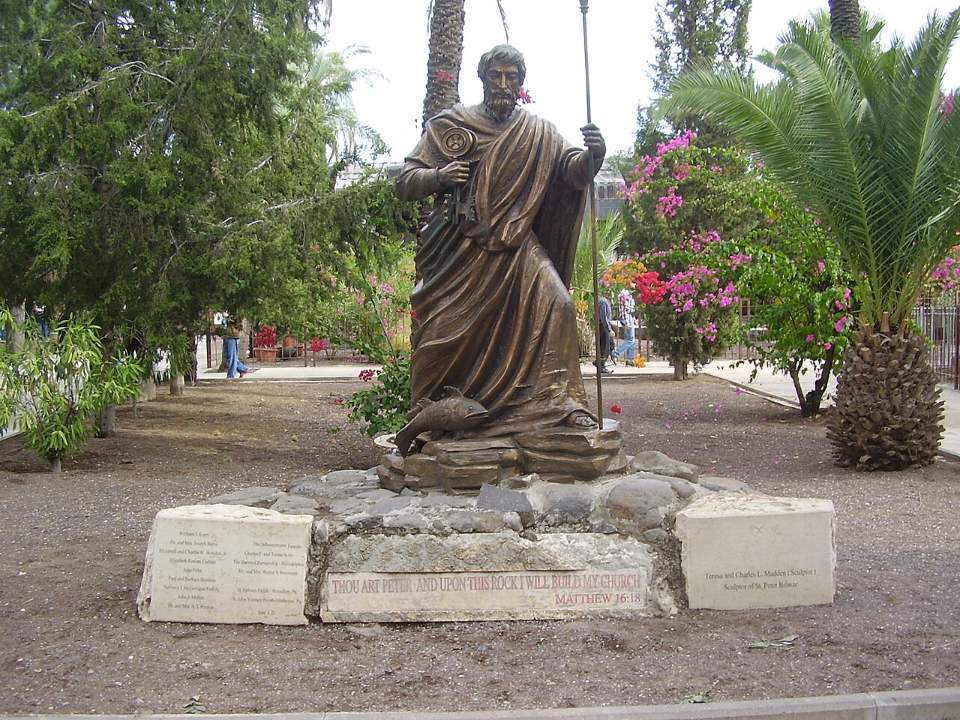
Saint Peter, also called Simon Peter or Cephas, was one of Jesus’ twelve apostles and a leading figure in the early Christian movement. The Gospels portray him as outspoken, devoted and sometimes uncertain. Acts presents him as a public speaker and leader whose work helped shape the growing community.
His story is compelling partly because it includes failure. Peter can speak with conviction and then act out of fear. For Christian readers, that combination has made him an enduring figure of faith, human weakness and renewed responsibility.
His original name was Simon. John describes Andrew bringing his brother to Jesus, who gives Simon the name Cephas (John 1:40–42). Cephas is associated with the Aramaic word for rock; Peter comes through the corresponding Greek name, Petros.
Matthew develops the rock imagery in the account set near Caesarea Philippi (Matthew 16:13–19). These passages have an important place in Christian reflection on Peter’s role, although churches differ in how they interpret their implications for authority.
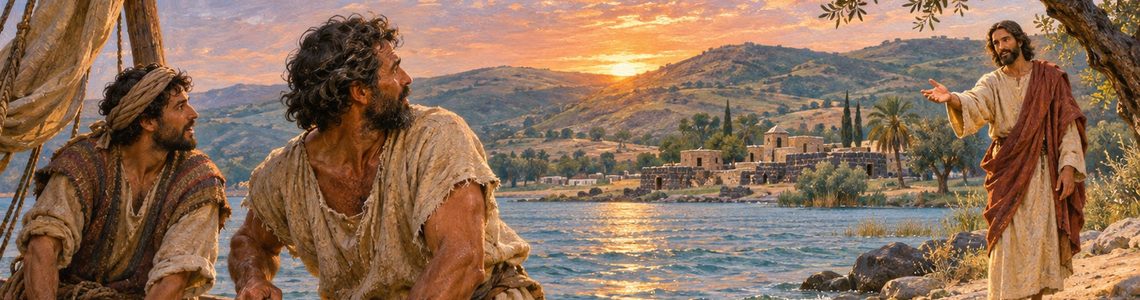
Before the journeys and sermons, there was fishing. Matthew describes Jesus encountering Peter and Andrew casting a net into the Sea of Galilee. The invitation changes the direction of their lives:
“Follow me, and I will make you fishers of men.” (Matthew 4:19, KJV)
The image grows naturally from their work. A visit to the lakeshore gives that language a physical setting, connecting a familiar verse with the world of boats, water and daily labor.
John 1:44 identifies Bethsaida as the town of Andrew and Peter. The Gospel accounts also connect Peter’s household with Capernaum. These references describe different parts of his geographical background rather than requiring a choice between the two places.
For visitors, Capernaum offers a particularly direct connection with the apostle through the house traditionally associated with him.
Yes, the New Testament indicates that Peter was married. Mark describes Jesus entering the house of Simon and Andrew and finding Simon’s mother-in-law ill with a fever (Mark 1:29–31). The passage gives a glimpse of a family household behind the better-known public story.
The Gospels do not provide a full biography of his wife. Her name is not given in the New Testament.
The healing of Peter’s mother-in-law brings Jesus into a domestic setting. Mark describes the encounter in simple terms:
“And he came and took her by the hand, and lifted her up;” (Mark 1:31, KJV)
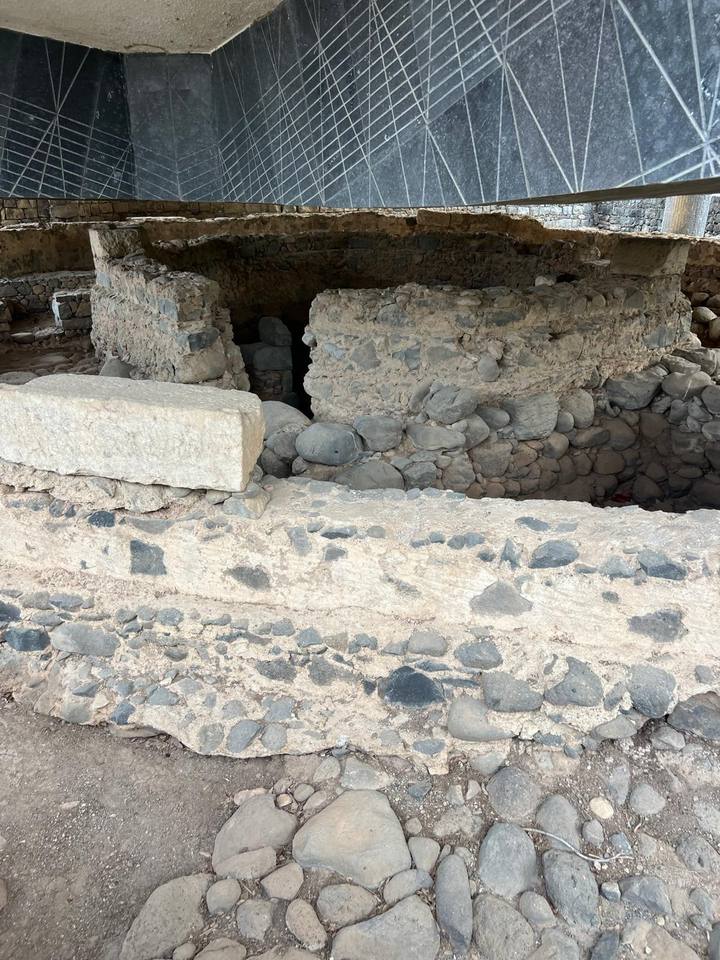
At Capernaum today, the site venerated as Peter’s house preserves a different kind of story: the transformation of a dwelling into a place of Christian worship. Excavations beneath the later church revealed residential remains and evidence of the building’s changing use.
The Franciscan excavators interpret the sequence as an early house of religious gathering, enlarged in the fourth century and replaced by an octagonal church in the fifth. The term domus ecclesiae means a house used by the church community, often described more simply as a house church.
The modern church stands above the remains, allowing visitors to look down into the layers below. The connection with Peter rests on the combination of archaeology, early pilgrimage testimony and longstanding veneration. It should not be presented as ownership established beyond doubt by excavation alone.
Allow time here to look closely. The importance of the site lies in the relationship between a home, a remembered Gospel story and a community that preserved the place through generations.
Luke places Peter’s denial after Jesus’ arrest, as he follows to the high priest’s house and sits near a fire. When people identify him as one of Jesus’ companions, he denies the connection three times. The setting conveys the danger and pressure surrounding his responses.
Fear is a natural reading of the scene, but the account is more powerful than a single explanation. Peter’s earlier confidence gives way under questioning. When the rooster crows, he remembers Jesus’ warning:
“And Peter went out, and wept bitterly.” (Luke 22:62, KJV)
The Church of Saint Peter in Gallicantu, on Mount Zion in Jerusalem, commemorates this story through Christian tradition. Its name refers to the rooster’s crow. The traditional identification of the site should be distinguished from a location established with archaeological certainty.
Peter’s failure does not end his story. The later New Testament accounts continue to give him an active place among Jesus’ followers.
Acts portrays Peter taking a prominent role in Jerusalem after the Resurrection and Ascension. At Pentecost, he stands with the other apostles and addresses the crowd (Acts 2). The fisherman who struggled to acknowledge Jesus during the arrest narrative is now depicted speaking publicly.
His activity also takes the story beyond Jerusalem. Joppa, modern Jaffa, and Caesarea become settings for encounters that explore who can belong to the growing community.
Acts 10 describes Peter staying with Simon the tanner in Joppa and receiving a vision. Messengers then bring him to Cornelius, a Roman centurion in Caesarea. Peter recognizes that he should not treat people as outside God’s welcome because of their background.
“Of a truth I perceive that God is no respecter of persons:” (Acts 10:34, KJV)
The encounter becomes an important account of Gentiles entering the Christian community. St. Peter’s Church in Jaffa commemorates the apostle’s connection with the town, giving visitors a place to connect the narrative with the Mediterranean coast.
In Catholic tradition, Peter is recognized as the first pope, with the bishops of Rome understood as his successors. Matthew’s rock and keys imagery and Jesus’ words to Peter in John 21 are important to that understanding.
The developed institution of the papacy emerged over time. Other Christian traditions interpret Peter’s authority and its relationship to later church leadership differently.
Christian tradition holds that Peter was martyred in Rome. The familiar account of his crucifixion upside down comes from later tradition, rather than a narrative of his death in the New Testament.
Eusebius, writing in the fourth century and citing Origen, reports that Peter was crucified head downward at his own request. This is a significant witness to the tradition, but it is not a contemporary eyewitness report. The precise date and circumstances should not be stated with more certainty than the sources allow.
Follow Peter’s story from a lakeside home to the streets of Jaffa with Bein Harim. Choose a guided day in the Galilee or a private tour shaped around the places that interest you most.
Join our Nazareth and Sea of Galilee Tour to visit Capernaum, the setting of Peter’s household and a center of Jesus’ ministry. Connect the archaeological remains with the Gospel narratives, then continue through other key Christian sites on the route. View the full itinerary and book your Galilee tour.
Choose our Nazareth and Sea of Galilee Private Tour for a personal experience with your own guide. Make Peter’s house a focus of your Capernaum visit and ask us about including the Church of the Primacy of St. Peter at Tabgha. Confirm your preferred stops when arranging the itinerary. Explore the private tour and plan your day with us.
Our Private Tour of Tel Aviv and Old Jaffa includes the old port town and a view of St. Peter’s Church, connecting the apostle’s story with Jaffa’s streets and sea views. Combine that biblical setting with the neighborhoods and markets of Tel Aviv. See the itinerary and book your private Tel Aviv and Jaffa tour.
Planning a visit to the places connected with Peter? Contact us to find the right tour for your trip.
Tours You May Like
Join Us
Keep in Touch


 Login / Register
 Contact


 Certificate of Excellence
 Guaranteed Departure
 Low Prices Guaranteed
 24/7 Support