It is the middle of the night on the Sea of Galilee. A small fishing boat has been fighting a headwind for hours, and the men at the oars are exhausted. Then, in the darkness before dawn, someone appears on the surface of the lake, walking toward them. Few Gospel scenes are as vivid or as widely remembered, and it unfolds on a lake that visitors to Israel can still see today.
The story of Jesus walking on water appears in three Gospels: Matthew 14:22–33, Mark 6:45–52 and John 6:16–21. After feeding the five thousand, Jesus sends his disciples ahead by boat across the Sea of Galilee. During the night he comes to them across the water, and in Matthew's account Peter steps out of the boat to meet him.
The evening begins on a hillside by the lake. Jesus has just fed a crowd of thousands with five loaves and two fish, the miracle remembered at Tabgha and told in our article on the feeding of the five thousand. Afterward he sends the disciples into the boat to cross ahead of him, dismisses the crowd, and goes up the mountain alone to pray.
Out on the water, conditions turn against the disciples. Matthew describes the scene in a single line:
“But the ship was now in the midst of the sea, tossed with waves: for the wind was contrary.” (Matthew 14:24, KJV)
Mark adds that Jesus saw them straining at the oars. John gives a sense of distance: they had rowed about twenty-five or thirty furlongs, roughly three to three and a half miles. Then, in the fourth watch of the night, between about three and six in the morning, Jesus comes to them, walking on the sea.
The disciples' first reaction is terror. Seeing a figure on the water in the dark, they cry out that it is a ghost. Jesus answers immediately:
“Be of good cheer; it is I; be not afraid.” (Matthew 14:27, KJV)
In Mark and John, Jesus then joins them in the boat. Mark notes that the wind ceased and the disciples were astonished. John adds a final detail: as soon as they took him into the boat, they reached the shore they were heading for.
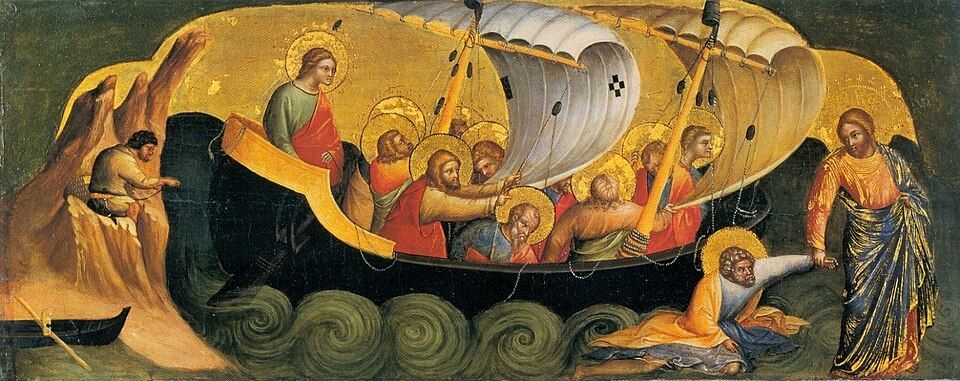
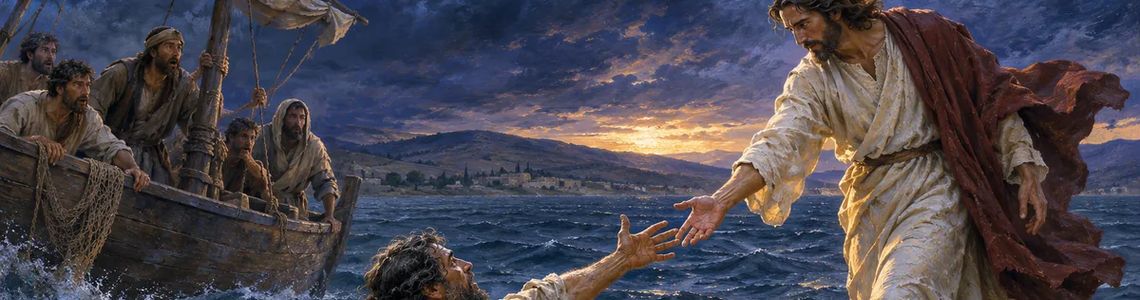
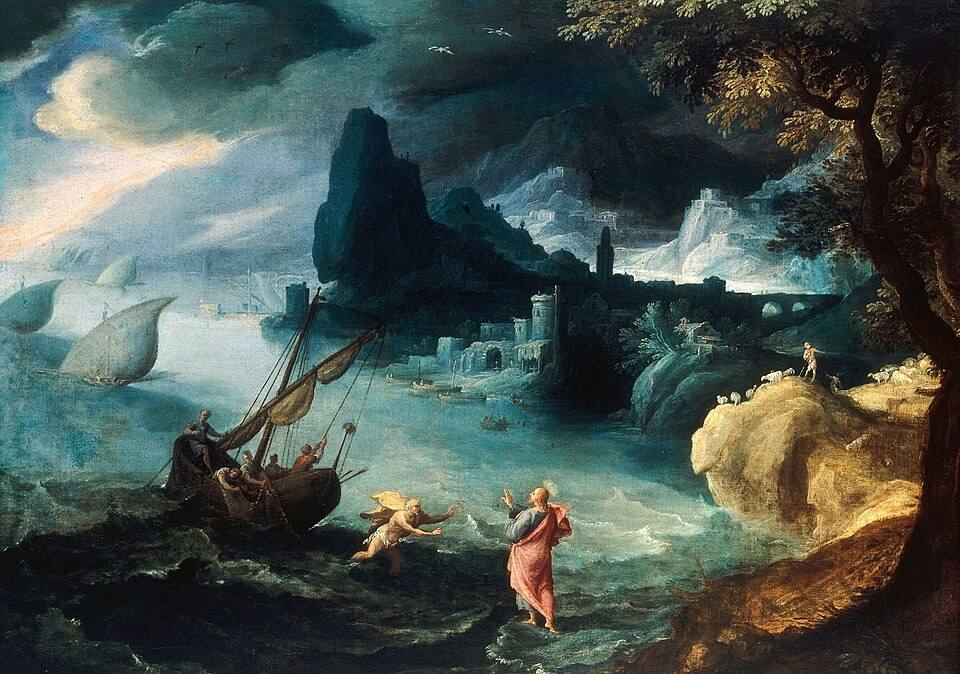
Matthew's Gospel includes a scene the others leave out. Peter, never one to hold back, calls out: “Lord, if it be thou, bid me come unto thee on the water.” Jesus answers with one word: “Come.”
Peter climbs over the side and begins walking toward Jesus. For a few steps, it works. Then he notices the strength of the wind, fear takes over, and he starts to sink.
“And beginning to sink, he cried, saying, Lord, save me.” (Matthew 14:30, KJV)
Jesus immediately reaches out, catches him and asks, “O thou of little faith, wherefore didst thou doubt?” When they climb into the boat together, the wind stops. The disciples worship him, saying, “Of a truth thou art the Son of God.”
The episode fits Peter's character throughout the Gospels: bold, impulsive and deeply devoted, yet capable of faltering. It is one of the reasons Christians have long found him so relatable. Read more about his life in our guide to Saint Peter.
For Christian readers, the story is first of all a revelation of who Jesus is. In the Hebrew Bible, power over the sea belongs to God. The Book of Job describes God as the one who “treadeth upon the waves of the sea” (Job 9:8), and the Psalms speak of God's path through great waters. By walking on the lake and calming the wind, Jesus does what Scripture attributes to God alone. Matthew makes the conclusion explicit with the disciples' confession.
Many interpreters also see significance in Jesus' words “It is I.” In Greek the phrase is ego eimi, literally “I am.” Some scholars connect it with the divine name revealed to Moses in Exodus 3:14. Others read it simply as a reassuring identification in a frightening moment. Both readings have long histories in Christian interpretation.
The story also speaks about faith and fear. Peter walks on the water while he looks toward Jesus and begins to sink when his attention shifts to the wind. Preachers through the centuries have drawn from this a lesson that resonates with ordinary life: courage and doubt can exist in the same person within moments of each other, and help is offered even when faith falters.
Mark adds a striking comment: the disciples were amazed because they had not understood the miracle of the loaves. For Mark, the two events belong together. The one who fed the crowd on the shore is the same one who comes to them across the water.
Peter. According to Matthew 14:28–31, Peter asked Jesus to call him out onto the water, walked toward him, and began to sink when he became afraid. Peter is the only disciple described as walking on water.
The Gospels describe it once. Matthew, Mark and John each tell the same event, with different details. It should not be confused with the separate occasion when Jesus calmed a storm from inside the boat.
No. It appears in Matthew, Mark and John. Luke tells the feeding of the five thousand but does not include the walk on the water. Only Matthew includes Peter stepping out of the boat.
On the night after the feeding of the five thousand, during his ministry in Galilee. Matthew and Mark place it in “the fourth watch of the night,” the last part of the night before dawn.
No. In the story of the calming of the storm (Mark 4:35–41, Matthew 8:23–27, Luke 8:22–25), Jesus is asleep in the boat when a violent storm strikes. The disciples wake him, and he rebukes the wind and the waves. In the walking on water, Jesus is not in the boat at all; he comes to the disciples across the lake. Both events take place on the Sea of Galilee and both show his authority over the sea, which is why they are often mixed up.

Jesus walked on the Sea of Galilee, the freshwater lake in northern Israel known in Hebrew as the Kinneret. The Gospels place the boat “in the midst of the sea” on a crossing toward Bethsaida and Capernaum, and say the disciples landed at Gennesaret, the fertile plain on the lake's northwestern shore.
The Gospels do not identify an exact point on the lake, and unlike many Gospel events, there is no single church or shrine that marks the spot. The northern part of the lake, between Tabgha, Capernaum and Gennesaret, is the natural setting, since that is where the surrounding stories take place.
The lake itself helps explain the story. Surrounded by hills, the Sea of Galilee is known for sudden winds that can sweep down onto the water and raise sharp waves, which is exactly the kind of headwind the disciples faced. Fishermen who had worked these waters all their lives knew how dangerous a night crossing could become.
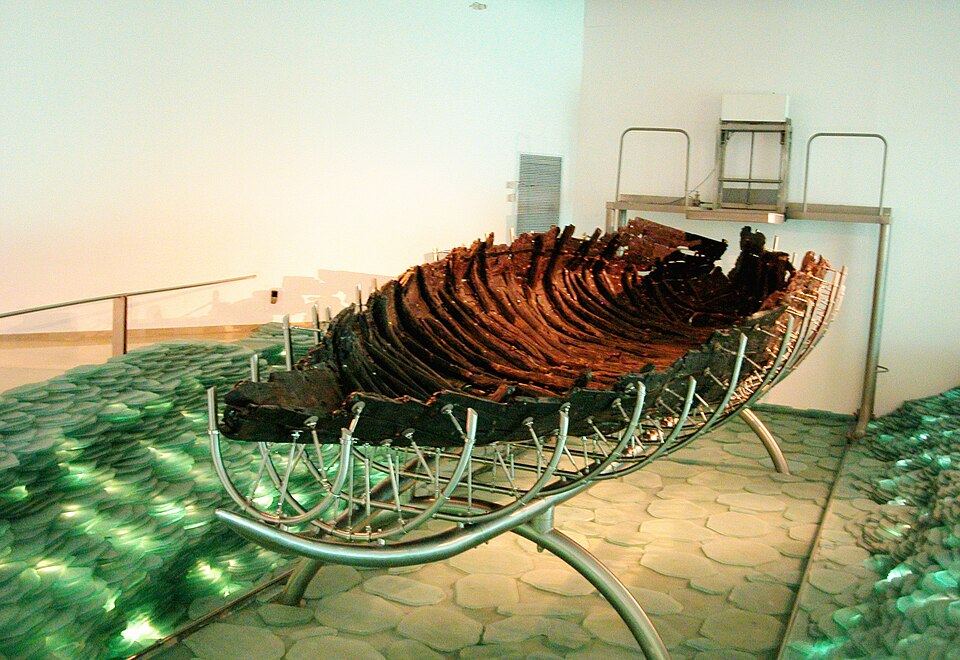
At Kibbutz Ginosar, on the shore of ancient Gennesaret, the Yigal Allon Museum displays a fishing boat discovered in the lakebed during a drought in 1986. Dated to around the 1st century, the boat known as the Jesus Boat cannot be linked to Jesus or his disciples, but it shows the kind of vessel Galilean fishermen used in that period. Standing beside it makes the Gospel crossing far easier to picture. Learn more about Ginosar and its history.
Nearby, Capernaum preserves the remains of the town where Jesus based his Galilean ministry and the house traditionally identified as Peter's. Together with Tabgha and Magdala, these sites place the story within the landscape where it is set.
There is something powerful about reading Matthew 14 beside the Sea of Galilee. The hills, the open water and the lakeside villages are the same features the disciples knew, and the distances in the story suddenly make sense when the far shore is in view.
Explore our Galilee tours to visit the lake and the places connected with Jesus' ministry, from Capernaum and Tabgha to Ginosar and Magdala. Itineraries differ, so choose a tour that includes the sites that matter most to you.
For a broader journey through the Gospels, from Nazareth to Jerusalem, browse our Christian tours of Israel.
Tours You May Like
Join Us
Keep in Touch


 Login / Register
 Contact


 Certificate of Excellence
 Guaranteed Departure
 Low Prices Guaranteed
 24/7 Support