Five loaves of bread, two fish, and thousands of hungry people. The feeding of the five thousand begins with a problem the disciples cannot solve and ends with more food than they started with. Beside the Sea of Galilee, an ancient mosaic still invites visitors to look closely at this familiar story and discover something they might have missed.
When Jesus feeds the 5000, the Gospels describe more than an extraordinary meal. They tell of compassion, faith, and abundance. Understanding the story also brings new meaning to a visit to Tabgha, where the Church of the Multiplication commemorates the miracle on the lake’s northwestern shore.
The Gospel accounts place Jesus and a large crowd in a remote setting. In Matthew, Jesus withdraws by boat after hearing about the death of John the Baptist. People follow him on foot from the surrounding towns. When he sees them, he responds with compassion and heals their sick.
Mark emphasizes another aspect of that compassion: Jesus sees people who seem like sheep without a shepherd and begins teaching them.
As the day grows late, the disciples recognize a practical problem. Thousands of people need food, and the place is isolated. They suggest sending everyone away to buy something to eat in the nearby villages. Jesus gives them a different task: feed the crowd themselves.
John’s account brings two disciples, Philip and Andrew, into the foreground. Jesus asks Philip where bread can be bought for so many people. Philip considers the expense and concludes that even a considerable amount of money would not buy enough for everyone to receive a little.
Andrew notices something much smaller.
In John’s Gospel, Andrew points out a boy carrying five barley loaves and two small fish:
“There is a lad here, which hath five barley loaves, and two small fishes: but what are they among so many?” (John 6:9, KJV)
The boy is not named, and the text tells us nothing about his family or background. Yet his presence creates one of the story’s most memorable contrasts: a small amount of ordinary food beside an immense crowd.
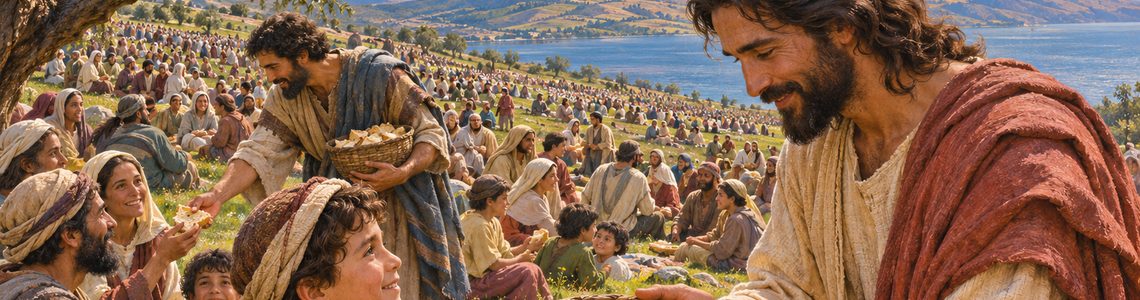
Jesus tells the people to sit down. He takes the bread, gives thanks, and distributes it. The fish are shared as well. What appeared hopelessly inadequate becomes enough for everyone.
The accounts do not describe a symbolic taste or a few bites passed around. The people eat until they are satisfied.
After the meal, Jesus instructs the disciples to collect what remains:
“Gather up the fragments that remain, that nothing be lost.” (John 6:12, KJV)
They fill twelve baskets with fragments. The food that seemed insufficient at the beginning has become an abundance.
There is also a detail hidden by the familiar name “the feeding of the five thousand.” Matthew 14:21 counts about five thousand men, besides women and children. The gathering was therefore larger, although the Gospel does not provide a total for everyone present.
John adds a revealing conclusion. After witnessing the sign, the people want to make Jesus king by force. Jesus withdraws alone to the mountain, refusing to become the kind of ruler the crowd seeks.
The feeding of the five thousand appears in all four Gospels. Each account preserves the central miracle while highlighting different details.
| Gospel passage | A detail to notice |
| Matthew 14:13–21 | Jesus responds with compassion, and the count of five thousand men excludes women and children. |
| Mark 6:30–44 | The apostles return from their work, and the crowd sits in groups on green grass. |
| Luke 9:10–17 | The setting is associated with Bethsaida, and Jesus welcomes the crowd, teaches, and heals. |
| John 6:1–15 | Passover is approaching; Philip is tested, and Andrew identifies the boy with barley loaves and fish. |
Reading the accounts together adds depth, but their details should not be treated as though every Gospel tells the story in exactly the same way. The boy, for example, is mentioned specifically in John.
This miracle is also distinct from the feeding of the four thousand in Matthew 15:32–39 and Mark 8:1–10. Those passages describe seven loaves and seven baskets of leftovers. Keeping the two stories separate helps readers follow their different settings and details.
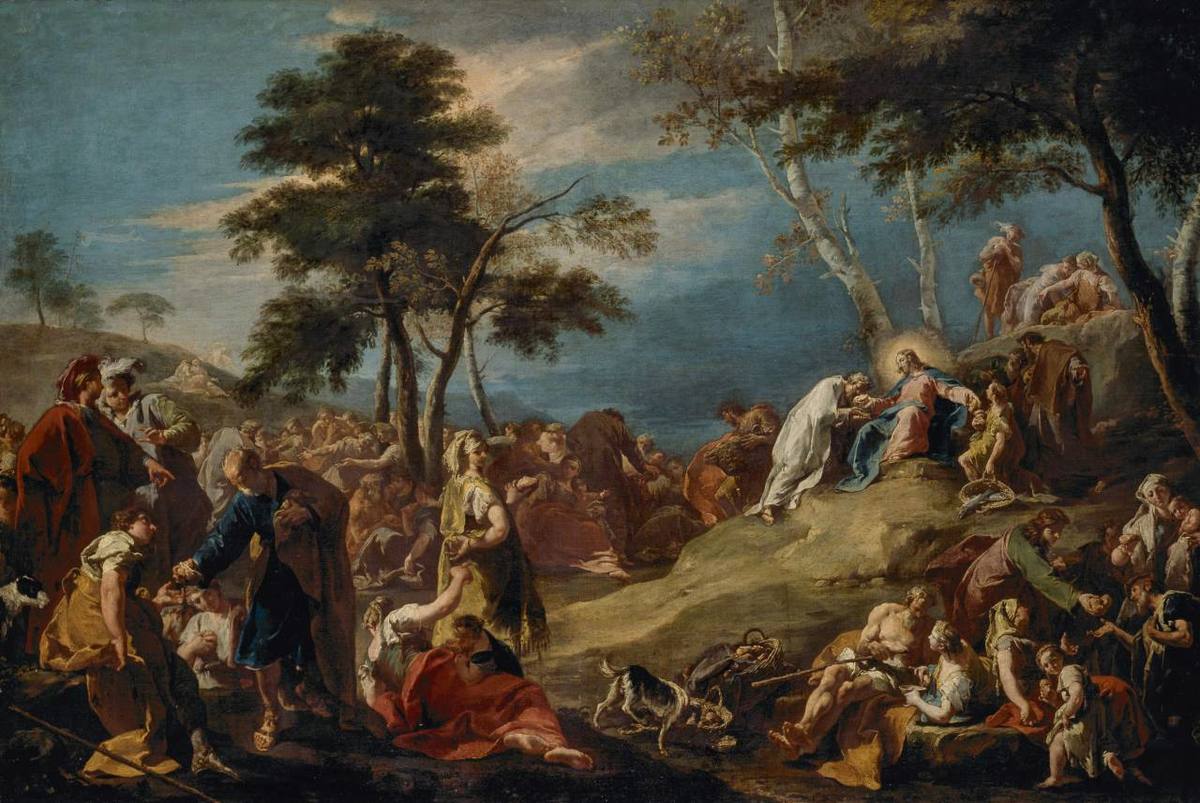
Compassion stands at the heart of the miracle. Jesus does not dismiss the crowd’s physical hunger as an inconvenience. Teaching, healing, and feeding belong together in the Gospel accounts.
The disciples become part of that response. They identify the problem, struggle to imagine a solution, and participate in feeding the people. Their involvement makes the story more immediate: they must act before they fully understand how the need will be met.
The miracle also contrasts human calculation with divine provision. Philip sees an unaffordable expense. Andrew sees food that cannot possibly stretch far enough. Christians understand the outcome as a revelation of Jesus’ power and generosity.
The twelve baskets emphasize that everyone has eaten and something still remains. Some Christian interpretations connect this number with the twelve tribes of Israel or the twelve apostles, although the feeding accounts themselves do not explicitly explain its symbolism.
In John, the meaning develops further in the Bread of Life discourse later in chapter 6. The meal leads into teaching about a deeper hunger and the life Jesus offers.
Many Christian traditions also recognize a connection with the Eucharist in the taking, blessing or giving thanks, and sharing of bread. That connection becomes especially meaningful when visitors stand before the altar at Tabgha.
The Gospels place the event in the landscape around the Sea of Galilee. Luke connects the withdrawal with Bethsaida, while the accounts describe a remote setting where the crowd gathers.
They do not identify a modern church or give coordinates that establish the precise location.
Tabgha, on the northwestern shore of the lake, became an important Christian place of remembrance. Its Church of the Multiplication preserves a longstanding tradition connecting the area with the feeding of the five thousand.
For visitors, the distinction is useful. Tabgha commemorates the miracle through centuries of worship and pilgrimage. Its significance does not depend on claiming that archaeology has proved the exact patch of ground where the crowd sat.
Visiting the area allows travelers to appreciate the setting of Jesus’ Galilean ministry: the lake, the surrounding hills, and the communities linked with the Gospel narratives.
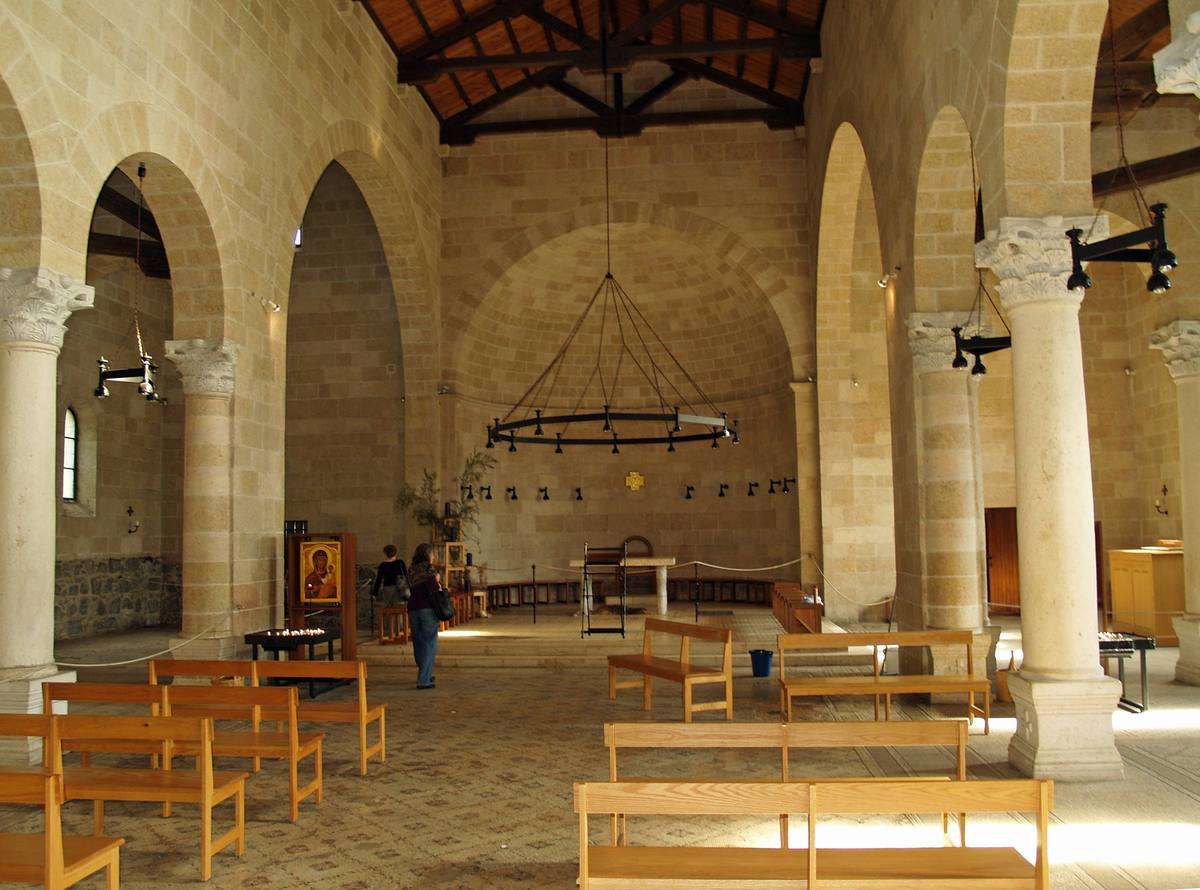
The Church of the Multiplication of the Loaves and Fish brings the story into a setting of pale stone, ancient mosaics, and quiet worship.
The present church was dedicated in 1982 and protects remains of earlier churches. Its restrained interior encourages visitors to slow down and look at the details.
Near the altar is the image many travelers recognize before they arrive: two fish beside a basket of bread.
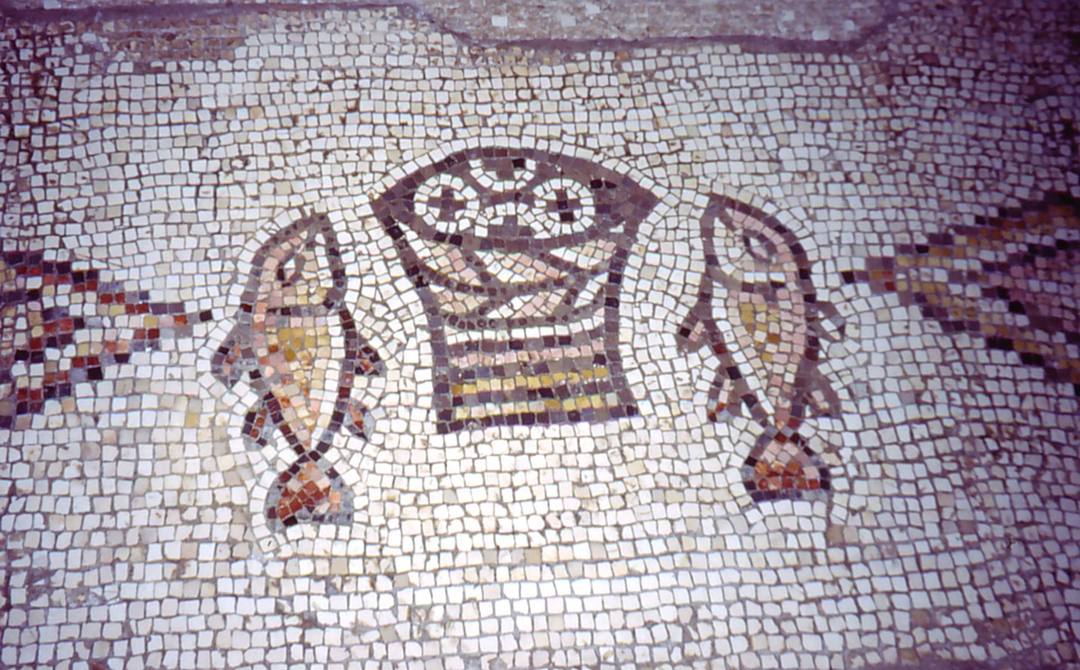
The Byzantine mosaic, generally dated to the fifth century, is one of the best-known images associated with the miracle. Its simple composition makes the story recognizable without showing Jesus, the disciples, or the waiting crowd.
But look closely at the basket. There are four visible loaves, not the five mentioned in the Gospels.
One Christian interpretation offers a compelling explanation: the fifth loaf is the Eucharistic bread placed on the altar during Mass. In this reading, the worship taking place above the mosaic completes the image below, connecting the feeding of the multitude with Christ as the Bread of Life.
This is a theological interpretation rather than a documented explanation left by the mosaic’s maker. Even so, it gives visitors a memorable way to understand the relationship between the artwork, the altar, and the church’s continuing worship.
Beneath the altar, a rock is venerated in connection with the miracle. The wider mosaic floor also includes birds and plants, rewarding those who look beyond the famous basket and fish.
Allow time for quiet reflection as well as photographs. Dress respectfully, follow the church’s visitor guidance, and remember that this is an active place of worship.
Reading the story beside the Sea of Galilee gives its landscape a new immediacy. At Tabgha, the loaves and fish mosaic connects that experience with generations of Christian pilgrims who came to remember the same miracle.
Our Nazareth and Sea of Galilee Tour includes the Church of the Multiplication at Tabgha, alongside Capernaum and important Christian sites in Nazareth. It offers a practical way to explore several places connected with Jesus’ life and ministry in one guided journey.
For a day shaped around your interests and pace, explore our Nazareth and Sea of Galilee Private Tour. Share the stories and sites that matter most to you, and our team can help you choose a suitable itinerary.
Thinking of visiting the places behind the Gospel stories? Contact us to start planning your Holy Land experience.
Tours You May Like
Join Us
Keep in Touch


 Login / Register
 Contact


 Certificate of Excellence
 Guaranteed Departure
 Low Prices Guaranteed
 24/7 Support