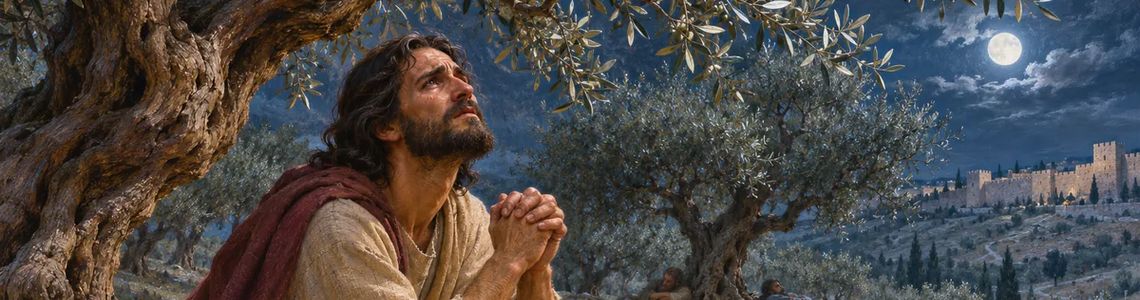
After the Last Supper, Jesus went with his disciples to Gethsemane. He asked them to stay awake with him, then stepped away to pray. Before the crowds, the trial, and the cross came this deeply personal moment: a prayer that voiced anguish without letting go of trust. Today, the garden at the foot of the Mount of Olives invites visitors to pause where Christians remember that night.
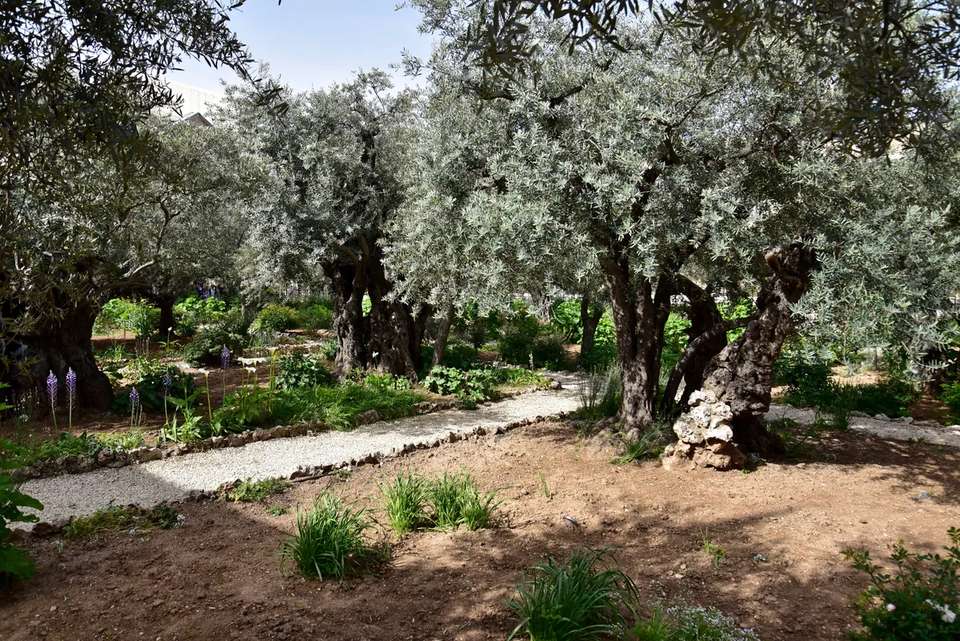
Gethsemane is at the foot of the Mount of Olives in East Jerusalem, across the Kidron Valley from the Old City. The name is commonly understood to mean “oil press,” a fitting connection with the olive groves associated with the area.
Jesus prayed there after the Last Supper, on the night of his arrest and before his crucifixion. Christians commemorate these events during Holy Week, particularly on Holy Thursday, also known as Maundy Thursday.
Matthew and Mark name Gethsemane as the place of prayer. Luke describes Jesus going to the Mount of Olives, while John describes a garden across the Kidron where Jesus often met with his disciples. These accounts connect the night with a familiar landscape outside Jerusalem’s walls, though they do not all recount the same details.
The Garden of Gethsemane visited today preserves the Christian memory of this episode. The olive grove and neighboring church help place the story within Jerusalem’s geography, without establishing the precise spot where every moment occurred.
The prayer follows an evening already heavy with anticipation. Jesus has shared a final meal with his disciples and spoken of betrayal. Now, away from the meal, he asks for their company while he prays.
In Matthew 26:36–46 and Mark 14:32–42, the scene moves between Jesus alone in prayer and his disciples struggling to remain awake. This repeated movement gives the account its emotional weight. Jesus seeks the Father, returns to his companions, and finds them sleeping.
Jesus takes Peter, James, and John farther with him. Mark names all three; Matthew identifies Peter and the two sons of Zebedee. He tells them that he is overwhelmed with sorrow and asks them to remain nearby and keep watch.
The request is simple but intimate. These are not instructions for a public speech or a journey. Jesus asks his closest companions to stay with him during a time of distress. He then goes a little farther and prays.
The Gospel accounts describe his posture differently: Matthew says he falls on his face, Mark describes him falling to the ground, and Luke says he kneels. Each draws attention to the intensity of the moment.
“O my Father, if it be possible, let this cup pass from me: nevertheless not as I will, but as thou wilt.” (Matthew 26:39, KJV)
What did Jesus pray in the Garden of Gethsemane? He asked the Father whether the cup before him could pass, while submitting himself to the Father’s will. Mark records the intimate address “Abba, Father.” Luke expresses the same tension between the request and the acceptance that follows.
The cup is a biblical image for an experience or portion someone must receive. In this setting, Christians understand it in relation to Jesus’ approaching suffering and death. Many Christian interpretations also connect it with divine judgment and the saving purpose of the Passion.
The prayer does not conceal distress. Jesus gives voice to what lies before him, yet the request is inseparable from his willingness to obey. Reading both parts together is essential to understanding the scene.
The familiar phrase “Not my will, but yours be done” captures the heart of Jesus’ prayer in Gethsemane. In the King James Version, Luke records it this way:
“Father, if thou be willing, remove this cup from me: nevertheless not my will, but thine, be done.” (Luke 22:42, KJV)
For Christian readers, these words express trust and willing obedience in the presence of suffering. The prayer is not presented as indifference to pain. Its significance lies partly in the fact that anguish and faith appear together.
How many times did Jesus pray in Gethsemane? Matthew describes him withdrawing to pray three times, with the third prayer repeating the same words (Matthew 26:44). The repetition gives the scene its rhythm: Jesus returns to the same request, remaining in prayer as the moment of his arrest approaches.
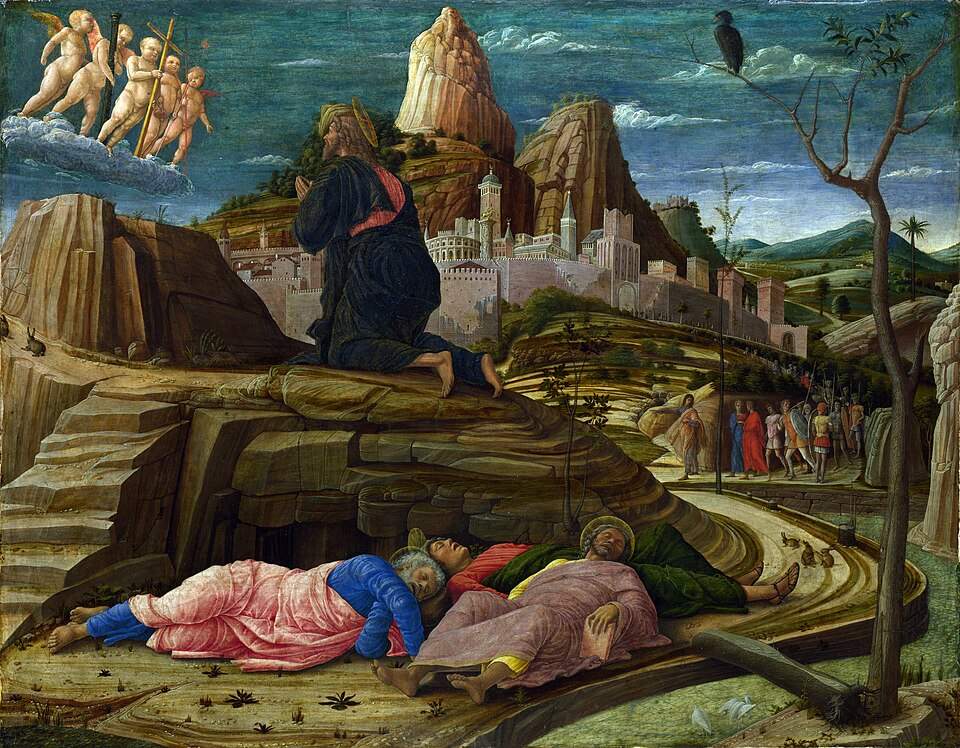
The episode is often called the Agony in the Garden, a name that reflects Jesus’ profound distress before his arrest. Christian art frequently depicts him praying beside a rock, sometimes with an angel nearby. Those images draw on Scripture and on the traditions through which the event has been remembered.
Luke 22:43–44 describes an angel strengthening Jesus and his sweat becoming like drops of blood falling to the ground. These verses are familiar in Christian worship, although some Bible editions note that they are absent from certain ancient manuscripts.
The question “Why did Jesus sweat blood?” often leads readers to this passage. Luke’s wording compares the sweat to drops of blood and emphasizes the intensity of his anguish and prayer. Medical explanations are sometimes proposed, but the passage does not establish a diagnosis. For Christian readers, the emphasis remains on the depth of his suffering and the earnestness of his prayer.
The angel’s presence is also important within Luke’s account. Strengthening does not remove the ordeal ahead. Instead, it accompanies Jesus as he continues to pray. This has made Gethsemane a powerful place of reflection for Christians facing grief, fear, or difficult decisions.
When Jesus returns to the disciples, he finds them sleeping. Mark describes their eyes as heavy, and Luke says they were sleeping because of sorrow. The accounts show human weakness at the very moment Jesus has asked for watchfulness.
“Watch and pray, that ye enter not into temptation: the spirit indeed is willing, but the flesh is weak.” (Matthew 26:41, KJV)
Jesus’ words connect staying awake with spiritual preparation. The disciples need prayer for what they are about to face, even if they do not yet grasp it. Their failure to keep watch contrasts with his persistence.
The story does not give a total duration for Jesus’ prayer. His question about their inability to watch for one hour expresses disappointment, but it should not be turned into an exact timetable for the entire episode.
This is one reason the sleeping disciples remain such a recognizable part of the story. They want to follow Jesus, yet sorrow and exhaustion overwhelm them. The scene invites reflection on faithfulness without pretending that human resolve is limitless.
The quiet separation between Jesus and his sleeping companions ends with the arrival of Judas and an armed group. In Matthew and Mark, Judas identifies Jesus with a kiss. The place of prayer becomes the setting of betrayal and arrest.
John adds a geographical detail: Judas knows the garden because Jesus often met there with his disciples. John does not retell the agony prayer found in the other Gospels, but his account explains why the group can find Jesus in this familiar place.
The transition matters. Gethsemane is not an isolated meditation between unrelated events. It stands between the Last Supper and the arrest, linking Jesus’ words to the suffering that follows. In Christian understanding, the willingness expressed in prayer continues as he faces those who have come for him.
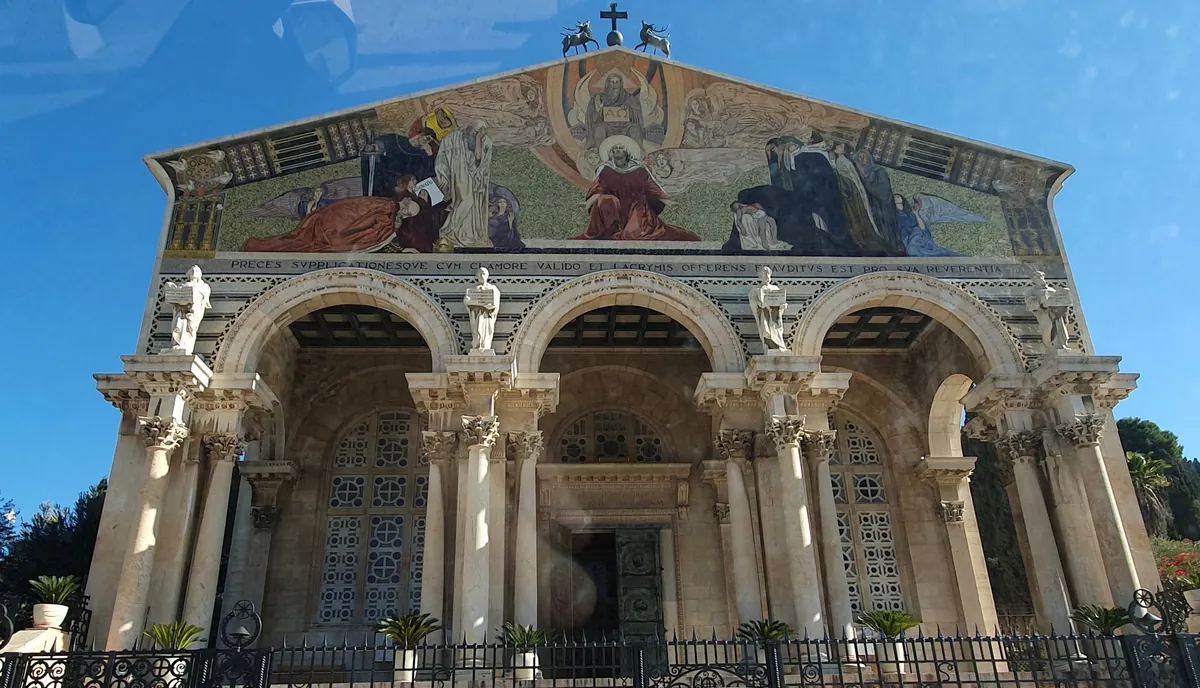
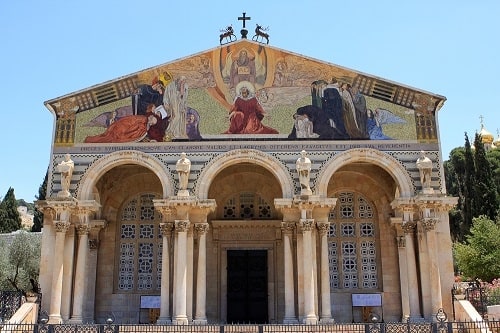
At Gethsemane, the geography brings the story close. The slope of the Mount of Olives, the Kidron Valley, and the walls of Jerusalem place the episode within a landscape visitors can begin to understand on foot. The garden offers a setting for recalling the prayer, while the adjoining Church of All Nations, also known as the Basilica of the Agony, commemorates it through architecture, mosaics, and worship.
Inside the church, a rock venerated in Christian tradition is associated with Jesus’ prayer. Its association with Jesus rests on Christian tradition rather than archaeological proof of the exact place where he knelt. Visitors come to reflect on the event remembered here and, when appropriate, spend a quiet moment in prayer.
To explore Gethsemane as part of Jerusalem’s wider Christian story, browse our Jerusalem tours. Different itineraries connect the Mount of Olives and the city’s sacred places in different ways, so choose a route that includes the sites most important to you.
Tours You May Like
Join Us
Keep in Touch


 Login / Register
 Contact


 Certificate of Excellence
 Guaranteed Departure
 Low Prices Guaranteed
 24/7 Support