 Login / Register
 Contact
Custodia di Terra Santa: The Franciscans of the Holy Land
A brown habit, a quiet procession, a church door opened for pilgrims. Across the Holy Land, the Franciscan presence is easy to notice, even if its story is less familiar. Behind many of these encounters is the Custodia di Terra Santa, a religious community whose work connects some of Christianity’s most treasured places with the people who worship, study, and live around them.
What Is the Custody of the Holy Land?
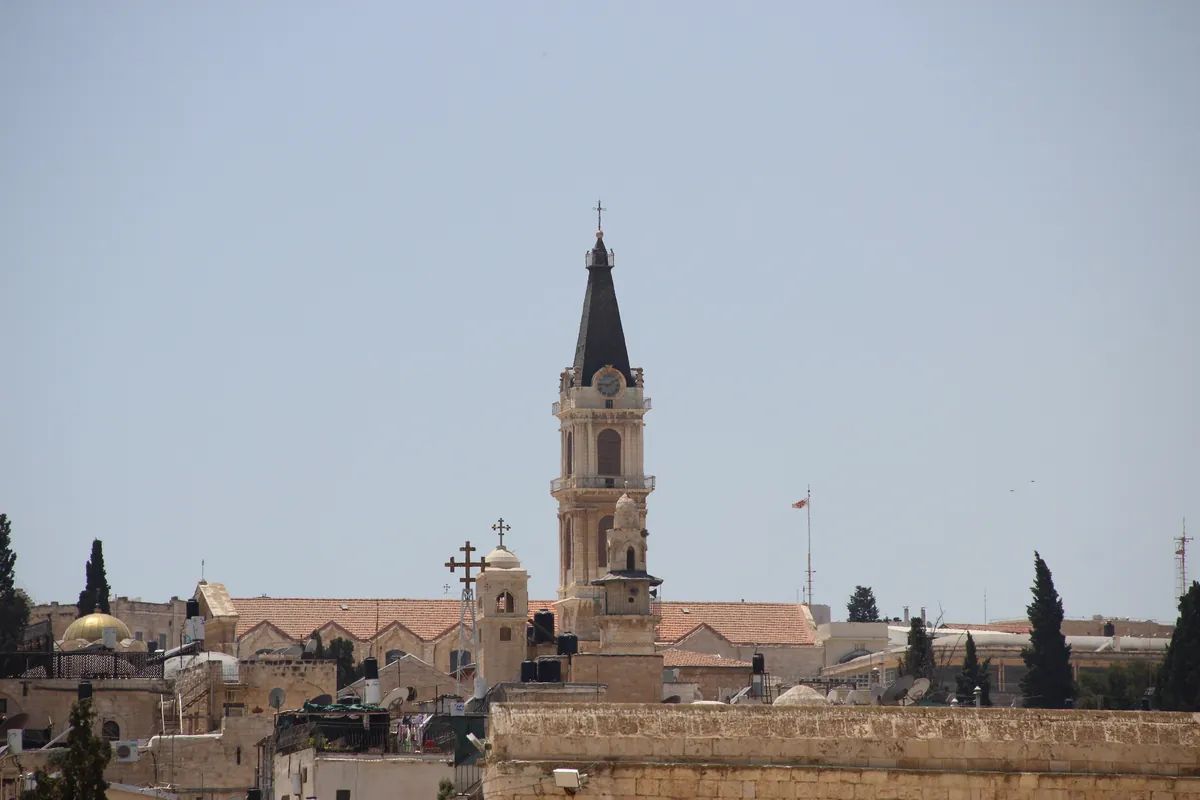
Saint Saviour’s Monastery in Jerusalem’s Old City (Photo: Gary Todd, CC0, via Wikimedia Commons)
The Custodia di Terra Santa, known in English as the Custody of the Holy Land, is a Franciscan religious body with a particular responsibility for Christian holy places on behalf of the Catholic Church. Its friars care for shrines, welcome pilgrims, celebrate worship, and support local communities. Their work also includes historical research and the preservation of Christian heritage.
You may encounter the Italian name Custodia di Terra Santa, the Latin Custodia Terrae Sanctae, or simply “the Custody.” These names refer to the same organization. Here, custody means guardianship: caring for places and sustaining the religious life associated with them.
That does not mean the Custody controls every church in Jerusalem or every Christian site in the region. The Holy Land is home to many Christian denominations, religious orders, and institutions. Understanding their different roles helps explain why neighboring churches, and sometimes different chapels within one building, have distinct traditions.
Who Are the Franciscans in the Holy Land?
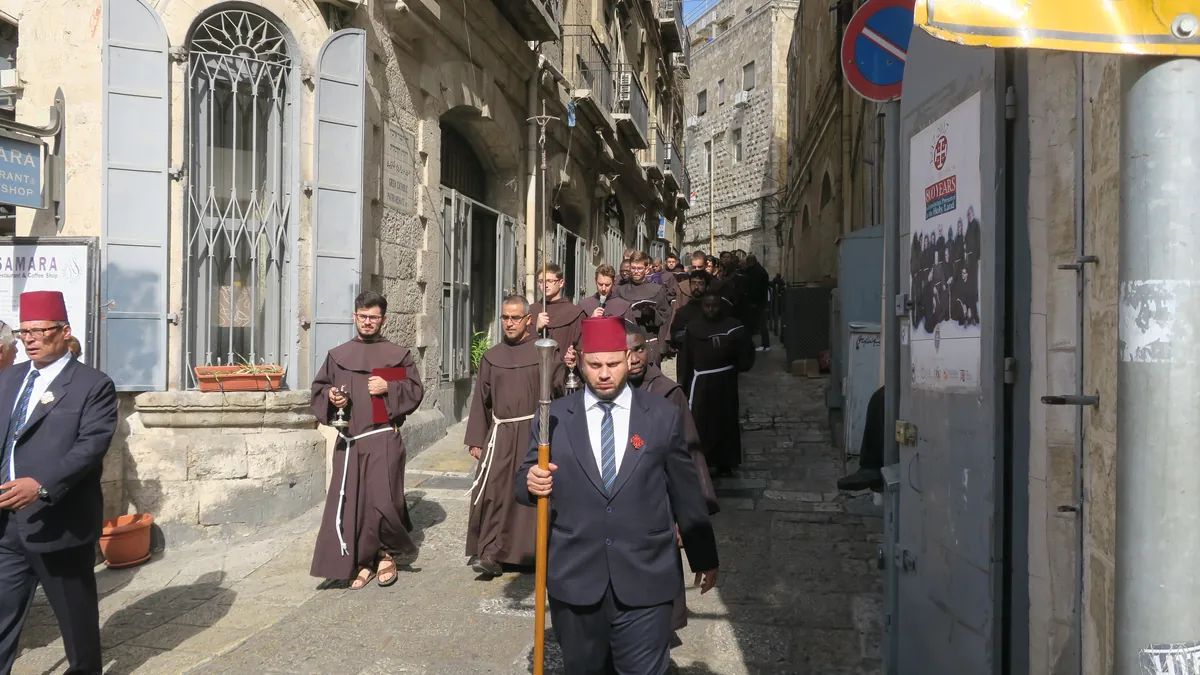
Franciscan friars in Jerusalem’s Old City (Photo: Terrazzo, CC BY 2.0, via Wikimedia Commons)
The Franciscans are members of the religious family inspired by St. Francis of Assisi. The friars of the Custody belong to the Order of Friars Minor, often abbreviated OFM. Franciscan spirituality emphasizes humility, service, and a life shaped by the Gospel.
In the Holy Land, that calling takes a particularly tangible form. Friars live and pray near places associated with the life of Jesus, while helping others encounter those places. A visitor might see them leading a service, assisting a pilgrim group, or taking part in the daily life of a sanctuary.
The head of the Custody is called the Custos, meaning guardian. Its headquarters are at Saint Saviour’s Monastery in Jerusalem’s Old City. The Custody is distinct from the Latin Patriarchate of Jerusalem, although both serve the Catholic community and work in the same region. The Patriarchate is the local Latin Catholic diocese; the Custody is a Franciscan body with its own mission and responsibilities.
How Did the Custody Begin?
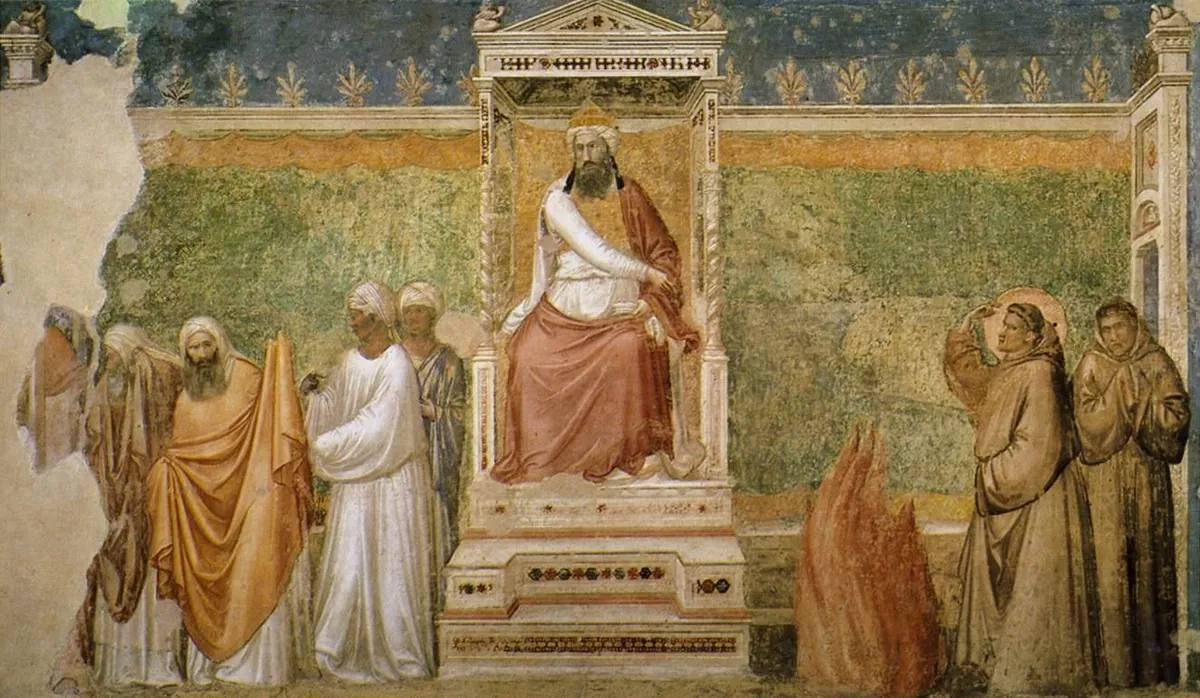
St Francis before the Sultan, fresco by Giotto (Photo: Giotto, Public domain, via Wikimedia Commons)
Two dates help explain its beginnings. In 1217, the Franciscan Order established a province that included the Holy Land. This is the starting point usually given for the Franciscan presence in the region. In 1219, Francis himself traveled to Egypt and met Sultan al-Malik al-Kamil, an encounter remembered within the Franciscan tradition as an important example of dialogue.
The year 1342 marks a different milestone. Pope Clement VI formally confirmed the Franciscans’ role in the holy places. It is therefore more accurate to distinguish the movement’s early presence from its later papal recognition than to give a single founding date without explanation.
The centuries that followed brought changing rulers, periods of conflict, negotiations over access, and the development of new sanctuaries. The churches visitors see today reflect these different chapters. A modern basilica may stand above earlier remains, while the devotion attached to its location reaches much further back.
Which Holy Sites Are Connected with the Custody?
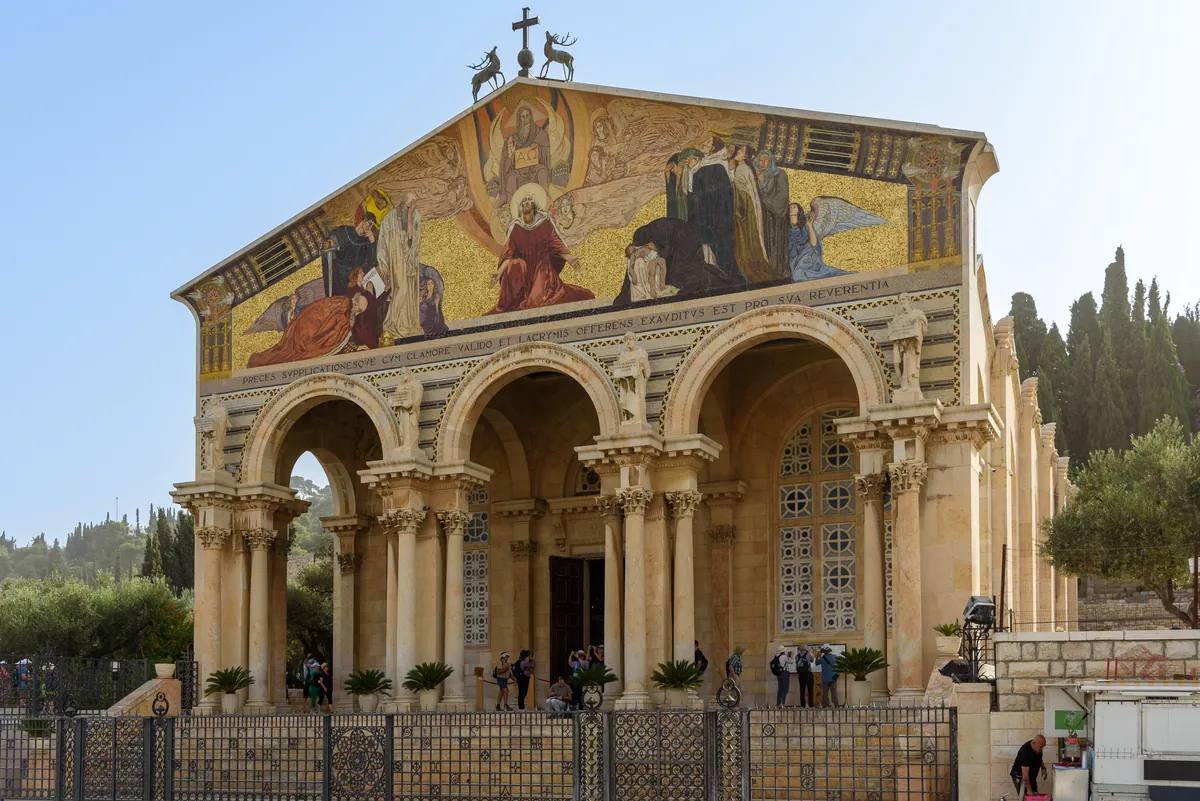
The Church of All Nations beside the Garden of Gethsemane (Photo: Mustang Joe, CC0, via Wikimedia Commons)
The Custody’s work stretches across several regions, so it is unlikely that travelers will encounter it at only one stop. These examples show how its responsibilities connect with a Christian journey through Jerusalem, Bethlehem, Nazareth, and Galilee.
| Place | Why it matters | The Franciscan connection |
| Church of the Holy Sepulchre, Jerusalem | Venerated as the place of Jesus’ crucifixion, burial, and resurrection. | The Franciscans represent the Latin Catholic community within a shared sanctuary. |
| Gethsemane, Jerusalem | Associated with Jesus’ prayer before his arrest. | The Custody cares for the Basilica of the Agony, also called the Church of All Nations. |
| Basilica of the Annunciation, Nazareth | Catholic tradition identifies its grotto with the Annunciation to Mary. | A major Franciscan sanctuary and place of worship. |
| Capernaum, Sea of Galilee | Connected with Jesus’ ministry and the tradition of Peter’s house. | The Franciscan site brings together archaeological remains and the memorial church above the traditionally identified house. |
| Nativity complex, Bethlehem | Venerated as the birthplace of Jesus. | The Franciscans have a role in the shared holy place and serve the adjoining Catholic Church of St. Catherine. |
At the Church of All Nations in Gethsemane, the connection is especially immediate: the sanctuary invites visitors to reflect on Jesus’ prayer on the Mount of Olives. In Nazareth, the Basilica of the Annunciation places Marian devotion at the center of the visit.
At Capernaum, archaeology adds another dimension. The remains help visitors imagine the village setting of the Gospel accounts. Archaeological interpretation and religious tradition contribute to the experience in different ways; they should not be treated as interchangeable forms of evidence.
The Holy Sepulchre and Shared Custodianship
Who looks after the Church of the Holy Sepulchre? There is no single answer. The Greek Orthodox, Armenian Apostolic, and Latin Catholic communities have principal responsibilities and rights, while other historic Christian communities also have a presence.
The Franciscans serve the Latin Catholic community. Arrangements commonly called the Status Quo regulate rights, spaces, and aspects of worship. This helps explain why a procession may pass through a shared area while another community continues its own liturgy nearby.
For visitors, the practical lesson is simple: the church is an active place of worship with several traditions living alongside one another. Pause when a service passes, keep voices low, and follow the directions given at individual chapels. Looking closely at the differences can make the visit more meaningful.
What Does the Custody Do Today?
Caring for a sanctuary involves more than maintaining its walls. Worship, conservation, research, and the welcome offered to pilgrims all contribute to keeping a holy place alive. The Custody’s work includes these activities, alongside education and support for local people.
Welcoming Pilgrims
The Christian Information Centre, supported by the Custody, provides information about churches, shrines, and religious life in the Holy Land. It can be a useful source when a visit involves particular liturgies or pilgrimage arrangements.
A sightseeing visit and a reserved celebration of Mass are different arrangements. Church groups hoping to worship at a particular shrine should organize that request in advance through the appropriate channels. Individual travelers should also remember that services may affect how and when parts of a church can be visited.
Studying and Preserving Christian Heritage
Franciscan scholarship connects biblical study with the geography, history, and archaeology of the region. The Studium Biblicum Franciscanum is an important part of that work. For travelers interested in the material background of the Gospel world, the Terra Sancta Museum provides another subject to explore when planning time in Jerusalem.
This scholarly work also encourages a more thoughtful way of visiting. Ask what belongs to the ancient remains, what was added by later Christian communities, and what reflects a tradition of prayer. A church can be important for all three reasons.
Supporting Local Communities
The Custody also supports schools and social initiatives. Its mission concerns the people who live around the holy places as well as the buildings themselves. Christian communities often express this connection through the image of “living stones.”
Remembering those communities changes the perspective of a pilgrimage. Jerusalem, Nazareth, and Bethlehem are places where people work, study, and raise families, as well as destinations associated with Scripture. Making room for that everyday life gives a visit greater depth.
Explore the Holy Land’s Christian Sites
Learning about the Custodia di Terra Santa gives familiar stops a new layer of meaning. At Gethsemane, you encounter a living sanctuary. In Nazareth, you see centuries of devotion expressed around a revered grotto. At the Holy Sepulchre, you witness the traditions of several Christian communities within one extraordinary church.
Our Christian tours of Israel offer different ways to explore the places connected with Jesus’ life and the history of Christian pilgrimage. Choose an itinerary that suits your interests, whether you want to focus on Jerusalem or include Nazareth and the Sea of Galilee.
 Certificate of Excellence
 Guaranteed Departure
 Low Prices Guaranteed
 24/7 Support


