In Nazareth, images of Mary arrive from countries around the world. In Ein Karem, her song appears in many languages on a church courtyard wall. Yet behind centuries of art and devotion is a story told in a handful of powerful biblical scenes: a young woman receiving unexpected news, visiting a relative, raising a child and standing beside a cross.
Mary was the Jewish mother of Jesus, known throughout Christianity as the Virgin Mary. The New Testament connects her with Nazareth, Joseph and the family life surrounding Jesus’ birth and childhood. Later passages place her at a wedding in Cana, beside the cross and among the community praying after Jesus’ Ascension.
For Christians, she is much more than a background figure. Catholic and Orthodox traditions give her a particularly prominent place in worship and devotion, while Christian communities differ in how they understand her role. Reading the biblical accounts alongside these traditions helps explain the churches and images travelers encounter throughout the Holy Land.
No. Mary, the mother of Jesus, and Mary Magdalene are different women. John’s account of the Crucifixion mentions Jesus’ mother and Mary Magdalene separately (John 19:25). Keeping them distinct makes the Gospel narratives easier to follow and prevents confusion between the churches dedicated to each.
Luke introduces Mary in Nazareth, a town in Galilee, where she is betrothed to Joseph (Luke 1:26–27). This is the clearest biblical starting point for her story. The Gospels do not provide a full childhood biography or identify her birthplace.
Later traditions fill some of those gaps, including accounts of her parents and birth. Such traditions matter to the history of pilgrimage, but they should not be treated as details supplied by the canonical Gospels. For travelers, Nazareth offers a natural place to begin exploring the part of her life described in Scripture.
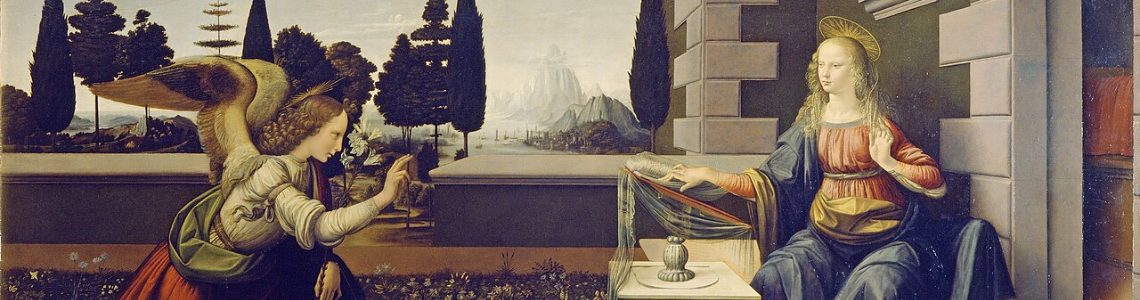
In Luke’s account, the angel Gabriel tells Mary that she will bear a son named Jesus. The scene, known as the Annunciation, brings together surprise, questioning and a willing response to an extraordinary calling.
“Behold the handmaid of the Lord; be it unto me according to thy word.” (Luke 1:38, KJV)
For many Christians, this response expresses trust rather than certainty about everything that lies ahead. It is one reason the Annunciation has inspired so much painting, prayer and reflection.
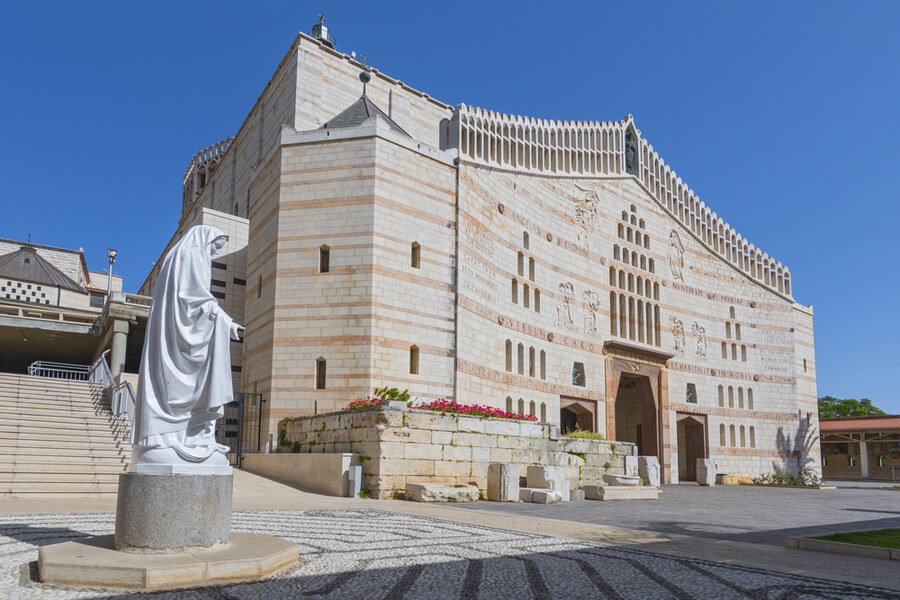
The Basilica of the Annunciation in Nazareth preserves the Catholic tradition associated with the event. Its grotto is venerated as part of Mary’s home. That identification belongs to the site’s religious tradition; Luke names Nazareth but does not identify the precise building visitors see today.
Looking at the basilica’s depictions of Mary from different countries adds another layer to a visit. A story rooted in a Galilean town has been interpreted through the artistic language of Christian communities around the world.
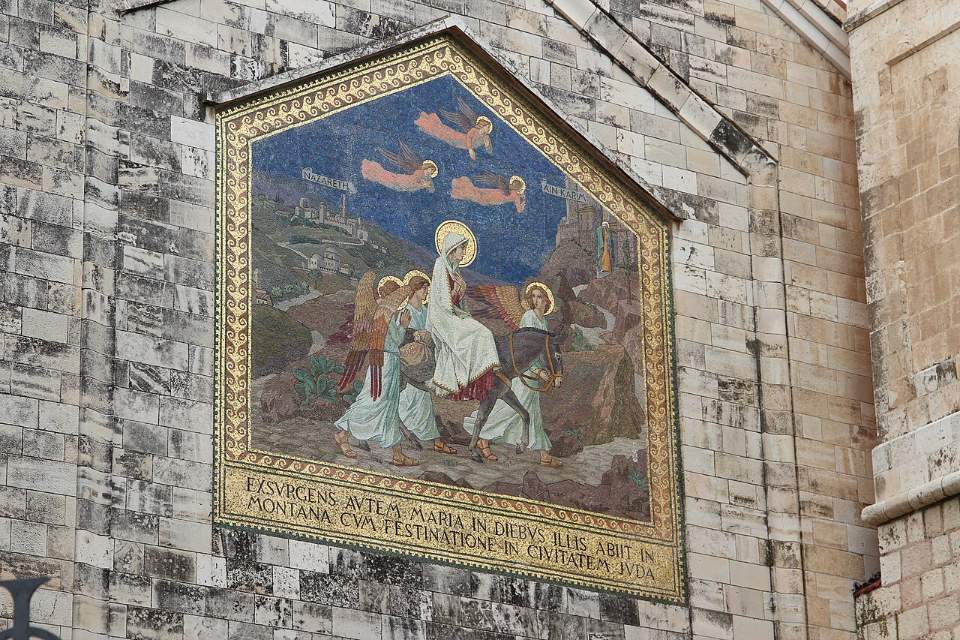
After the Annunciation, Luke describes Mary traveling to the hill country of Judea to visit Elizabeth, who is expecting John the Baptist. Their meeting becomes a scene of recognition and joy, followed by Mary’s song of praise, the Magnificat (Luke 1:39–56).
“My soul doth magnify the Lord,” (Luke 1:46, KJV)
Christian tradition identifies Ein Karem, now a neighborhood of Jerusalem, with the Visitation. Luke describes a town in the hill country but does not name Ein Karem. The distinction allows visitors to appreciate both the biblical account and the long history of devotion attached to the place.
At the Church of the Visitation, the Magnificat displayed in different languages gives the story a visible, international presence. Take time to read a version you recognize before turning back toward the church and the surrounding hills.
Luke’s narrative takes Mary and Joseph from Nazareth to Bethlehem, where Jesus is born. The account focuses on simple, intimate actions rather than royal surroundings.
“And she brought forth her firstborn son, and wrapped him in swaddling clothes, and laid him in a manger;” (Luke 2:7, KJV)
Mary appears here as a mother caring for her newborn. Later in the chapter, Luke describes her remembering and reflecting on the events surrounding the birth. That quieter portrait stands behind many familiar images of Mary holding the infant Jesus.
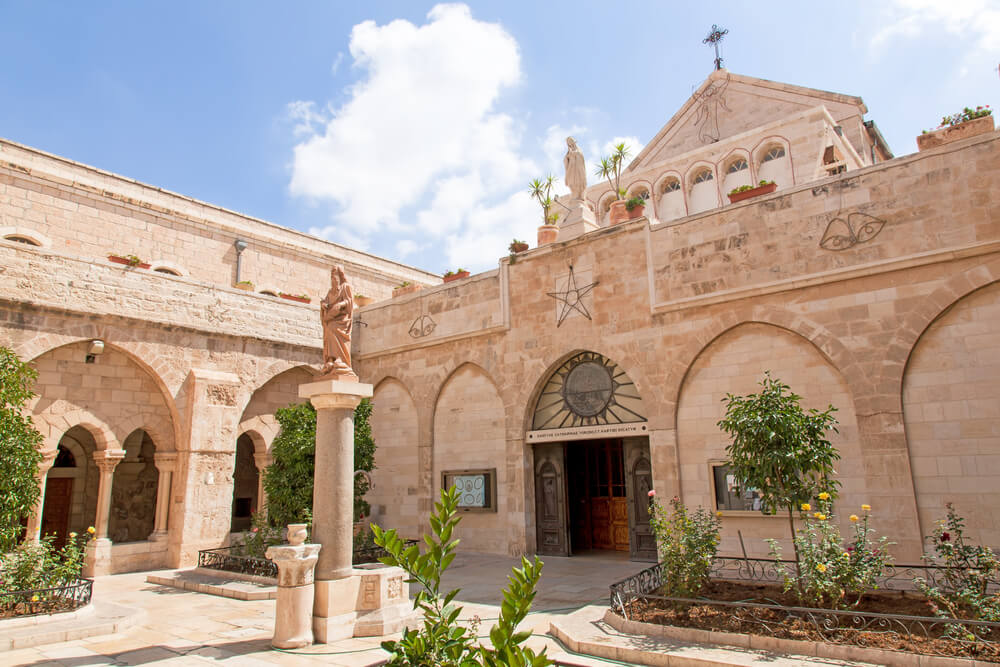
The Church of the Nativity commemorates the birth through an ancient Christian tradition centered on the grotto beneath the church. Matthew also places Jesus’ birth in Bethlehem and recounts the family fleeing to Egypt before settling in Nazareth. The Gospel accounts should be read in their own terms rather than forced into a modern diary with every movement precisely dated.
The New Testament does not state Mary’s age when she gave birth to Jesus. Claims that she was a particular age are estimates or later interpretations, not a number recorded in the Gospels.
Historical discussion sometimes draws on marriage practices in the ancient world, but general customs cannot establish one individual’s exact age. The most accurate answer is that her age is unknown. That uncertainty does not diminish her importance in the biblical story.
At the wedding in Cana, John describes Jesus’ mother drawing attention to the lack of wine and speaking to the servants before Jesus turns water into wine (John 2:1–11).
“Whatsoever he saith unto you, do it.” (John 2:5, KJV)
The words are brief, but they give Mary an active place in the narrative. For Christian readers, the scene has become an important expression of her relationship with Jesus and her trust in him.
John later places her beside the cross. Jesus addresses his mother and the disciple he loves, entrusting them to one another (John 19:25–27). The passage brings the story from a wedding celebration to suffering and care at the end of Jesus’ life.
The New Testament also remembers Mary beyond the Crucifixion. Acts 1:14 names her among those gathered in prayer after the Ascension. Her appearances are relatively few, but they connect several of the defining moments in the Christian narrative.
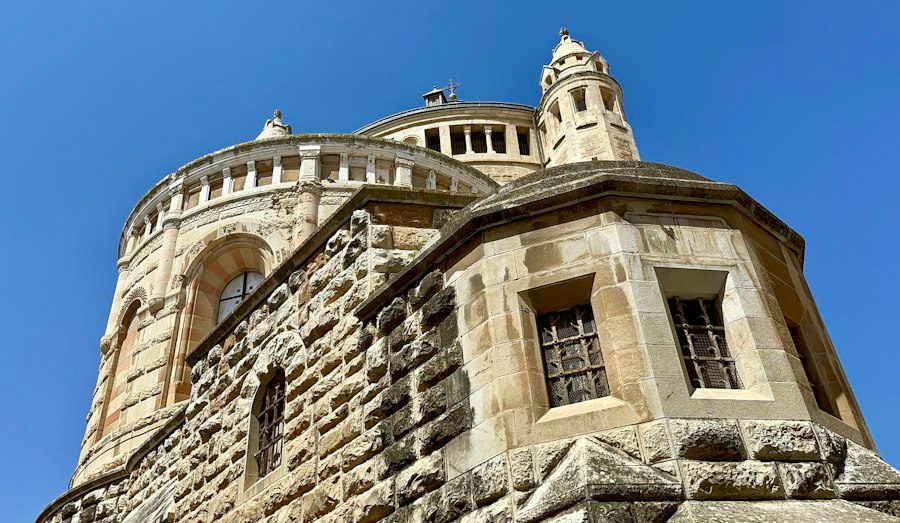
The New Testament does not describe Mary’s death, give her age at death or identify a burial place. Accounts of her final years belong to later traditions, which developed differently across Christian communities.
Two Jerusalem sites help visitors understand those traditions. Dormition Abbey on Mount Zion commemorates Mary’s “falling asleep.” The Tomb of Mary near the Mount of Olives is venerated as her traditional burial place. These are distinct sites, and neither should be presented as a location identified in a New Testament account of her death.
Catholic teaching describes Mary as assumed into heavenly glory, body and soul, at the completion of her earthly life. Eastern Christian traditions place particular emphasis on the Dormition. Other Christian communities approach these beliefs differently. Explaining the traditions respectfully helps travelers understand what each church commemorates without presenting one interpretation as universal.
Mary’s story gives a personal thread to a journey through the Holy Land. Nazareth recalls the Annunciation, Ein Karem the Visitation, Bethlehem the birth of Jesus, and Jerusalem the Passion narratives and later traditions about her final days.
Allow time for the differences between these places. Some commemorate events described in Scripture; others preserve traditions that grew over centuries. Each can reveal something about the relationship between biblical narrative, belief and pilgrimage.
To explore Nazareth alongside key places connected with Jesus’ ministry, discover Bein Harim’s Nazareth and Sea of Galilee Tour. Check the current itinerary when planning your visit. Understanding Mary’s place in the story makes the churches more than landmarks: they become places to read, look closely and reflect.
Tours You May Like
Join Us
Keep in Touch


 Login / Register
 Contact


 Certificate of Excellence
 Guaranteed Departure
 Low Prices Guaranteed
 24/7 Support