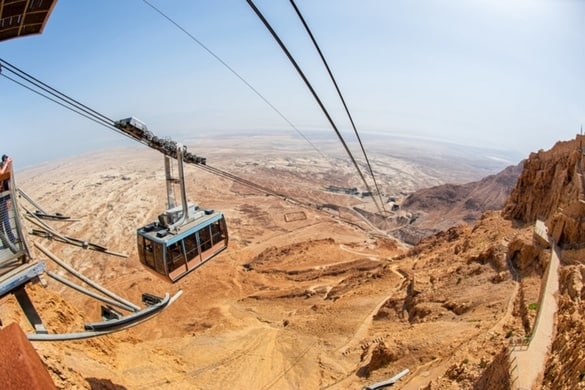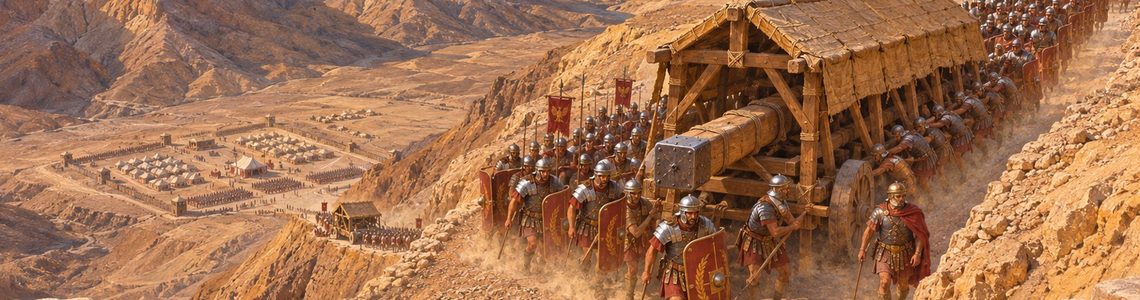
From the summit of Masada, the Roman camps still look like shapes drawn across the desert. On the western side, a great ramp climbs toward the fortress walls. These remains turn a distant historical event into something visitors can read in the landscape: an army surrounding a mountain, a community trapped above it, and a final confrontation whose story continues to provoke questions.
The siege of Masada was one of the closing episodes of the First Jewish–Roman War. Its physical traces are exceptionally well preserved, while its dramatic ending comes primarily from the historian Josephus. Understanding both makes a visit to the fortress far more meaningful.
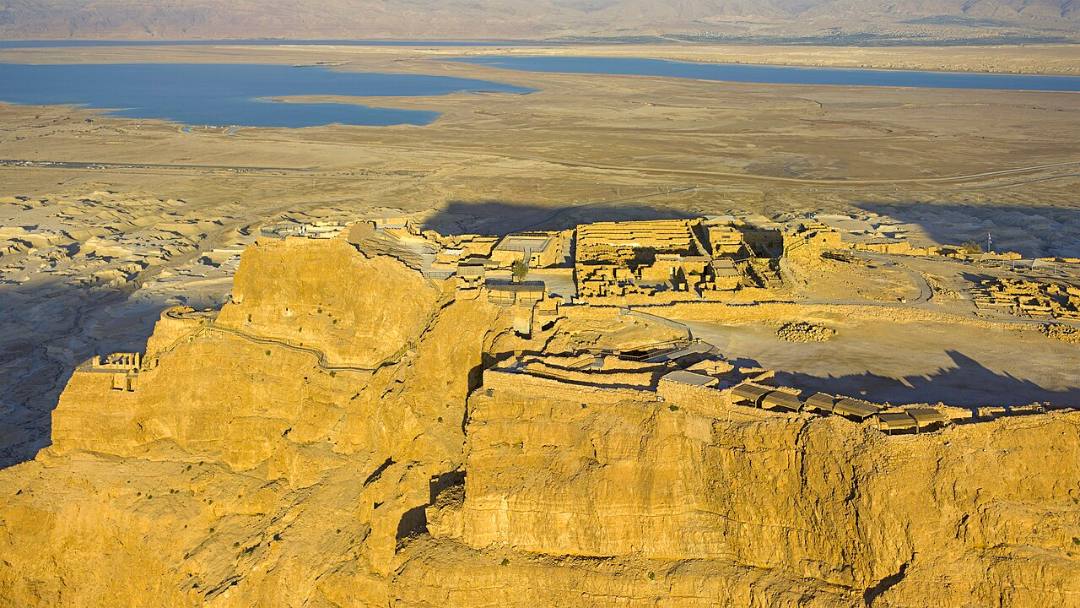
In 73 or 74 CE, Roman forces commanded by Flavius Silva besieged Masada, a desert fortress overlooking the Dead Sea. A group of Jewish rebels and their families occupied the summit. The Romans enclosed the mountain with camps and a siege wall, then constructed an assault ramp on its western side.
According to Josephus, the defenders faced imminent capture after the Romans overcame their defenses. He describes a collective killing followed by the suicide of the last man, with two women and five children surviving in hiding. His account gives the number of those who died as 960.
That ending is central to Masada’s fame, but it should be attributed to Josephus rather than presented as something archaeology has independently established in every detail. The siege works survive; the exact circumstances of the final deaths remain debated.
The story begins before the Roman army arrived. King Herod had developed Masada into a fortified palace complex during the first century BCE. Its steep sides, substantial defenses, storerooms, and water cisterns made it a formidable refuge as well as a royal retreat.
When the revolt against Roman rule began in 66 CE, rebels seized the fortress from its Roman garrison. After Jerusalem fell and the Second Temple was destroyed in 70 CE, Masada remained outside Roman control.
For Rome, the wider campaign was not complete simply because Jerusalem had fallen. Remaining centers of resistance still challenged imperial authority. Masada’s capture belonged to that effort to consolidate control, although researchers continue to investigate why this remote stronghold warranted such a substantial operation.
Josephus identifies Eleazar ben Yair as the leader of the group at Masada. He associates the defenders with the Sicarii, a militant Jewish faction whose name derives from a type of dagger.
They are often called “Zealots” in popular accounts, but that broad label can blur distinctions among the groups involved in the revolt. The community on the mountain also included women and children, so it should not be imagined as a garrison made up entirely of fighters.
Masada’s inhabitants adapted Herod’s buildings for their own needs. Domestic spaces and religious life existed alongside the defenses. The archaeological remains therefore reveal a community living through conflict, not simply a battlefield.
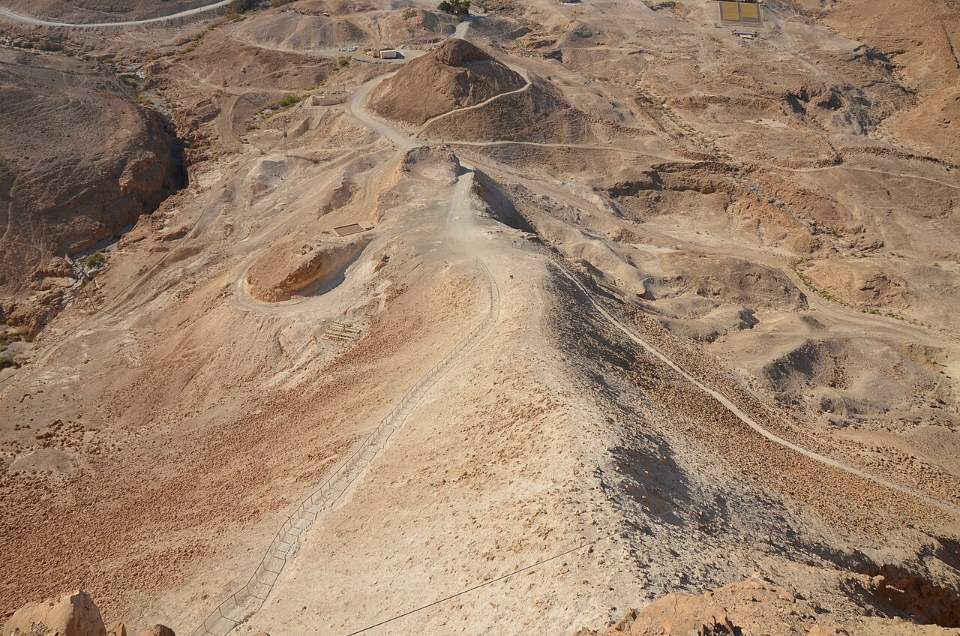
Masada’s cliffs offered protection, but the Roman army approached the problem systematically. The remains of eight camps and a surrounding siege wall show how it established a military presence around the fortress and restricted movement.
The western side provided the best approach for an assault. There, a natural spur reduced the height the Romans needed to overcome. The ramp incorporated that existing landform rather than rising from the desert floor as an entirely artificial mountain.
Josephus describes the Romans bringing siege equipment toward the walls along this approach. A tower and battering ram formed part of the operation. In his narrative, the defenders built an additional barrier of timber and earth after the outer defenses were breached, and the Romans attacked it with fire.
Looking down from the summit helps explain the engineering more clearly than a photograph alone. The ramp, the cliff, and the surviving camp outlines belong to a single military landscape. UNESCO recognizes the exceptional completeness of Masada’s Roman siege works.
It is worth separating these remains from Herod’s construction. The palaces and much of the summit’s infrastructure predate the siege by roughly a century. The Roman encampments and assault works belong to the later campaign against the rebels.
Masada remained in rebel hands for years, but that does not mean the Romans besieged it throughout that period. The time between Jerusalem’s fall and Masada’s capture is often confused with the duration of the actual siege.
A study published in the Journal of Roman Archaeology in 2024 used surveying and three-dimensional modeling to analyze the Roman siege system. Its authors estimated that building the wall and camps required about two weeks, based on their calculations of the work involved and the available workforce.
The researchers argued for a siege lasting several weeks rather than several years. This is an evidence-based reconstruction, not a surviving Roman timetable. The estimate for the wall and camps should also not be repeated as proof that every element, including the assault ramp, was completed in exactly two weeks.
The capture is commonly dated to 73 CE, while some scholarly chronologies place it in 74 CE. Giving the date as 73 or 74 CE acknowledges that uncertainty without distracting from the sequence of events.
Josephus provides the only surviving detailed ancient narrative of Masada’s fall. In The Jewish War, Book VII, he presents Eleazar urging the community to choose death over enslavement.
In William Whiston’s translation, Josephus has Eleazar say:
“Let us die before we become slaves under our enemies:” (Josephus, The Jewish War, Book VII, Chapter 8, Whiston translation)
This is a speech transmitted through Josephus’ writing, not a verbatim transcript. Josephus was not an eyewitness to the final scene, and ancient historians often composed speeches to express what they considered a speaker’s position.
His account describes men killing their families, ten men selected by lot to kill the others, and a final man who killed the remaining nine before taking his own life. The familiar expression “mass suicide” therefore simplifies a narrative that also describes the killing of others.
Josephus says two women and five children escaped the deaths by hiding and later emerged. We should neither omit these survivors nor turn their reported testimony into independent confirmation of every detail in his story.
It is a tragic account involving an entire community. Telling it respectfully means avoiding graphic detail and allowing space for the human cost, even when discussing Masada’s later symbolism.
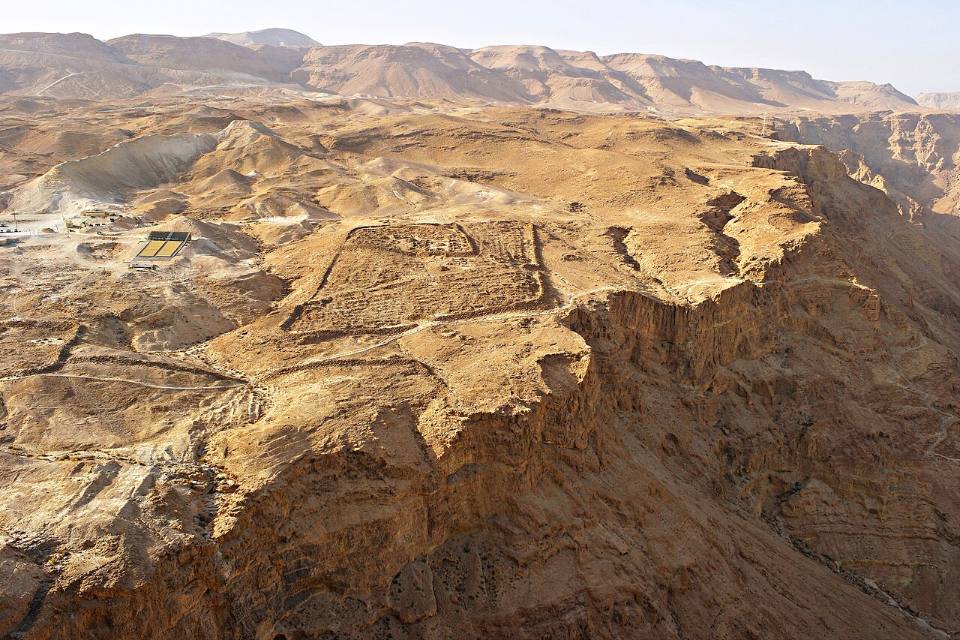
Archaeology provides compelling evidence for Roman military activity around Masada. The camps, wall, ramp, and finds associated with the conflict help researchers reconstruct how the siege operated.
Excavations on the summit also illuminate the lives of its inhabitants through buildings, everyday objects, and written material. Together, these discoveries allow historians to test aspects of the literary account against physical evidence.
They do not settle every question about the final night. Inscribed pottery fragments, sometimes linked to Josephus’ account of drawing lots, do not by themselves prove that interpretation. Nor has the reported number and sequence of deaths been conclusively demonstrated.
Masada’s historical importance survives these uncertainties. In modern Jewish and Israeli memory, it became a powerful symbol of resistance, independence, and the consequences of defeat. Its archaeological significance also extends beyond that symbolism: visitors can encounter the remains of the besieged community and the besieging army in the same landscape.
At Masada Fortress, look beyond the palace ruins. The western approach explains the Roman assault, while the camp outlines below reveal how thoroughly the mountain was surrounded. Storerooms, cisterns, and adapted living spaces help tell the story of those inside.
A guided visit brings these features together, helping you distinguish Herod’s royal retreat from the later rebel occupation and Roman siege.
Our Masada and Dead Sea Day Tour combines a visit to the fortress, reached by cable car, with time at the Dead Sea. It is a rewarding way to connect the history with the striking desert landscape. The itinerary does not include a walk through the Roman camps or an ascent along the western ramp.
Explore our Masada tours to find a suitable option. Interested in a visit focused on archaeology or Jewish history? Contact us to discuss your Holy Land journey.
Join Us
Keep in Touch


 Login / Register
 Contact


 Certificate of Excellence
 Guaranteed Departure
 Low Prices Guaranteed
 24/7 Support