Blessed are the peacemakers. Love your enemies. Treat others as you would want them to treat you. Some of Jesus’ most familiar teachings belong to a single passage in Matthew’s Gospel: the Sermon on the Mount. Read together, they form a challenging vision of life shaped by mercy, sincerity, and trust in God. In Galilee, the hillside traditionally associated with the sermon brings these words into a landscape visitors can still experience.
The Sermon on the Mount is an extended collection of Jesus’ teachings recorded in Matthew chapters 5, 6, and 7. It begins with the Beatitudes and includes the Lord’s Prayer, teachings about forgiveness and generosity, the Golden Rule, and the story of the wise and foolish builders.
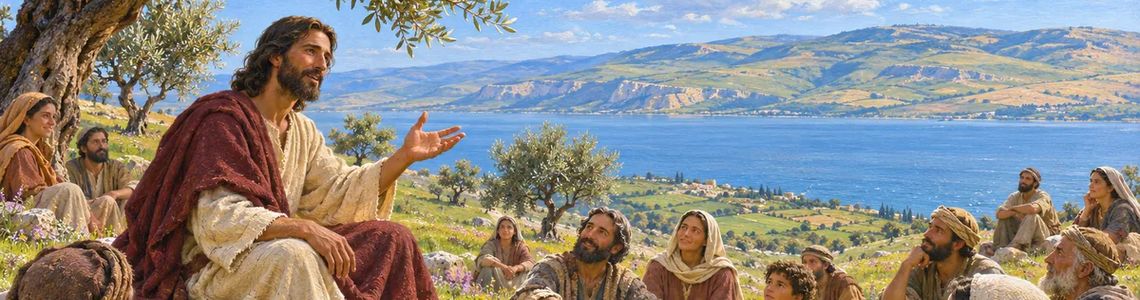
Matthew sets the scene during Jesus’ ministry in Galilee. Seeing the crowds, Jesus goes up a mountain, sits down, and begins teaching as his disciples approach. At the end of the sermon, the crowds are astonished by the authority of his words (Matthew 7:28–29).
The address moves from the character of those called blessed to practical questions about anger, prayer, money, anxiety, and relationships. Its images are memorable, but its demands reach beyond memorable sayings. Jesus repeatedly asks his listeners to connect what they believe with how they live.
When was the Sermon on the Mount? Matthew places it in Jesus’ Galilean ministry, but gives no exact date. The Gospel’s sequence provides a narrative setting rather than a calendar day or a reliably identifiable year.

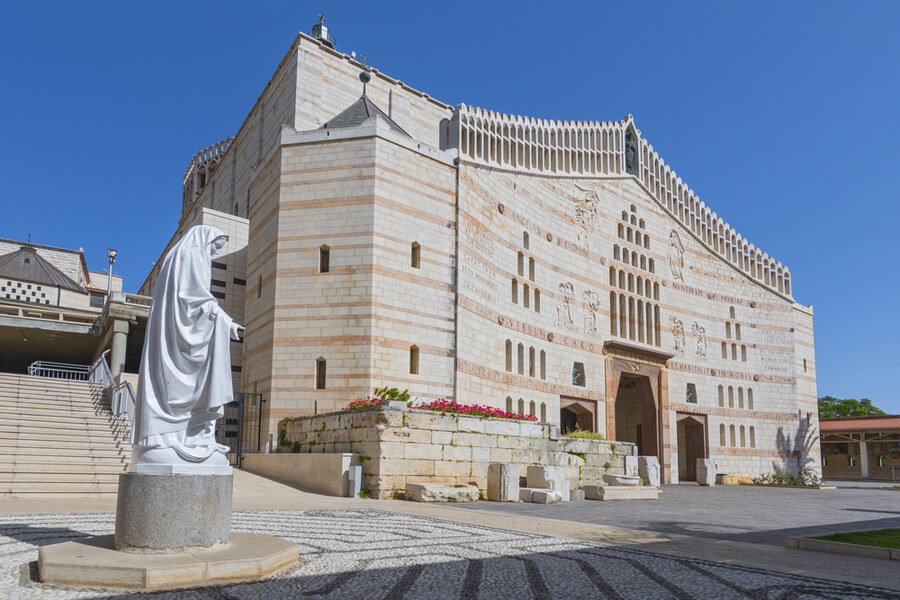
The traditional location is the Mount of Beatitudes, a hillside overlooking the northwestern shore of the Sea of Galilee, near Tabgha and Capernaum. Its church and gardens commemorate the teaching that gives the place its name.
Matthew describes a mountain without naming it. The modern pilgrimage site therefore preserves a Christian tradition rather than a proven identification of the exact spot where Jesus sat. That distinction leaves room to appreciate both the biblical account and the history of devotion surrounding it.
The setting offers a useful perspective on the sermon’s language. Hills, plants, birds, houses, and changing weather belong to the world of its illustrations. Looking across Galilee helps readers picture that world, even when the precise location of an individual teaching cannot be established.
Matthew 5 opens with blessings and turns to the life expected of Jesus’ followers. Chapter 6 examines religious practice, possessions, and trust. Chapter 7 addresses judgment, prayer, discernment, and the need to put teaching into action. The following themes trace that movement through the sermon.
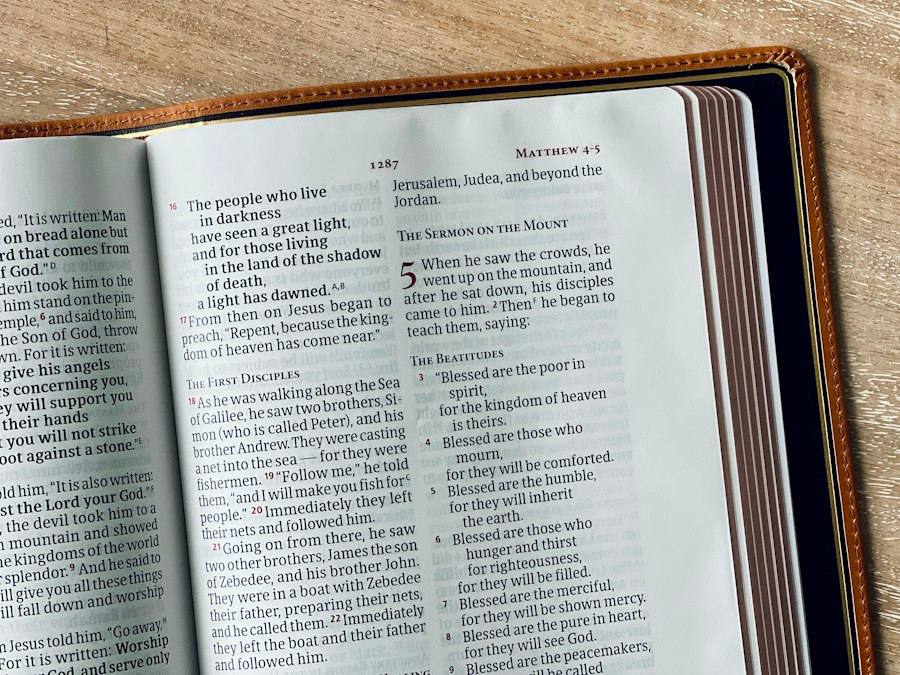
The Beatitudes are the blessings that open the sermon. They draw attention to people whose circumstances or qualities might not ordinarily be associated with success: those who mourn, the meek, the merciful, and people persecuted for righteousness.
“Blessed are the peacemakers: for they shall be called the children of God.” (Matthew 5:9, KJV)
Matthew 5:3–10 is commonly arranged as eight Beatitudes. Verses 11–12 continue with a blessing addressed directly to those who suffer because of Jesus, which explains why some lists count them differently.
The eight Beatitudes in Matthew 5:3–10, summarized
| Those called blessed | The promise | Verse |
| The poor in spirit | The kingdom of heaven | 5:3 |
| Those who mourn | Comfort | 5:4 |
| The meek | Inheriting the earth | 5:5 |
| Those who hunger and thirst for righteousness | Being filled | 5:6 |
| The merciful | Receiving mercy | 5:7 |
| The pure in heart | Seeing God | 5:8 |
| The peacemakers | Being called God’s children | 5:9 |
| Those persecuted for righteousness | The kingdom of heaven | 5:10 |
These blessings are not a celebration of suffering for its own sake. In Christian interpretation, they announce God’s care and the values of his kingdom, challenging familiar assumptions about power, status, and whose lives matter.
Jesus then calls his followers the salt of the earth and the light of the world (Matthew 5:13–16). The language moves from receiving blessing to living with responsibility toward others.
A lamp is meant to give light, and a city on a hill cannot remain hidden. The point is not self-promotion. Jesus says that people should see good works and glorify the Father. This distinction becomes especially important when chapter 6 warns against performing religious acts simply to win an audience’s approval.
Before addressing particular behaviors, Jesus states that he has come to fulfill the Law and the Prophets, not abolish them (Matthew 5:17). The sermon belongs within his Jewish setting and engagement with Scripture.
The teaching then moves beyond outward compliance into motives and relationships. Avoiding murder is not the end of responsibility when anger and contempt remain unchecked. Reconciliation is urgent enough that a person bringing an offering is told first to make peace with an offended brother. The chapter also addresses lust, marriage, truthful speech, and retaliation.
The challenge culminates in love for enemies:
“Love your enemies, bless them that curse you, do good to them that hate you, and pray for them which despitefully use you, and persecute you.” (Matthew 5:44, KJV)
Jesus connects this love with the Father’s generosity, describing sun and rain given to the just and unjust alike. The call reaches beyond kindness exchanged between friends to a generosity that does not depend on being repaid.
Matthew 6 turns to giving, prayer, and fasting. In each case, Jesus warns against making devotion a performance. The concern is the intention behind the practice: seeking God rather than admiration.
Within this teaching comes the Lord’s Prayer (Matthew 6:9–13). It begins by addressing the Father and turns toward the holiness of God’s name, the coming kingdom, and God’s will. It also asks for daily bread, forgiveness, and deliverance from evil.
“Thy kingdom come, Thy will be done in earth, as it is in heaven.” (Matthew 6:10, KJV)
The prayer brings daily needs and spiritual commitments together. Forgiveness is not left as an abstract idea: immediately afterward, Jesus emphasizes forgiving others. Prayer and relationships are closely connected throughout the passage.
Jesus asks his listeners to consider where they store their treasure and what commands their loyalty. Possessions are vulnerable to loss, and a life directed entirely by wealth places the heart in a fragile position. Matthew 6:24 states the conflict plainly: a person cannot serve both God and wealth.
The next section turns to worry about food, drink, and clothing. Jesus points to birds and the lilies of the field, using ordinary sights to speak about the Father’s care. The invitation is to seek God’s kingdom and righteousness rather than allow anxiety about tomorrow to dominate today.
Read within the sermon, this teaching directs attention toward trust and priorities. It does not make hunger or hardship unreal. Daily bread has just been included among the needs for which Jesus teaches his followers to pray.
Matthew 7 begins with a warning about judging others and the image of someone noticing a tiny speck in another person’s eye while ignoring a beam in their own. Jesus directs attention first toward honest self-examination.
The chapter also calls for discernment, including recognizing false prophets by their fruits. Its warning against judgment therefore sits alongside a responsibility to distinguish between words and conduct.
The Golden Rule offers a practical expression of the sermon’s concern for others:
“Therefore all things whatsoever ye would that men should do to you, do ye even so to them: for this is the law and the prophets.” (Matthew 7:12, KJV)
The instruction is active. It asks listeners to take the consideration they hope to receive and extend it to someone else.
The sermon ends with two builders (Matthew 7:24–27). One builds on rock; the other builds on sand. Rain falls, floods rise, and winds strike both houses, but only the house with a secure foundation stands.
Jesus compares the wise builder with someone who hears his words and acts on them. The foolish builder also hears, but does not act. The difference is not access to the teaching. It is the response.
This closing image gives the entire sermon its direction. Admiring the Beatitudes or remembering a phrase about kindness is only a beginning. The teaching calls for a life built through practice.
The Sermon on the Mount describes life oriented toward God’s kingdom, expressed through the intentions of the heart and everyday actions. Mercy, reconciliation, sincerity, generosity, and trust belong together.
Its structure matters. The opening blessings challenge assumptions about who is favored. The central teaching examines relationships, worship, and priorities. The final warnings ask listeners to choose how they will live.
Christian traditions differ in how they explain and apply some of its demands, but the sermon’s repeated movement from hearing to doing is unmistakable. Its lasting influence comes partly from the directness with which familiar situations become questions of faith: an argument, a gift, a prayer, a worry, or an encounter with someone difficult to love.
Luke 6:17–49 contains a related address often called the Sermon on the Plain. Luke places Jesus on a level place and includes blessings, warnings, love for enemies, teaching about judgment, and a story about building on a firm foundation.
The accounts have important differences. Luke’s blessings are accompanied by woes, and his address is shorter than Matthew’s three-chapter sermon. The Lord’s Prayer appears elsewhere in Luke, in chapter 11.
Christians and scholars interpret the relationship between these passages in different ways. Some understand them as accounts of the same occasion; others see related teachings delivered on different occasions or arranged differently by the Gospel writers. Matthew’s sermon can be read on its own terms without forcing every detail into a single reconstructed event.

At the Mount of Beatitudes, gardens and views across the Sea of Galilee offer space to reflect on the teachings associated with this hillside. The church commemorates the Beatitudes, while the surrounding landscape places the sermon within the region where Jesus taught and gathered followers.
A visit can form part of a wider exploration of Galilee’s Christian heritage, including places associated with Jesus’ ministry around the lake. Reading a few verses before arriving can make the experience more personal, whether your interest is pilgrimage, biblical history, or understanding the setting of the Gospels.
Explore our Galilee tours to find an itinerary that connects the region’s sacred places and landscapes. Routes vary, so check the included stops and let us know if visiting the Mount of Beatitudes is a priority for you.
Tours You May Like
Join Us
Keep in Touch


 Login / Register
 Contact


 Certificate of Excellence
 Guaranteed Departure
 Low Prices Guaranteed
 24/7 Support