 Login / Register
 Contact
The Ark of the Covenant: What It Was and Where It Is Today
A gold-covered chest crosses a river ahead of a nation, falls into enemy hands, and enters Jerusalem amid music and dancing. Then, somewhere between the world of the biblical kings and the destruction of their Temple, its trail becomes uncertain. The Ark of the Covenant has inspired faith and speculation for centuries. Its story also follows a landscape you can still explore today.
In the Bible, the Ark of the Covenant is a sacred chest associated with God’s covenant with Israel and the tablets of the Ten Commandments. Its present location is unknown: no object has been independently authenticated as the biblical Ark. Yet the places connected with its journey, from the Jordan Valley to the hills around Jerusalem, offer a way to understand the story beyond the mystery of its disappearance.
What Was the Ark of the Covenant?
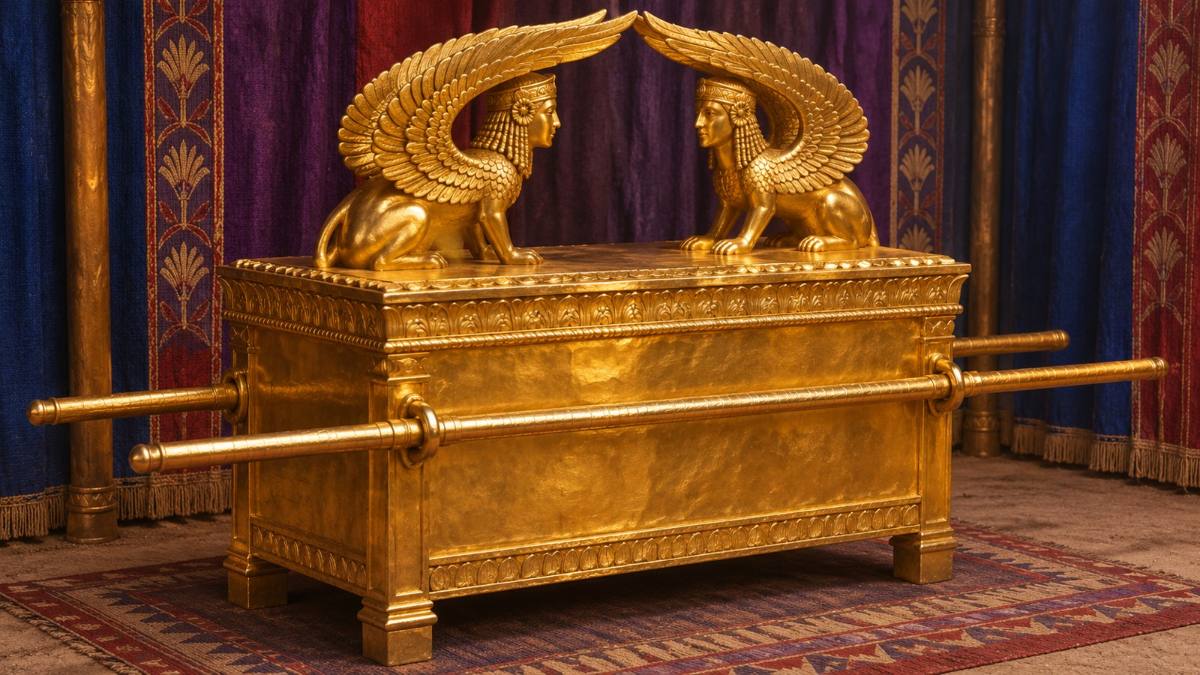
The Ark of the Covenant in the Tabernacle (AI illustration)
The Ark was the most sacred furnishing of the Tabernacle, the portable sanctuary described in Exodus. It belonged to the inner sanctuary, screened from the rest of the tent by a veil. Later, according to 1 Kings, Solomon placed it in the Holy of Holies of the Temple in Jerusalem.
Its name points to the covenant, the relationship between God and Israel expressed through the commandments. The Ark held the stone tablets and was associated with divine presence and communication. Exodus describes God speaking to Moses from above its cover, between two golden cherubim. This explains why the biblical accounts treat carrying, approaching, and housing the Ark as matters of profound consequence.
The stories also resist treating it as a guarantee of success. In 1 Samuel, bringing the Ark onto a battlefield does not prevent defeat. Its significance rests in the covenant and the holiness it represents, rather than in the idea of a portable weapon.
It is also different from Noah’s ark. Noah’s ark is the vessel in the Flood narrative; the Ark of the Covenant is a chest carried on poles. The English word “ark” can obscure that distinction, but the objects have separate stories and purposes.
Who Built the Ark of the Covenant?
Exodus 25 gives Moses instructions for making the Ark. Exodus 31 identifies Bezalel, assisted by Oholiab and other skilled workers, as an artisan chosen for the sanctuary’s construction. Exodus 37 specifically credits Bezalel with making the Ark.
So Moses and Bezalel have different roles in the account: Moses receives and communicates the instructions, while Bezalel makes the chest. The surrounding chapters describe craftsmanship in wood, metal, textiles, and precious materials. The Ark belongs within that larger account of a community building its sanctuary.
What Did the Ark Look Like?
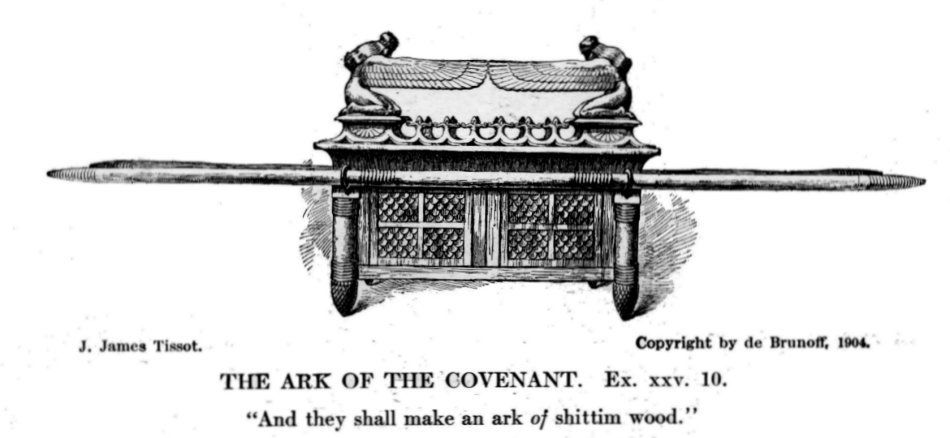
The Ark of the Covenant by James Tissot (Photo: J. James Tissot, Public domain, via Wikimedia Commons)
According to Exodus 25 and 37, the Ark was made from acacia wood, overlaid inside and outside with gold. Gold-covered wooden poles passed through rings at its sides so it could be carried. The poles were to remain in the rings.
The stated dimensions are two and a half cubits long, one and a half cubits wide, and one and a half cubits high. Using an approximate cubit of 18 inches gives a chest about 45 inches long and 27 inches wide and high, or roughly 114 by 69 by 69 centimeters. Ancient cubits varied, so these are illustrative conversions, not exact measurements.
Its gold cover is called the kapporet, often translated as the “mercy seat” in English Bibles. This was not a chair in the ordinary sense. Two golden cherubim faced one another above it, their wings spread over the cover. The term connects the Ark with atonement and divine presence.
“And there I will meet with thee, and I will commune with thee from above the mercy seat.” (Exodus 25:22, KJV)
Illustrations inevitably add choices about details the text does not fully specify, including the appearance of the cherubim. Any modern reconstruction should therefore be understood as an interpretation of the description.
What Was Inside the Ark of the Covenant?
The stone tablets are central to the biblical descriptions. Deuteronomy 10 connects their placement in the Ark with Moses’ return from the mountain. When the Ark enters Solomon’s Temple, 1 Kings makes a particularly specific statement:
“There was nothing in the ark save the two tables of stone.” (1 Kings 8:9, KJV)
Hebrews 9:4, in the New Testament, describes the Ark in connection with a golden jar of manna, Aaron’s staff that budded, and the tablets of the covenant. These objects recall different experiences of Israel in the wilderness: food provided during the journey, priestly authority, and the covenant itself.
The earlier passages about preserving manna and Aaron’s staff describe them being kept before the Lord or before the testimony (Exodus 16:32–34; Numbers 17:10 in many English editions). The descriptions should not be flattened into one inventory that was necessarily unchanged throughout the Ark’s history. First Kings describes its contents at the Temple dedication; Hebrews presents the sanctuary and its sacred furnishings in a later theological discussion.
One further distinction matters: Deuteronomy 31:26 says the book of the law is to be placed beside the Ark. It should not simply be added to the list of things inside it.
The Ark’s Journey Through the Holy Land
The Ark’s biblical journey connects wilderness worship, the entry into Canaan, the era of Samuel, and the reigns of David and Solomon. Following these episodes gives the story a geographical shape. It is a journey through the biblical narrative, rather than an archaeologically verified itinerary for a surviving object.
Crossing the Jordan and the Fall of Jericho
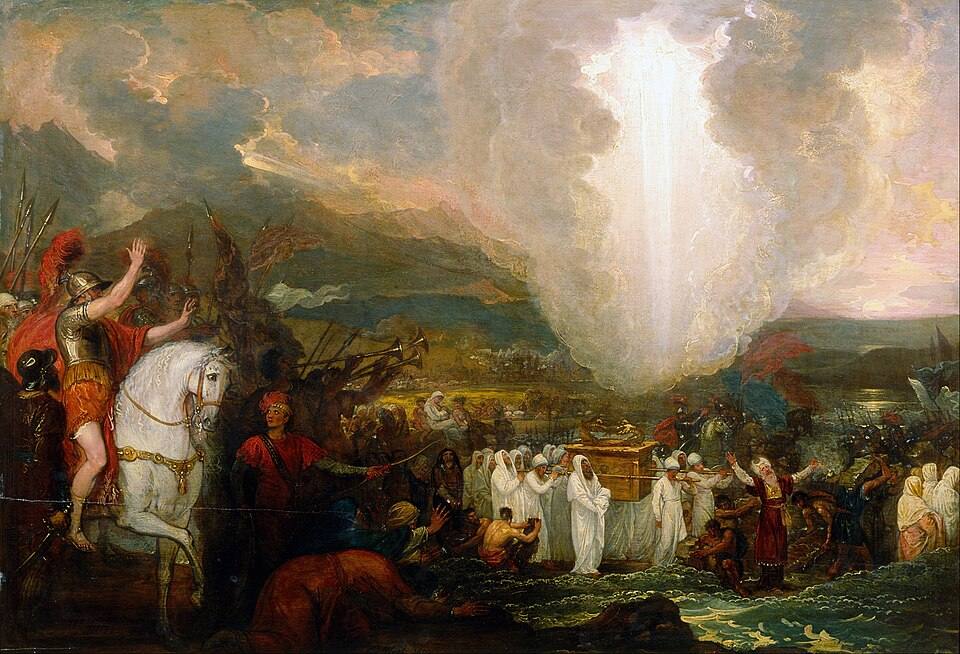
Joshua crossing the Jordan with the Ark (Photo: Benjamin West, Public domain, via Wikimedia Commons)
Joshua 3 describes priests carrying the Ark into the Jordan ahead of the people. When their feet enter the water, the river stops flowing and the Israelites cross on dry ground. The Ark remains in the riverbed while the people pass, making it central to the account of entering the land.
At Jericho, the Ark appears in another carefully ordered procession. In Joshua 6, priests with trumpets accompany it as the Israelites circle the city. On the final day, the people shout and the walls fall. The narrative presents the victory as an act of God rather than a conventional siege.
A visit to the Jordan Valley helps readers picture the river, the plain, and the approach to Jericho. It does not establish the precise crossing point, nor does the archaeology of ancient Jericho independently confirm every detail of Joshua’s account.
Shiloh, the Philistines, and the Return to Beth Shemesh
Shiloh becomes an important sanctuary in the biblical account. It is where Samuel serves under Eli, and where 1 Samuel 3 places the Ark. In the next chapter, Israelite forces bring it from Shiloh to their camp after suffering a defeat. They hope its presence will save them. Instead, the Philistines win the battle and capture it.
In Ashdod, the captured Ark is placed in the temple of Dagon. The story describes Dagon’s image falling before it and afflictions striking the population. The Ark is moved to Gath and then Ekron, where its arrival causes alarm. These episodes turn an apparent military trophy into something its captors desperately want to return.
After seven months in Philistine territory, according to 1 Samuel 6, the Ark is sent away on a cart drawn by two cows, accompanied by offerings. The animals take the road to Beth Shemesh, where people harvesting wheat see it approaching.
The return is not an uncomplicated happy ending. The chapter also describes judgment at Beth Shemesh, after which its inhabitants ask the people of Kiriath Jearim to take the Ark. The narrative repeatedly emphasizes that proximity to the sacred calls for reverence, whether among Israelites or Philistines.
Kiriath Jearim, King David, and Jerusalem
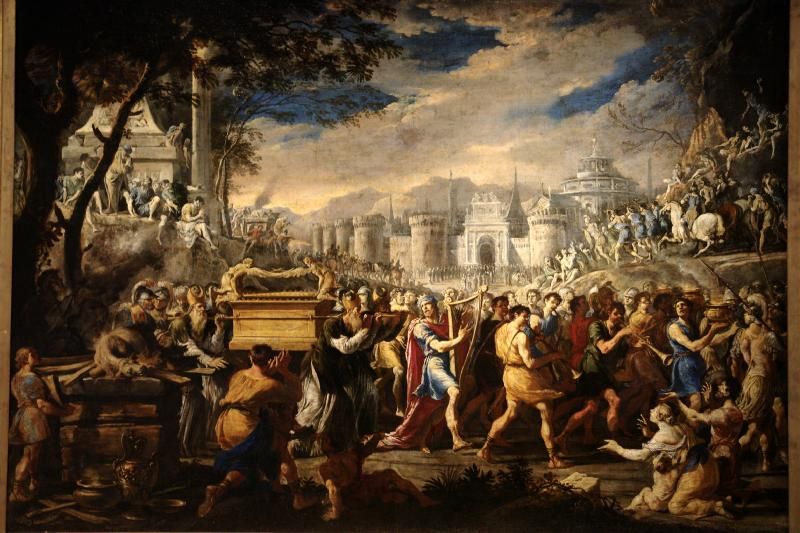
David brings the Ark to Jerusalem (Photo: Domenico Gargiulo, Public domain, via Wikimedia Commons)
At Kiriath Jearim, the Ark is taken into the house of Abinadab, and his son Eleazar is consecrated to guard it (1 Samuel 7:1). The location is generally associated with the hill above Abu Ghosh, west of Jerusalem. Excavations there contribute to discussion of the site’s history, although they have not produced the Ark itself.
Second Samuel 6 describes David’s attempt to bring it to Jerusalem. During the journey, Uzzah reaches toward it when the oxen stumble and is struck dead. David, frightened by what has happened, leaves the Ark at the house of Obed-edom for three months.
Later, David brings it into the city with celebration, dancing before the Lord. It is placed in a tent he has prepared. The story also includes Michal’s criticism of David’s behavior, making the procession a revealing episode about kingship, public devotion, and family tensions.
Solomon later transfers the Ark into the Temple’s inner sanctuary, beneath the wings of the great cherubim (1 Kings 8). These Temple cherubim belong to the surrounding sanctuary; they should not be confused with the smaller figures described on the Ark’s cover.
For travelers interested in this transition from David’s city to Solomon’s Temple, our Jerusalem tours offer different ways to explore the city’s history and sacred landscape. Compare the itineraries to choose the places and depth of explanation that suit your interests.
What Happened to the Ark of the Covenant?
The short answer is that its final fate is unknown. The Bible describes the Ark in the Temple, but does not give an unambiguous account of its destruction, removal, or permanent hiding place.
Second Chronicles 35:3 refers to the holy Ark during the reign of Josiah. The biblical accounts of the Babylonian destruction of Jerusalem and the First Temple, conventionally dated to 586 BCE, list Temple furnishings taken or destroyed without clearly explaining what happened to the Ark. That gap has generated centuries of interpretation.
Several possibilities are proposed: it may have been destroyed, taken away, or concealed before the Temple fell. None has been established conclusively. It is tempting to choose the most dramatic theory, but the surviving evidence does not permit a confident answer.
Jewish traditions include accounts of the Ark being hidden. Second Maccabees 2 describes Jeremiah concealing the tent, Ark, and incense altar in a cave on the mountain associated with Moses’ view of the land. Second Maccabees belongs to the biblical canon of some Christian traditions, but not to the Jewish Tanakh or most Protestant Bibles. Naming the source helps readers understand the status of this account.
The Ark is also distinct from the later Torah ark found in synagogues, the cabinet that houses Torah scrolls. Nor does visiting the Western Wall mean seeing a surviving wall of the First Temple’s inner sanctuary. The visible wall belongs to the retaining structure of the later Temple Mount complex.
Is the Ark of the Covenant in Ethiopia?
Ethiopian Orthodox tradition holds that the Ark is preserved in Aksum, in a chapel associated with the Church of Our Lady Mary of Zion. The wider tradition connects its arrival with Menelik, the son of Solomon and the Queen of Sheba in the Ethiopian royal narrative.
This belief has deep significance in Ethiopian Christianity. It should be described respectfully as a living religious tradition. The object is not available for independent scholarly examination, however, so the claim has not been established through publicly verifiable archaeological evidence.
Respecting the tradition does not require presenting it as a confirmed answer to the historical question. A careful account can explain both its religious importance and the limits of what has been verified.
Has the Ark of the Covenant Been Found?
No discovery has been independently authenticated as the biblical Ark of the Covenant. Headlines sometimes describe a temple, stone, platform, or chamber as a possible clue to its whereabouts. Such finds can be worth studying without constituting the discovery of the Ark.
At sites such as Shiloh, Beth Shemesh, and Kiriath Jearim, archaeologists investigate settlement history, architecture, and religious activity. Connecting an ancient structure with a named biblical event requires additional interpretation. Excavators may also disagree about the date or function of a building.
For a visitor, this does not make the sites less interesting. They allow us to ask how ancient communities lived and worshipped, and how their landscapes relate to the texts. The strongest archaeological visit leaves room for questions rather than turning every suggestive discovery into proof.
Discover the Holy Land Places Connected with the Ark of the Covenant
You cannot visit an authenticated original Ark, but you can explore places connected with its biblical journey. Each contributes something different: a landscape, an archaeological site, or a later place of commemoration.
Jericho and the Jordan Valley provide the setting for the opening episodes in Joshua. Ancient Shiloh, in the West Bank, connects the story with the sanctuary of Eli and Samuel. Tel Beth Shemesh brings the return from Philistine territory into geographical focus. At each site, separate what the text describes from what the visible remains can demonstrate.
Kiriath Jearim, near Abu Ghosh, recalls the Ark’s stay at Abinadab’s house. The hill’s Church of Our Lady of the Ark of the Covenant is a later Christian commemoration, not a building from the Ark’s biblical period. Jerusalem connects David’s procession with the Temple tradition and offers the clearest place to bring the wider story together.
If you would like to follow several of these locations, explore our private tours in Israel and discuss a route with us. These stops are spread across different areas and should not be assumed to fit into one day. Visits to Shiloh and other locations require confirmation of current access and arrangements; they are not automatically included in a standard Jerusalem itinerary.
Tell us which parts of the story interest you most, whether biblical history, archaeology, or religious tradition. Ask about walking surfaces, steps, and the pace of the proposed day if mobility is a consideration. A well-planned visit gives you time to understand the places, rather than simply collect their names.
 Certificate of Excellence
 Guaranteed Departure
 Low Prices Guaranteed
 24/7 Support


