 Login / Register
 Contact
Why Is Jerusalem Important to Christians?
For Christians around the world, Jerusalem is far more than an ancient city. It is the setting for many of the most significant events recorded in the New Testament, including Jesus' crucifixion, burial, resurrection, and the birth of the early Church. It is also deeply connected to the Old Testament, providing the historical and spiritual foundation on which Christianity was built.
Whether you are preparing for a pilgrimage, studying the Bible, or simply seeking to understand Christianity better, Jerusalem occupies a unique place in the Christian faith. Here, biblical history, centuries of Christian tradition, and living communities of faith come together in one remarkable city.
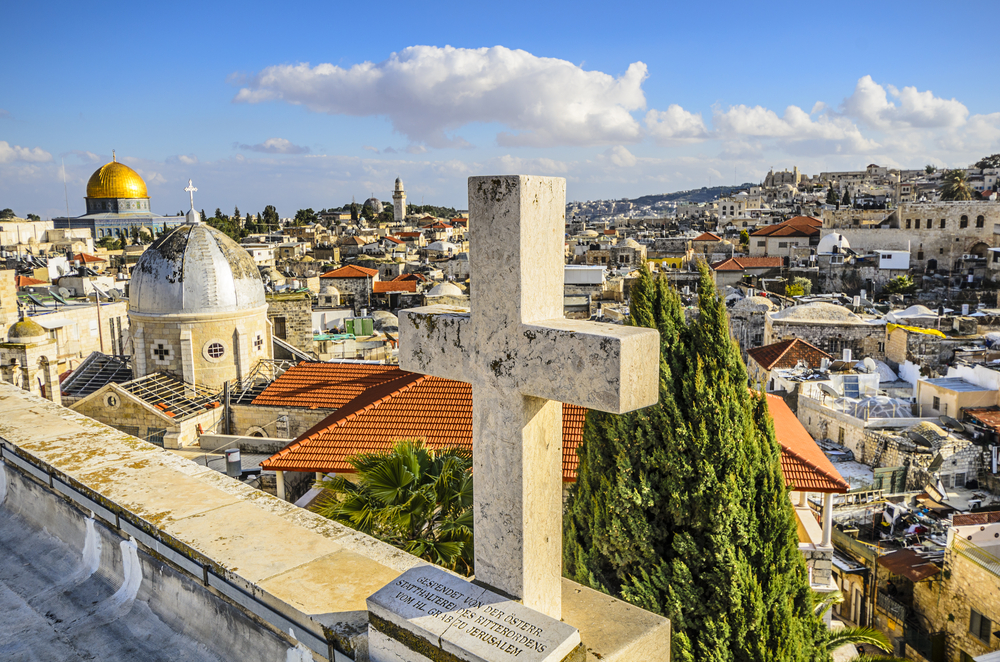
Jerusalem
Understanding why Jerusalem is important to Christians requires looking beyond a single event. Its significance unfolds throughout Scripture, beginning with Israel's history, reaching its climax during the final days of Jesus' earthly ministry, continuing through the Book of Acts, and extending to the New Jerusalem described in the Book of Revelation.
 Quick Fact: Jerusalem, alongside the Galilee, is perhaps the most central destination in Christian pilgrimage group trips to Israel.
Today, millions of Christians visit Jerusalem each year to walk where Jesus walked, pray at sites connected with His Passion and Resurrection, and deepen their understanding of the Bible. While different Christian traditions sometimes identify specific locations differently, they share a profound conviction that Jerusalem remains central to the story of salvation.
The Old Testament Foundations of Jerusalem's Importance
Although Christianity centers on the life, death, and resurrection of Jesus Christ, Jerusalem's importance begins long before the New Testament.
The city first appears in the Hebrew Bible as a place closely associated with God's covenant with His people. According to Genesis, Abraham traveled to the region of Mount Moriah, traditionally identified with Jerusalem, where God tested his faith by asking him to offer Isaac as a sacrifice (Genesis 22). For Christians, this event foreshadows God's offering of His own Son centuries later.
Jerusalem later became the political and spiritual heart of ancient Israel when King David established it as his capital (2 Samuel 5). His son Solomon built the First Temple there, making the city the center of Jewish worship and pilgrimage.
These events form an essential background to Christian belief because Jesus was born into the Jewish people, observed Jewish festivals, worshipped at the Temple, and fulfilled promises that Christians understand to have been foretold by the prophets.
As the Gospel of Matthew records, Jesus declared:
"Do not think that I have come to abolish the Law or the Prophets; I have not come to abolish them but to fulfill them." (Matthew 5:17, NIV)
For Christians, Jerusalem represents continuity between God's covenant with Israel and the message of the Gospel.
Why Is Jerusalem Important to Christians?
The simplest answer is that Jerusalem witnessed the defining events of Christianity.
Within the city and its surrounding hills, Christians believe Jesus:
- Entered Jerusalem before Passover
- Shared the Last Supper with His disciples
- Prayed in the Garden of Gethsemane
- Was arrested, tried, and sentenced
- Was crucified
- Was buried
- Rose from the dead
- Appeared to His followers after the Resurrection
- Commissioned His disciples before His Ascension nearby on the Mount of Olives
- Sent the Holy Spirit upon the disciples during Pentecost, leading to the birth of the Christian Church
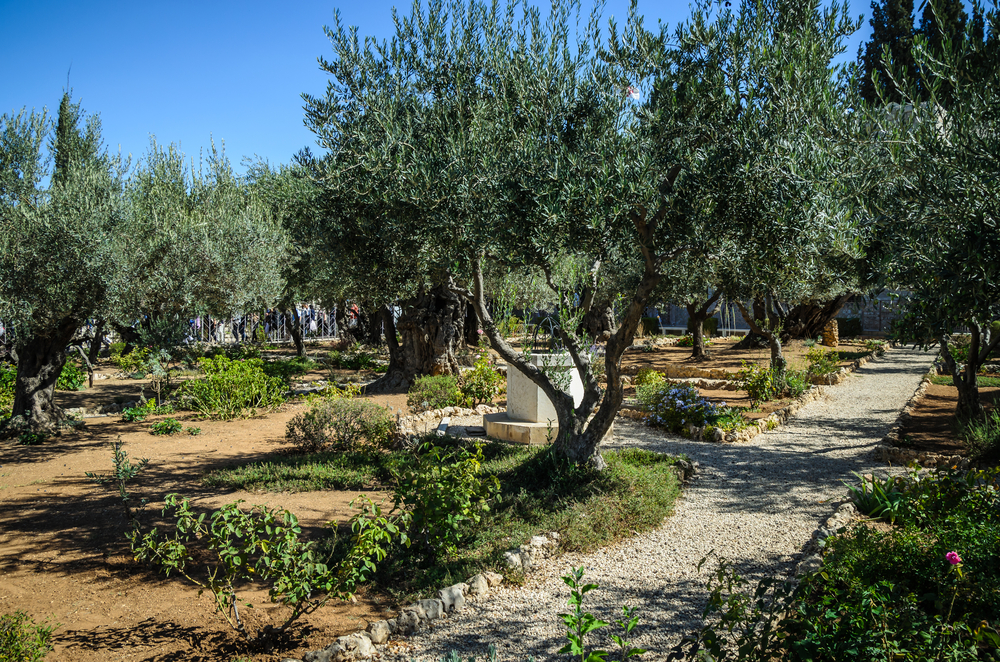
Garden of Gethsemane, Mount of Olives
No other city is connected with so many pivotal moments in the Christian faith.
Jerusalem is therefore not only historically important. It also symbolizes sacrifice, redemption, hope, and the fulfillment of God's promises.
Jerusalem During the Life and Ministry of Jesus
Jesus visited Jerusalem several times during His ministry, particularly during the major Jewish pilgrimage festivals. The Gospels describe Him teaching in the Temple courts, healing the sick, debating religious leaders, and revealing His mission more openly as His final Passover approached.
The Temple held profound significance. It was the spiritual center of Jewish worship and represented God's dwelling among His people. Jesus' actions there, including driving out the money changers (Matthew 21:12-13), demonstrated both His reverence for the Temple and His authority to call Israel back to genuine worship.
These visits also illustrate that Christianity emerged within first-century Judaism rather than apart from it. Understanding Jerusalem's role in Jewish history helps explain why the city became equally important to Christianity.
Jesus' Triumphal Entry into Jerusalem
One of the most celebrated events in the Christian calendar is Jesus' entry into Jerusalem, commemorated on Palm Sunday.
According to the Gospels, Jesus entered the city riding on a donkey while crowds spread palm branches and cloaks along the road, shouting:
"Hosanna to the Son of David! Blessed is he who comes in the name of the Lord!" (Matthew 21:9, NIV)
Christians understand this event as the fulfillment of the prophecy found in Zechariah 9:9, which describes Israel's king arriving humbly on a donkey.
Today, many pilgrims retrace this route from the Mount of Olives toward the Old City during Palm Sunday celebrations. The walk offers sweeping views of Jerusalem before descending toward the Kidron Valley and the historic city walls, helping visitors appreciate the geographical setting described in the Gospels.
The Last Supper and the Upper Room
The evening before His crucifixion, Jesus gathered with His disciples to celebrate the Passover meal.
According to the New Testament, this meal took place in an upper room in Jerusalem, traditionally associated with the Cenacle, also known as the Upper Room, located on Mount Zion.
During the meal, Jesus instituted what Christians now celebrate as Holy Communion, saying:
"Do this in remembrance of me." (Luke 22:19, NIV)
The Gospels also record Jesus washing His disciples' feet, teaching about servant leadership, and preparing them for the events that would soon unfold.
While the exact location of the Upper Room cannot be confirmed archaeologically, the Cenacle has been revered by Christians for centuries and remains an important stop on many pilgrimage itineraries.
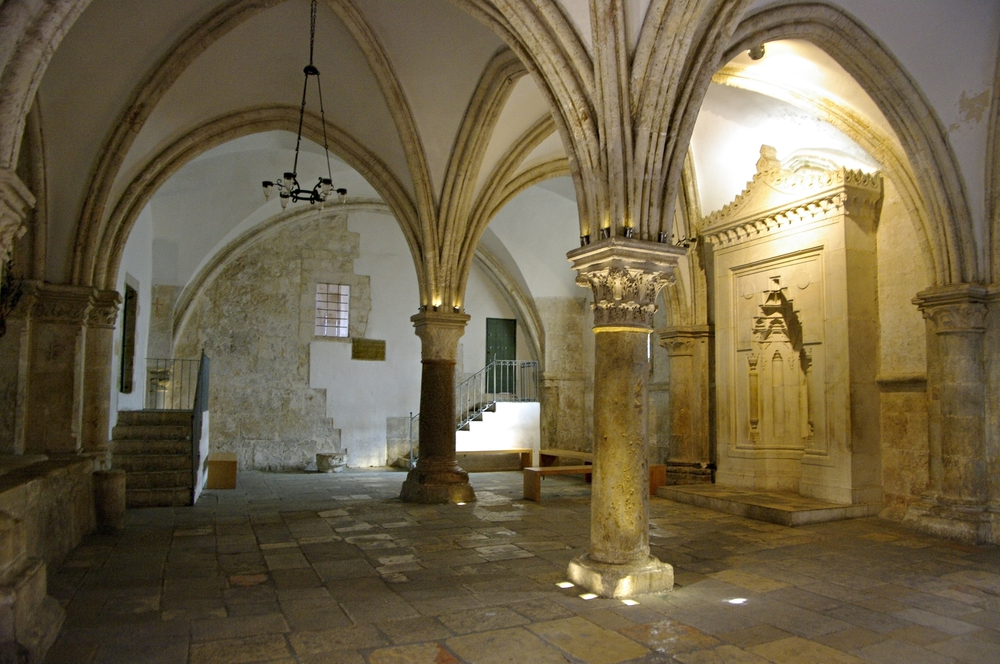
The Upper Room on Mount Zion
The Garden of Gethsemane: A Place of Prayer and Surrender
After the Last Supper, Jesus crossed the Kidron Valley to the Garden of Gethsemane on the lower slopes of the Mount of Olives.
Here, according to the Gospels, He prayed in deep anguish while His disciples struggled to remain awake.
Jesus prayed:
"Yet not as I will, but as you will." (Matthew 26:39, NIV)
For Christians, Gethsemane represents complete obedience to God's will, even in the face of suffering.
Today, pilgrims visit the peaceful olive grove beside the Church of All Nations, where ancient olive trees help create an atmosphere of reflection. Although the current trees are not old enough to date to the time of Jesus, scientific studies suggest some may descend from much older root systems, preserving the character of this sacred place.
The adjacent Church of All Nations marks the traditional site where Jesus prayed before His arrest. Its subdued interior is intentionally designed to encourage quiet meditation, making it one of Jerusalem's most meaningful places for Christian visitors.
The Arrest, Trial, and Crucifixion of Jesus
Following His prayer in Gethsemane, Jesus was arrested and brought before Jewish and Roman authorities.
According to the New Testament, He was eventually sentenced to death by crucifixion under the Roman governor Pontius Pilate.
Christians believe that Jesus willingly accepted death to reconcile humanity with God.
As John writes:
"For God so loved the world that he gave his one and only Son..." (John 3:16, NIV)
The traditional route Jesus walked carrying the cross is remembered today as the Via Dolorosa, or "Way of Suffering." Marked by fourteen Stations of the Cross, it has become one of Jerusalem's best-known pilgrimage routes.
It is important to distinguish between Scripture and later Christian tradition. The Gospels describe Jesus' journey to the place of crucifixion but do not specify every station commemorated along today's Via Dolorosa. Many stations developed through centuries of Christian devotion, helping pilgrims meditate on the events of Good Friday even where historical certainty is limited.
The journey ends at the Church of the Holy Sepulchre, revered by many Christians as the site of both Jesus' crucifixion at Golgotha and His burial.
The Church of the Holy Sepulchre: Christianity's Holiest Shrine
For many Christians, no place in Jerusalem is more significant than the Church of the Holy Sepulchre in the Christian Quarter of the Old City. Since the fourth century, it has been venerated by most Catholic, Orthodox, Oriental Orthodox, and many Protestant Christians as the traditional site of Jesus' crucifixion, burial, and resurrection.
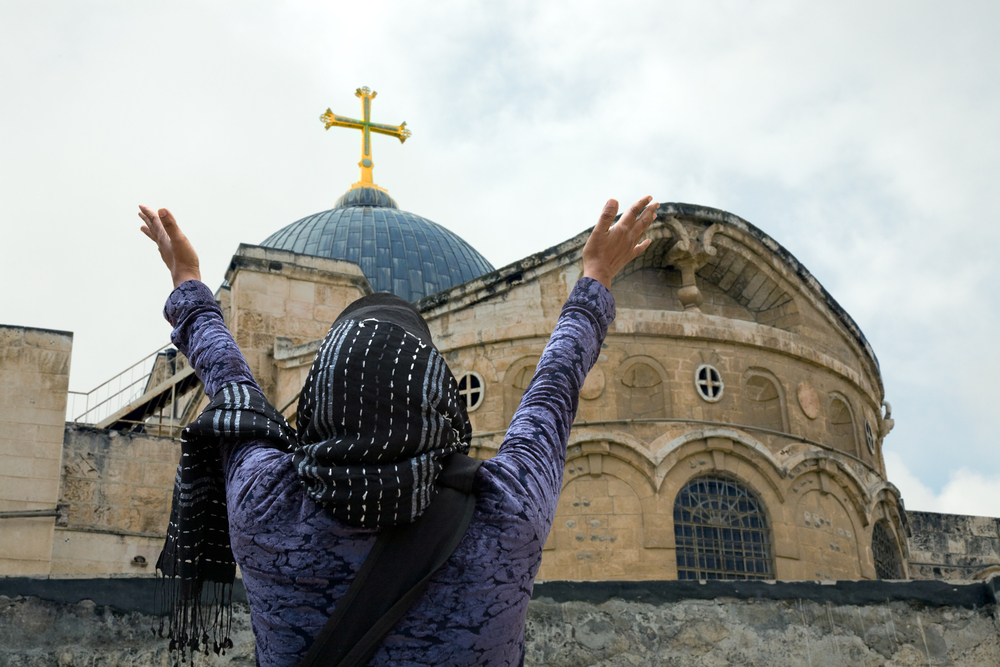
The Church of the Holy Sepulchre
According to Christian tradition, the church encompasses two of the most sacred locations in the New Testament:
- Golgotha (Calvary), where Jesus was crucified.
- The Tomb of Christ, where He was buried and from which Christians believe He rose on the third day.
The first church was commissioned by Emperor Constantine after his mother, Helena, visited the Holy Land in the fourth century. Although the building has been destroyed, rebuilt, and renovated several times over the centuries, it remains one of Christianity's most important pilgrimage destinations.
From a historical perspective, many scholars note that the area lay outside Jerusalem's city walls during the time of Jesus, consistent with the Gospel accounts (Hebrews 13:12). While archaeology cannot prove that this is the exact location of Jesus' crucifixion and burial, it supports the possibility that the site fits the biblical setting.
Today, the church is shared by several Christian communities under the long-standing Status Quo agreement, including the Greek Orthodox, Roman Catholic, Armenian Apostolic, Coptic Orthodox, Syriac Orthodox, and Ethiopian Orthodox churches. Visitors often witness different liturgies taking place throughout the day, reflecting Jerusalem's rich and diverse Christian heritage.
The Resurrection: The Foundation of Christian Faith
The importance of Jerusalem to Christianity ultimately rests on one event above all others: the Resurrection of Jesus.
All four Gospels record that on the third day after His crucifixion, women who came to Jesus' tomb found it empty. According to the Gospel of Matthew, the angel announced:
"He is not here; he has risen, just as he said." (Matthew 28:6, NIV)
For Christians, the Resurrection is not simply another biblical event. It is the cornerstone of the Christian faith, affirming Jesus' victory over sin and death and offering the promise of eternal life.
The Apostle Paul later wrote:
"And if Christ has not been raised, our preaching is useless and so is your faith." (1 Corinthians 15:14, NIV)
Because Christians believe the Resurrection took place in Jerusalem, the city has become a place of hope as much as remembrance. Pilgrims do not come only to reflect on Jesus' suffering but also to celebrate His triumph over death.
The Garden Tomb: An Alternative Tradition
Not all Christians identify the Church of the Holy Sepulchre as the location of Jesus' burial.
Many Protestant and Evangelical pilgrims also visit the Garden Tomb, located just north of the Old City. Since the nineteenth century, it has been regarded by some Christians as a possible site of Jesus' crucifixion and resurrection because of its peaceful setting and its resemblance to descriptions found in the Gospels.
Most archaeologists, however, date the tomb itself to several centuries before the time of Jesus, making it unlikely to be His actual burial place.
For this reason, many scholars continue to consider the Church of the Holy Sepulchre the more historically probable location. Nevertheless, the Garden Tomb remains a meaningful place for prayer and worship, particularly for visitors who appreciate its quiet atmosphere.
Rather than viewing these traditions as competing claims, many pilgrims choose to visit both sites. Doing so offers an opportunity to appreciate the historical evidence while recognizing the diversity of Christian devotion.
Pentecost and the Birth of the Church
Jerusalem's role in Christianity did not end with the Resurrection.
Fifty days later, during the Jewish Feast of Weeks, the followers of Jesus gathered in Jerusalem when the Holy Spirit descended upon them.
The Book of Acts records:
"All of them were filled with the Holy Spirit and began to speak in other tongues as the Spirit enabled them." (Acts 2:4, NIV)
Christians recognize this event as Pentecost, marking the birth of the Christian Church.
Peter's sermon that day led thousands of people to embrace the Gospel, and the message of Jesus began spreading far beyond Jerusalem.
For this reason, Christians often describe Jerusalem not only as the place where Jesus completed His earthly mission but also as the city where Christianity first began to grow as a worldwide faith.
Jerusalem in the Book of Acts
The Book of Acts portrays Jerusalem as the center of the earliest Christian community.
The apostles gathered there for prayer, teaching, and fellowship. Miracles were performed, new believers were baptized, and the first Christian leaders organized the growing Church.
Jerusalem also became the setting for the Council of Jerusalem (Acts 15), where the apostles discussed whether Gentile converts were required to observe all aspects of Jewish law.
This meeting proved pivotal in the history of Christianity. By affirming that salvation was available to all people through faith in Christ, the early Church opened the way for Christianity to spread throughout the Roman Empire and eventually around the world.
Although the faith expanded into many nations, Jerusalem retained its unique spiritual significance as the city where the Gospel first took root.
The Mount of Olives: Looking Across Biblical History
Few places offer a clearer perspective on the story of Jesus than the Mount of Olives, located just east of Jerusalem's Old City.
From its slopes, visitors enjoy one of the city's most recognizable views, overlooking the Temple Mount, the Kidron Valley, and the ancient walls.
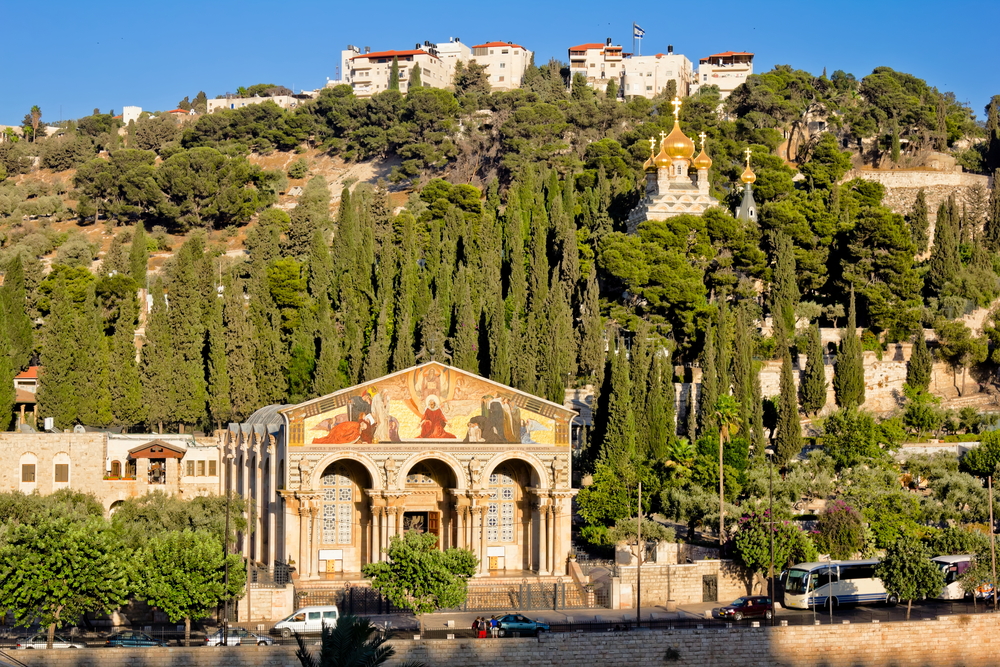
Gethsemane and the Church of all Nations on the Mount of olives in Jerusalem
The Mount of Olives is associated with several important events recorded in the New Testament:
- Jesus frequently taught His disciples there.
- It was the location of the Garden of Gethsemane.
- Jesus delivered the Olivet Discourse concerning future events (Matthew 24).
- According to Acts 1:9-12, Jesus ascended into heaven from the Mount of Olives after His Resurrection.
Several important churches are located along its slopes.
Church of All Nations
Built beside the Garden of Gethsemane, this church commemorates Jesus' prayer before His arrest. Its striking mosaic façade and subdued interior encourage visitors to reflect on Christ's final hours before the Passion.
Dominus Flevit
The name Dominus Flevit means "The Lord Wept."
According to Christian tradition, this church marks the place where Jesus wept over Jerusalem, foreseeing the city's future destruction.
As Luke records:
"If you, even you, had only known on this day what would bring you peace..." (Luke 19:42, NIV)
The church's large window frames one of the most memorable views of the Old City, allowing visitors to contemplate the same landscape Jesus is believed to have seen.
Church of St. Peter in Gallicantu
On the eastern slope of Mount Zion stands the Church of St. Peter in Gallicantu, traditionally associated with the house of the High Priest Caiaphas.
According to Christian tradition, this is where Peter denied knowing Jesus three times before the rooster crowed, fulfilling Jesus' prediction (Luke 22:54-62).
Excavations beneath the church have uncovered ancient structures dating to the Second Temple period. While archaeologists cannot confirm that these remains belonged to Caiaphas' residence, they provide valuable insight into Jerusalem during the time of Jesus.
Why Do Christians Continue to Visit Jerusalem Today?
For many believers, visiting Jerusalem is an opportunity to connect more deeply with the biblical narrative.
Reading the Gospels and standing in the places where those events unfolded are very different experiences. Walking through the narrow streets of the Old City, overlooking Jerusalem from the Mount of Olives, or praying in the Garden of Gethsemane helps many pilgrims understand the geographical and historical context of Scripture in a way that cannot be gained from books alone.
A pilgrimage is also an opportunity for worship, reflection, and spiritual renewal. While the experience differs from person to person, many visitors describe returning home with a richer appreciation of the Bible and the life of Jesus.
At the same time, Jerusalem is a living city rather than an open-air museum. Ancient churches stand alongside vibrant neighborhoods, markets, and communities representing many Christian traditions. Visiting with respect for local worshippers and residents helps preserve the city's unique spiritual atmosphere.
The Spiritual Meaning of Jerusalem in Christianity Today
Jerusalem is important to Christians not only because of its history but also because of what it represents. For believers around the world, the city serves as a reminder of God's faithfulness, the fulfillment of biblical promises, and the hope found through Jesus Christ.
Unlike a historical monument preserved in the past, Jerusalem remains a living city where worship, prayer, and pilgrimage continue every day. Its churches welcome visitors from every continent, while Christian communities of many traditions continue centuries-old practices alongside local residents.
For many pilgrims, visiting Jerusalem is not considered a requirement of the Christian faith. The New Testament does not teach that believers must make a pilgrimage to the Holy Land. Nevertheless, countless Christians find that experiencing the places described in Scripture strengthens their understanding of the Bible and deepens their personal faith.
Walking through the streets of Jerusalem often transforms familiar Bible passages into real places. Distances become tangible, the landscape gains context, and events that may have seemed abstract suddenly feel much more immediate.
The New Jerusalem: A Promise of Hope
Jerusalem's significance in Christianity extends beyond the events of the New Testament. The final book of the Bible presents a vision of the New Jerusalem, symbolizing God's eternal presence with His people.
In Revelation, the Apostle John writes:
"I saw the Holy City, the new Jerusalem, coming down out of heaven from God, prepared as a bride beautifully dressed for her husband." (Revelation 21:2, NIV)
For Christians, the New Jerusalem represents the fulfillment of God's plan for creation. Rather than describing the earthly city alone, it points toward the future hope of restored fellowship between God and humanity.
Different Christian traditions interpret these passages in various ways. Some understand the New Jerusalem primarily as a future physical reality, while others emphasize its symbolic meaning as the completion of God's kingdom. Despite these differences, Christians broadly agree that Jerusalem remains a powerful symbol of redemption, restoration, and eternal hope.
This biblical vision adds another dimension to the city's importance. Jerusalem is remembered not only for what happened there in the past but also for what it represents in the Christian hope for the future.
What to Expect When Visiting Jerusalem as a Christian Pilgrim
For first-time visitors, Jerusalem can be both inspiring and overwhelming. The Old City is compact, yet its narrow streets contain some of Christianity's most significant holy sites, often alongside places sacred to Judaism and Islam.
Pilgrims should expect:
- Busy streets, especially during religious holidays.
- Uneven stone pathways and frequent walking.
- Security screening at some religious sites.
- Active places of worship rather than museums.
- A respectful atmosphere where services and private prayer may be taking place.
Many churches have limited seating, and some become particularly crowded during Easter, Christmas, and other major Christian celebrations. Arriving early in the morning often provides a quieter experience and better opportunities for reflection.
Because many biblical sites are close together, Jerusalem is well suited to exploring on foot. However, the city's hills and cobblestone streets can be physically demanding, particularly for older travelers or those with limited mobility. Comfortable walking shoes are highly recommended.
Dress Code and Respectful Behavior at Holy Sites
Jerusalem welcomes visitors of every faith, but modest dress and respectful behavior are expected in churches and other religious locations.
As a general guideline:
Shoulders and knees should be covered when entering churches.
- Hats should usually be removed inside Christian holy sites, unless worn for religious reasons.
- Speak quietly, especially where worship services are taking place.
- Avoid blocking entrances or interrupting religious ceremonies while taking photographs.
- Follow any instructions provided by church staff or local guides.
Photography is permitted in many churches, but flash photography or photography during services may be restricted. It is always courteous to ask before photographing clergy or worshippers.
Respecting local customs helps ensure that these sacred places remain welcoming for pilgrims from around the world.
Why Visit Jerusalem with a Licensed Local Guide?
Jerusalem is layered with more than three thousand years of history, making it one of the world's most rewarding and complex destinations to explore.
While independent travel is certainly possible, many visitors find that a licensed Israeli tour guide provides valuable context that is difficult to gain from guidebooks or mobile apps alone.
An experienced guide can help explain:
- The historical background of biblical events.
- The difference between Scripture, Christian tradition, archaeology, and later historical developments.
- The significance of different churches and denominations.
- How Jerusalem has changed from the time of Jesus to the present day.
- Practical details that make visiting busy sites smoother and more enjoyable.
Local expertise also helps visitors understand the relationships between sites that might otherwise seem unrelated. For example, seeing the Mount of Olives before entering the Old City offers a much clearer picture of Jesus' final days than visiting each location separately without historical context.
For church groups and pilgrimage leaders, a knowledgeable guide can tailor explanations to the interests and traditions of the group while presenting the city's rich Christian heritage in a balanced and respectful way.
Christian Pilgrimage or General Sightseeing?
Although many of Jerusalem's landmarks appear on standard sightseeing itineraries, a Christian pilgrimage offers a different experience.
A general city tour often emphasizes Jerusalem's broad history, archaeology, architecture, and multicultural character. A Christian pilgrimage, by contrast, follows the biblical narrative and allows more time for reflection at sites connected with the life of Jesus and the early Church.
Many pilgrims choose to include opportunities for Scripture reading, prayer, or worship at significant locations. Others prefer a stronger focus on historical and archaeological context. There is no single "right" approach, which is why many travelers appreciate itineraries that can be adapted to their interests, denomination, available time, and pace.
Combining Jerusalem with Other Biblical Destinations
Jerusalem is often the centerpiece of a Christian pilgrimage, but it is only one part of the biblical story. Many visitors choose to combine it with other significant destinations in Israel and the surrounding region to gain a more complete understanding of Scripture.
Popular combinations include:
- Bethlehem, where Christians commemorate the birth of Jesus at the Church of the Nativity.
- The Mount of Olives, often explored together with the Old City and the Garden of Gethsemane.
- Jericho, associated with both the Old Testament and the ministry of Jesus.
- The Jordan River, where Christian tradition identifies the area of Jesus' baptism.
- The Sea of Galilee, where much of Jesus' public ministry took place, including Capernaum, the Mount of Beatitudes, and Tabgha.
- Nazareth, the town where Jesus spent His childhood and where the Angel Gabriel announced the birth of Christ to Mary according to the Gospel of Luke.
For travelers with additional time, a multi-day itinerary allows these destinations to be experienced in their biblical and geographical context rather than as isolated stops.
Private and tailor-made tours also provide flexibility for different types of travelers. Church groups may wish to include time for worship and fellowship, while families often prefer a slower pace with opportunities to explore at their own rhythm. Independent travelers may benefit from combining guided touring with free time in Jerusalem's historic neighborhoods.
Jerusalem occupies a unique place in Christianity because it is where the central events of the Christian faith unfolded. From Jesus' triumphal entry and the Last Supper to His crucifixion, resurrection, and the coming of the Holy Spirit at Pentecost, the city stands at the heart of the Gospel story.
Its importance, however, extends beyond history. Jerusalem connects the promises of the Old Testament with the message of the New Testament, links the beginnings of the early Church with Christianity's global growth, and points believers toward the hope of the New Jerusalem described in Revelation.
Whether you visit as a pilgrim, a student of biblical history, or a curious traveler, Jerusalem offers an opportunity to experience Scripture within its original landscape. Understanding the city's geography, history, and living Christian traditions can bring new depth to familiar Bible passages and enrich your appreciation of the Christian faith.
At Bein Harim Tours, we have been helping travelers discover Israel since 1993 through professionally planned tours led by licensed Israeli guides. Whether you are planning your first pilgrimage, organizing a church group, or looking for a customized itinerary, our team can help you explore Jerusalem and the Holy Land with historical insight, practical local knowledge, and respect for the diverse traditions that make these places so meaningful.
Explore our Christian tours, private Israel tours, or contact our travel specialists to begin planning a journey that reflects your interests, schedule, and spiritual goals.
FAQ
Q: Why is Jerusalem important to Christians?
A: Jerusalem is where Jesus' crucifixion, burial, resurrection, and the coming of the Holy Spirit at Pentecost took place. It is also the birthplace of the early Christian Church and one of Christianity's holiest cities.
Q: Is Jerusalem a holy city for Christians?
A: Yes. Christians regard Jerusalem as a holy city because of its central role in the life of Jesus and the events that form the foundation of the Christian faith.
Q: Why do Christians go on pilgrimage to Jerusalem?
A: Many Christians visit Jerusalem to deepen their understanding of the Bible, pray at important holy sites, and experience the places connected with Jesus' ministry, death, and resurrection.
Q: What is the most important Christian site in Jerusalem?
A: For most Christian denominations, the Church of the Holy Sepulchre is considered the holiest site because it is traditionally associated with both Golgotha and the Tomb of Jesus.
Q: Can Christians visit all the holy sites in Jerusalem?
A: Yes. Most Christian holy sites are open to visitors throughout the year, although opening hours, security procedures, and religious services may affect access.
Q: Why do some Christians visit the Garden Tomb instead of the Church of the Holy Sepulchre?
A: Some Protestant and Evangelical Christians prefer the Garden Tomb because of its peaceful setting and devotional atmosphere. However, most historians and archaeologists consider the Church of the Holy Sepulchre the more likely historical location of Jesus' crucifixion and burial.
 Certificate of Excellence
 Guaranteed Departure
 Low Prices Guaranteed
 24/7 Support


