 Login / Register
 Contact
The Jerusalem Cross: Meaning, History and Its Connection to the Holy Land
Look closely as you walk through Jerusalem, and you may notice a cross unlike any other: one large cross surrounded by four smaller ones. It appears on churches, pendants, carved wooden keepsakes, and even on the skin of pilgrims. Known as the Jerusalem Cross, this simple design carries centuries of history and, for many Christians, a deeply personal connection to the Holy Land.
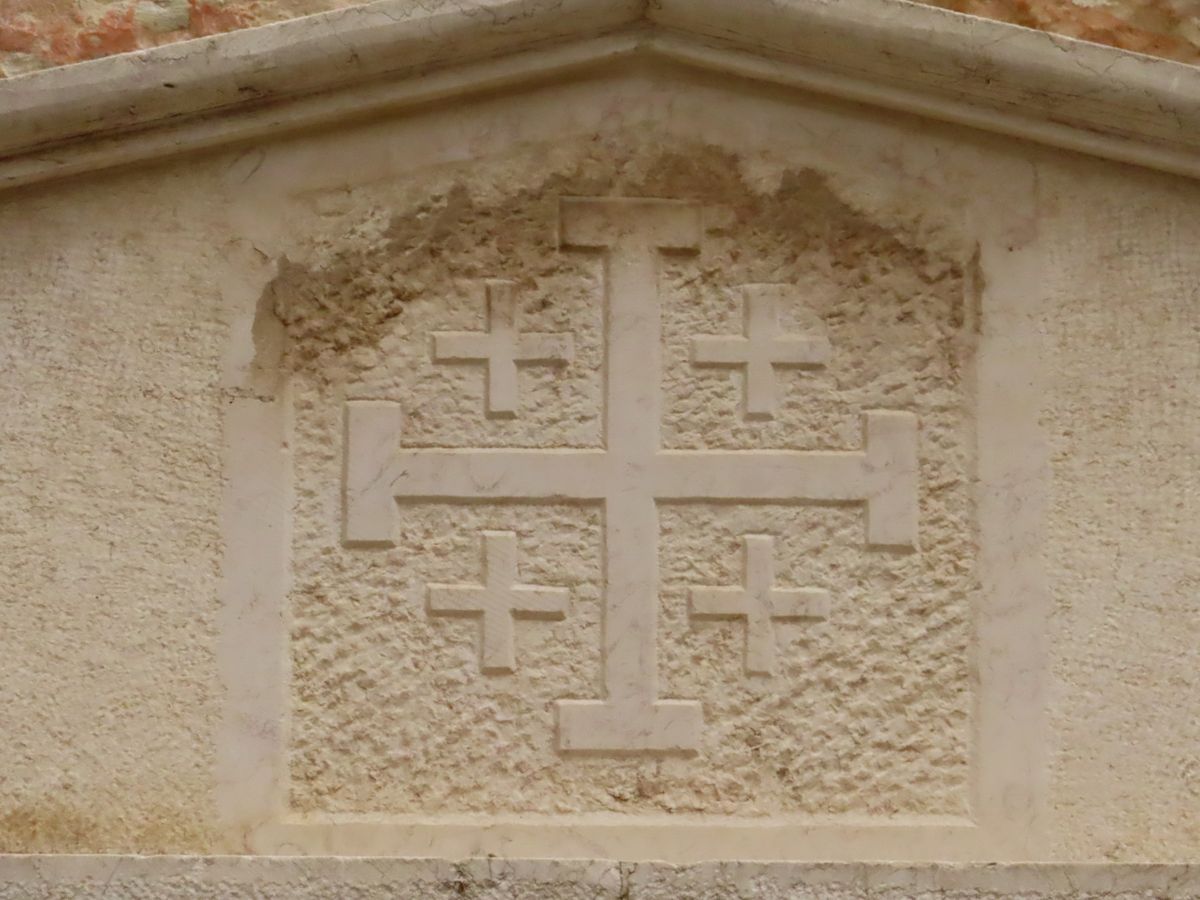
Photo: Fallaner · Source · CC BY-SA 4.0. Resized; no crop.
What Is the Jerusalem Cross?
The Jerusalem Cross is a Christian symbol made up of one large central cross with four smaller crosses in the spaces around it. The central cross often has short bars at the ends of its arms, a design known in heraldry as a cross potent. The smaller crosses usually have four arms of equal length.
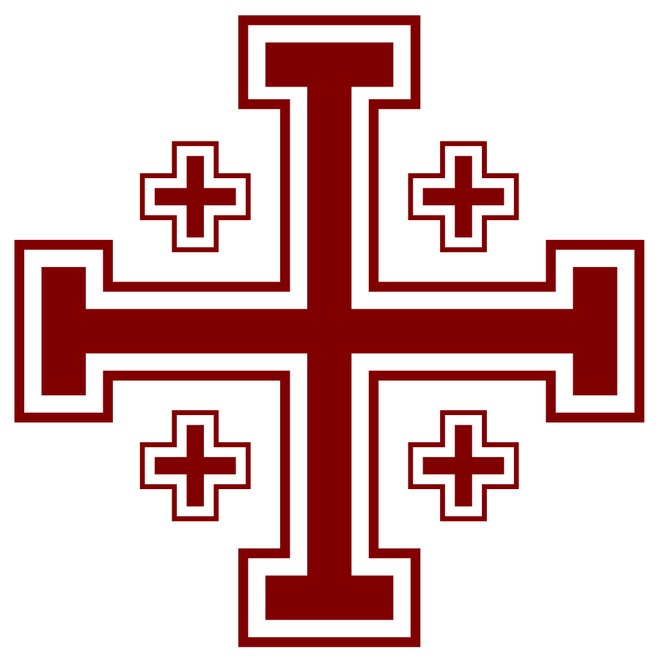
Illustration: Nafsadh / AnonMoos, via Wikimedia Commons · Source · Public domain. SVG rendered as PNG.
You may also hear it called the Five-Fold Cross or the Crusader’s Cross. Its connection to Jerusalem runs through medieval history, Christian pilgrimage, and the churches that continue to care for holy places in the city today.
What Does the Jerusalem Cross Mean?
For many Christians, the Jerusalem Cross is a reminder of Jesus, His Passion, and the faith that spread from Jerusalem to the world. The following interpretations are traditions associated with the symbol. They help explain what it means to believers, although they do not establish a single, certain explanation for how the design first arose.
The Five Wounds of Christ
One of the best-known interpretations connects the five crosses with the wounds Jesus received during the Crucifixion: those associated with His hands, feet, and side. For pilgrims, the symbol can bring to mind both His suffering and the hope of the Resurrection.
In the Gospel of John, the risen Jesus invites Thomas to look at His wounds:
“Reach hither thy finger, and behold my hands” (John 20:27, KJV).
The verse itself does not describe the Jerusalem Cross. Rather, the connection between the wounds and the five crosses developed through Christian tradition. In Jerusalem, that association can feel especially close when visiting the Church of the Holy Sepulchre, revered by many Christians as the place of the Crucifixion, burial, and Resurrection.
Jesus and the Four Evangelists
Another interpretation sees the large central cross as a symbol of Jesus and the four smaller crosses as Matthew, Mark, Luke, and John, the authors traditionally associated with the four Gospels. Each Gospel offers a distinctive account of Jesus’ life and ministry, while together they carry His story to readers around the world.
The Gospel Reaching the Four Corners of the World
A third interpretation links the central cross with Christ and Jerusalem, while the four smaller crosses represent the spread of the Gospel in all directions. It is an image of faith traveling outward from the Holy City to communities across the world.
Christians may associate this interpretation with Jesus’ instruction to His disciples:
“Go ye therefore, and teach all nations” (Matthew 28:19, KJV).
The History of the Jerusalem Cross
The Jerusalem Cross is closely associated with the medieval Kingdom of Jerusalem, established after the First Crusade captured the city in 1099. Its familiar form became part of the kingdom’s heraldic tradition, and the emblem continued to develop and spread in the centuries that followed.
Its precise origins, however, are not known with certainty. Cross designs with smaller marks or crosses appeared in different places and periods, and historians do not all agree on how they relate to the Jerusalem Cross known today. The recognizable five-cross emblem is documented in association with claims to the Kingdom of Jerusalem by the late 13th century. It is therefore difficult to say that one person invented the design or that every crusader carried this exact symbol.
For generations of pilgrims, the cross became a sign of devotion and a reminder of their journey to the Holy Land.
Why Is It Also Called the Crusader’s Cross?
The name reflects the cross’s association with the Kingdom of Jerusalem and the Crusader period. On historical coats of arms, a gold version of the central cross and four smaller crosses appeared against a silver or white background. Red versions are also familiar today.
The term “Crusader cross” can be used for different cross designs, so a cross associated with the Crusades is not always the same as the Jerusalem Cross. Today, the five-cross symbol holds spiritual meaning for many Christians who connect it with Jerusalem, the Passion of Jesus, and pilgrimage.
Is the Jerusalem Cross Catholic?
The Jerusalem Cross has a strong association with Catholic communities, especially the Franciscans and the Order of the Holy Sepulchre. It is also worn and appreciated by Christians from other traditions as an expression of faith and a connection to the Holy Land.
The Jerusalem Cross and the Custody of the Holy Land
The Custody of the Holy Land, the Franciscan community entrusted with caring for many Christian holy places, uses a red Jerusalem Cross as one of its symbols. In its broader emblem, the cross can appear alongside other Franciscan imagery. The Jerusalem Cross itself and the complete Franciscan emblem are therefore related, but they are not identical.
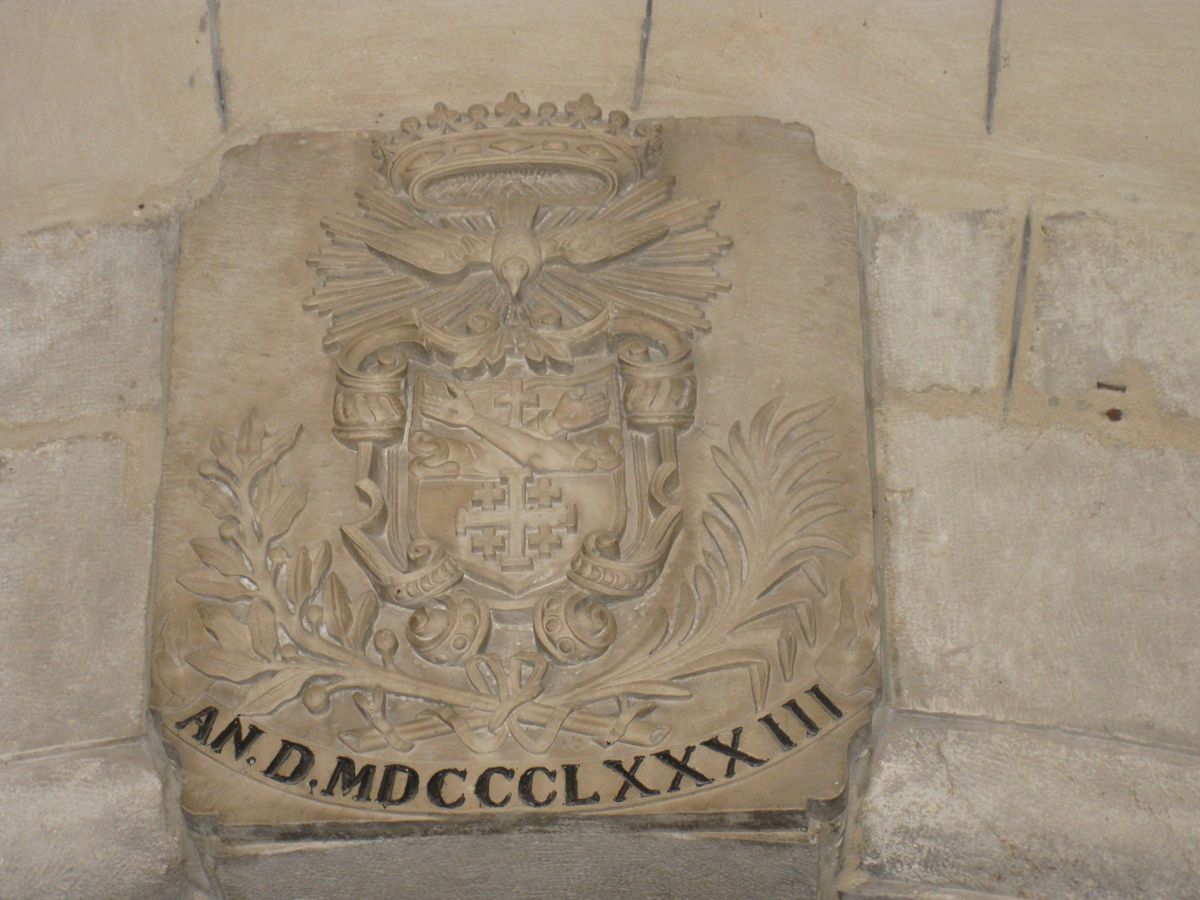
Photo: Deror Avi · Source · CC BY-SA 3.0. Resized; no crop.
Franciscan history is woven into many of the churches of Jerusalem’s Old City. As you explore, looking for the symbol can offer a new way to notice the communities and traditions connected to these places.
Where Can You See the Jerusalem Cross in Jerusalem?
In Jerusalem, the cross is not confined to museums or history books. Look for it on religious objects, church-related buildings, and items displayed in shops around the Old City.
One documented example forms part of a Franciscan emblem at St. Saviour Monastery, near the New Gate in the Christian Quarter. The monastery is associated with the Custody of the Holy Land. Access to religious buildings and the visibility of individual details can change, so ask a local guide what can be seen during your visit.
The cross also connects pilgrims with the Church of the Holy Sepulchre, where communities gather for prayer at a site central to the story of Jesus’ Passion and Resurrection. Walking the Stations of the Cross through the Old City offers another opportunity to reflect on that story.
The Jerusalem Cross as a Pilgrimage Tattoo
For some pilgrims, a Jerusalem Cross is more than something to take home. It becomes a permanent reminder of the journey itself.
Christian pilgrimage tattoos have a long history in Jerusalem. Crosses and other religious designs have been used to commemorate a visit to the Holy Land, sometimes with the year of the journey included. Today, the Jerusalem Cross remains one of the designs chosen by visitors who want a lasting expression of faith or a reminder of their time in the Holy City.
Some Jerusalem tattoo artists preserve designs on carved wooden blocks, connecting present-day visitors with an older craft.
Where Can You Buy a Jerusalem Cross in the Holy Land?
You can find Jerusalem Cross necklaces, pendants, wall crosses, and other keepsakes in religious gift shops in Jerusalem’s Old City and in Bethlehem. Some are carved from olive wood; others are made from silver, metal, or mother-of-pearl. Each material gives the familiar design a different appearance, from a simple wooden cross to a detailed piece of jewelry.
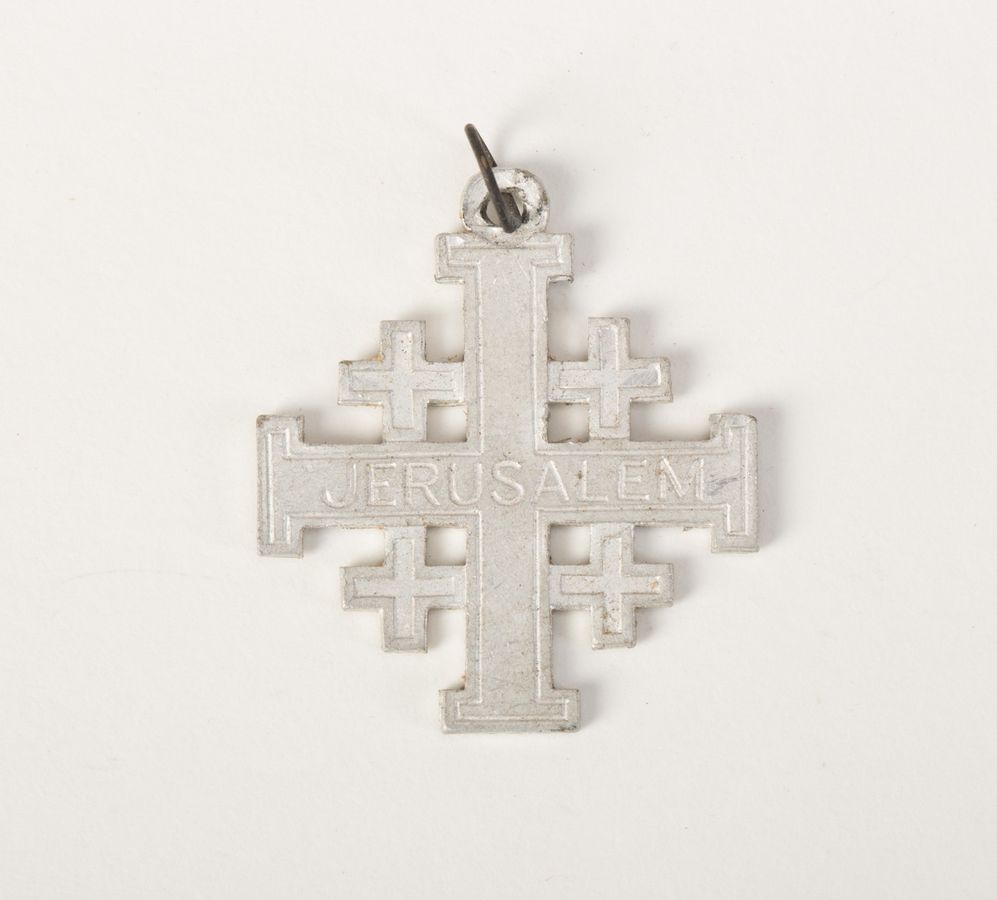
Photo: Auckland Museum · Source · CC BY 4.0. Resized; no crop.
If buying a locally made item matters to you, ask the seller where it was made, what material it contains, and whether it was carved or assembled by hand. It is a good opportunity to learn about the craft behind the keepsake as well as the symbol itself.
Many pilgrims like to choose a Jerusalem Cross during their visit and carry it with them to the Church of the Holy Sepulchre and other sacred places in Jerusalem. For some, praying with the cross at these sites gives their keepsake a deeper spiritual meaning and creates a lasting connection to their journey.
On a Bein Harim Jerusalem tour, you are welcome to ask your guide whether there will be an opportunity to purchase a cross during the day. Shopping time depends on the itinerary and the time available. Our Jerusalem Day Tour includes the Church of the Holy Sepulchre in its listed itinerary, although access and the order of visits can vary.
Discover Jerusalem with Bein Harim
A Jerusalem Cross can be a small reminder of an extraordinary journey. In Jerusalem, the meaning behind it comes into focus as you walk the Old City, visit places connected with the Gospels, and hear the stories of the communities that have welcomed pilgrims for generations.
Explore the Old City and the Church of the Holy Sepulchre on our Jerusalem Day Tour, or follow more sites associated with Jesus’ ministry on our Christian Jerusalem Jesus Tour. Each itinerary is different, so check its details when choosing your visit.
Planning your journey to the Holy Land? Contact us and we’ll help you find the Jerusalem tour that suits your interests.
 Certificate of Excellence
 Guaranteed Departure
 Low Prices Guaranteed
 24/7 Support


