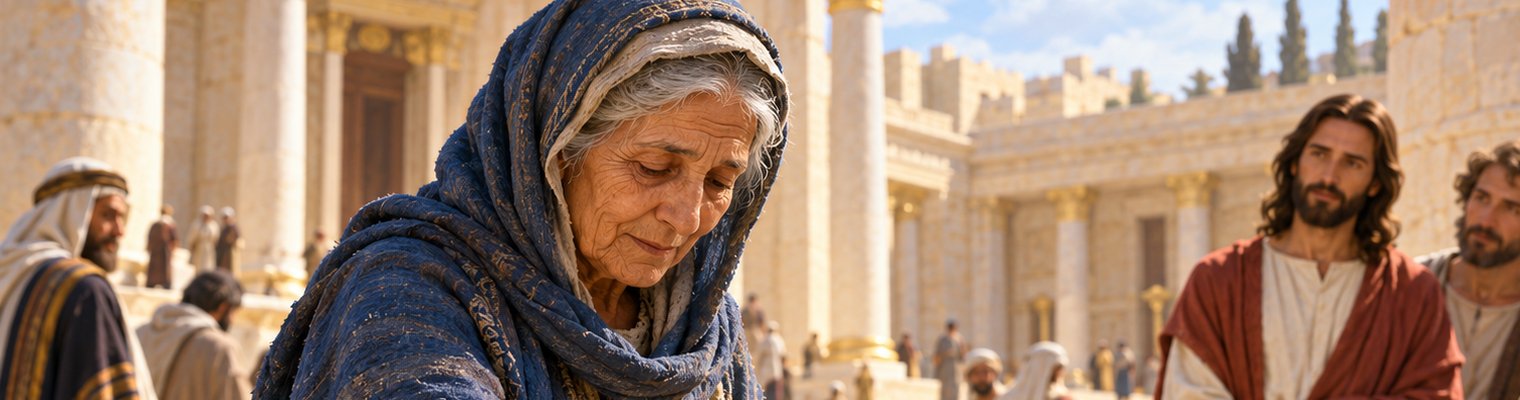
Two tiny coins, almost lost among the offerings of the wealthy, became the center of one of the most memorable scenes in the Gospels. The widow’s mite story invites us to look beyond a gift’s size. It also opens a window onto the world of ancient Jerusalem, where small bronze coins passed through ordinary hands and pilgrims gathered at the Temple.
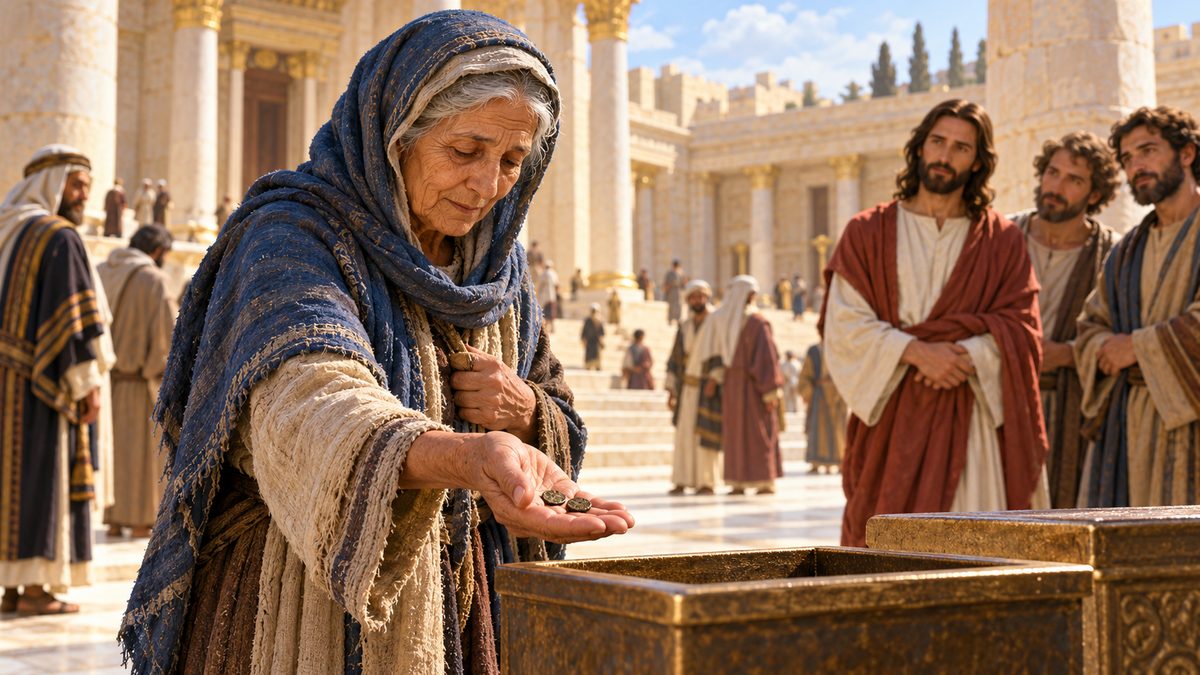
The widow’s mite refers to the small coins given by a poor widow to the Temple treasury in Jerusalem. Jesus watches her offering and tells his disciples that she has given more than the wealthy donors, because they have contributed from their abundance while she has given everything she has to live on.
Although the familiar name uses the singular “mite,” the woman gives two coins. “Mite” is the word used in the King James Version for a very small coin. The Greek Gospel text calls the coins lepta, the plural of lepton.
Today, the expression can describe a modest gift that represents a great personal sacrifice. For readers interested in biblical history, it also raises a question: what did those small coins actually look like?
The scene unfolds at Jerusalem’s Temple, a place of worship and pilgrimage at the heart of Jewish life. Jesus sits opposite the treasury, watching people put in their offerings. Many wealthy donors give large amounts. Then a poor widow approaches and contributes two small coins.
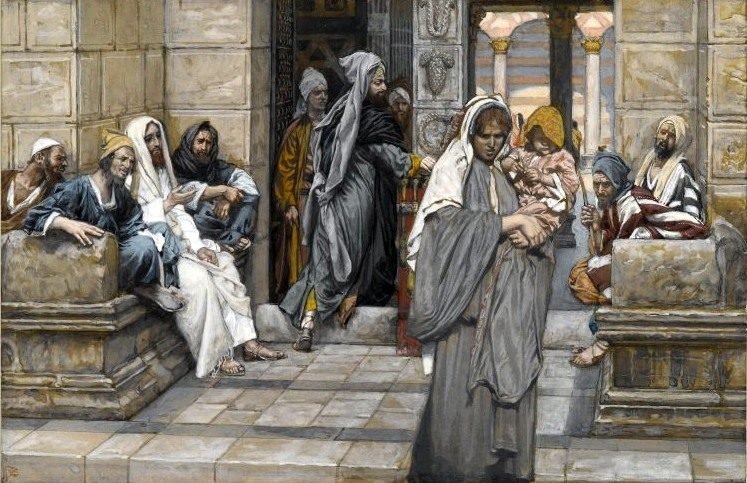
To an observer counting only money, her contribution would seem insignificant. Jesus draws his disciples’ attention to what the amount alone cannot reveal: the cost of the gift to the person giving it.
“This poor widow hath cast more in, than all they which have cast into the treasury”
Mark 12:43, KJV
His explanation turns the comparison around. The others have money left after giving. The widow has offered her whole means of support. The Gospel does not give her name or tell us what happens to her afterward. Its attention stays on her offering and Jesus’ response.
The account appears in Mark 12:41–44 and Luke 21:1–4. Mark describes Jesus sitting opposite the treasury and calling his disciples to him. Luke gives a shorter account, preserving the same contrast between the wealthy donors and the poor widow.
Mark also explains the relationship between the coins: the widow’s two mites together make a “farthing” in the KJV, translating the Greek reference to a Roman quadrans. This ancient denomination should not be confused with the later British coin of the same English name.
Christians have long understood the widow’s offering as a lesson about generosity, faith, and sacrifice. A gift cannot be measured only by its financial value. Something small to one person may represent a profound commitment for another.
The story is especially moving because Jesus notices someone whose contribution could so easily have been overlooked. Her poverty does not make her invisible to him. Neither wealth nor public recognition determines the importance of her gift.
“but she of her want did cast in all that she had, even all her living.”
Mark 12:44, KJV
There is also a wider context. Immediately before this scene, Mark records Jesus warning against scribes who “devour widows’ houses” (Mark 12:40, KJV). Some interpreters therefore emphasize the widow’s vulnerability and the responsibility to protect people in need, alongside the traditional emphasis on sacrificial giving. These readings remind us to approach her situation with compassion rather than turn it into a simple instruction to give away everything.
A lepton was a coin of very low value. Small bronze coins circulated in Judaea before and during the time of Jesus, and examples survive in museum collections and archaeological finds. They help us picture the everyday money behind the Gospel account.
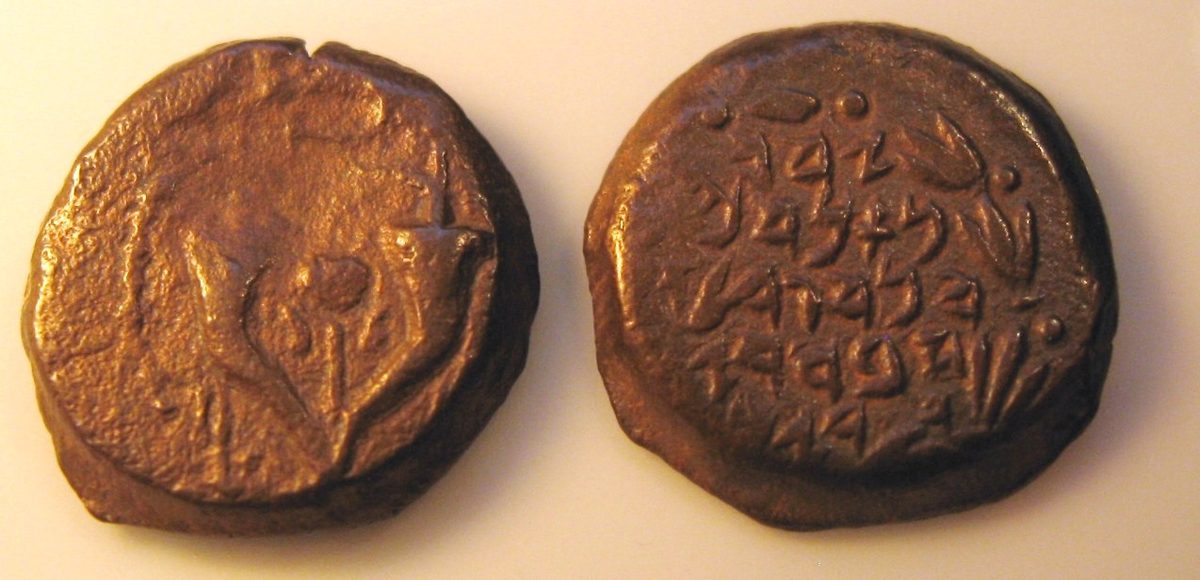
Coins commonly called “widow’s mites” today are often associated with Alexander Jannaeus, the Hasmonean ruler who reigned from 103 to 76 BC, or related small bronze issues. Their connection with the story does not mean they were minted especially for religious offerings.
Identification needs care. The terms lepton and prutah appear in discussions of these coins, and pieces sold under the popular name do not all represent an identical denomination or issue. The Gospel does not name the ruler, describe a design, or identify the actual coins. No surviving example can be authenticated as one of the widow’s own two coins.
One familiar coin type of Alexander Jannaeus carries an anchor on one side and an eight-rayed star within a diadem on the other. Museum examples preserve Greek and ancient Hebrew inscriptions connecting the design with the king.
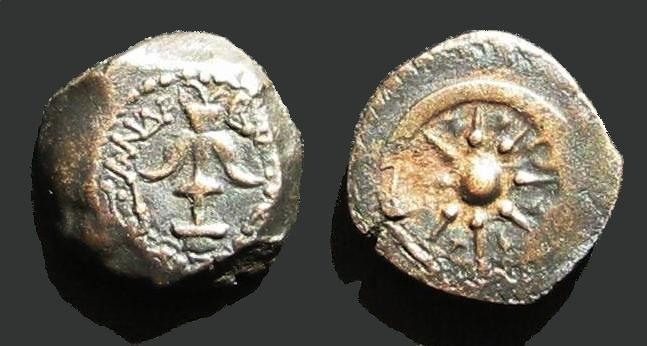
On worn specimens, these details can be difficult to recognize. The lettering may be incomplete and the design off center. These are ancient royal symbols, predating Christianity; an anchor on such a coin should not automatically be interpreted as a Christian emblem.
The clearest comparison comes from Mark himself: the two coins together equaled one quadrans, a very low-value Roman denomination. Their monetary worth was small, which makes the contrast with the wealthy donors essential to the story.
A precise conversion into today’s dollars would be misleading. Ancient wages, food costs, and purchasing power do not translate neatly into modern money. The Gospel’s central comparison is personal: the wealthy give part of what they have, while the widow gives her entire livelihood.
The value of an ancient coin to a modern collector is a separate question. Authenticity, condition, rarity, and the particular issue all matter. A coin’s association with the biblical period should never be confused with evidence that it belonged to a person named in Scripture.
The Temple where the scene takes place no longer stands. Visitors can nevertheless explore remains and reconstructions that make its setting easier to understand. These places illuminate the world of the account without identifying the exact spot where the widow stood.
The Southern Steps and Davidson Center, beside the Temple Mount, introduce visitors to the surroundings of the Second Temple. Surviving steps, ancient paving, and ritual baths help explain how worshippers approached the sacred complex.
Seeing this setting adds scale to a story that can otherwise feel detached from a real city. The widow’s offering belonged to a world of pilgrimage, worship, and everyday economic contrasts. The archaeological park helps bring that larger world into focus.
For a different perspective, visit the Second Temple model at the Israel Museum. It reconstructs Jerusalem in AD 66, several decades after Jesus’ ministry, with the Temple complex at its center.
Walking around the model helps visitors understand how the Temple related to the surrounding city. It is a reconstruction rather than a surviving ancient structure, but it offers a valuable introduction to the Jerusalem behind many Gospel passages. Pairing it with archaeological remains can make the history much easier to visualize.
The widow’s two coins lead us into a much larger story about Jerusalem, its Temple, and the people who came there to worship. Exploring that history with a guide gives the Gospel account a setting you can see and begin to understand for yourself.
Browse our Jerusalem tours to discover the city’s biblical history and sacred landmarks. If you would like to focus on Second Temple archaeology or include the Israel Museum, contact us about a private itinerary tailored to your interests. Museum and archaeological park visits depend on the itinerary selected and are not included in every tour.
Join Us
Keep in Touch


 Login / Register
 Contact


 Certificate of Excellence
 Guaranteed Departure
 Low Prices Guaranteed
 24/7 Support