 Login / Register
 Contact
What Is the Holy Land and Where Is It?
The Holy Land is a historic and religious term for the region at the eastern end of the Mediterranean that is sacred to Judaism, Christianity, and Islam. In modern geographical terms, its core is generally associated with Israel and the Palestinian territories, including places such as Jerusalem, Bethlehem, Nazareth, the Sea of Galilee, Jericho, and the Jordan River.
The Holy Land is not the official name of a modern country, nor does it have universally agreed political borders. Its meaning comes from thousands of years of biblical history, religious tradition, pilgrimage, and the connection between faith and specific places.
For travelers, understanding the Holy Land means understanding both its geography and why this relatively small region has played such an important role in world religion and history.
What Is the Holy Land?
The Holy Land is the name traditionally given to the region connected with many of the central events, people, and sacred places of the Bible and the religious traditions that developed from it.
In Judaism, the land is closely connected with the biblical patriarchs, the people of Israel, Jerusalem, and the Temple.
For Christians, it is the land where Jesus was born, grew up, carried out much of his ministry, was crucified, and, according to the New Testament, rose from the dead.
In Islam, Jerusalem is one of the religion's most sacred cities and is associated with important Islamic traditions.
Because the term is religious and historical rather than political, there is no single official boundary that defines exactly where the Holy Land begins and ends.
The expression should therefore not be understood as another name for one modern state. It refers to a sacred geographical region whose meaning developed over centuries.
Did you know? The Holy Land attracts many Christian pilgrims every year, some visit independently, while others prefer a Christian tour to the Holy Land in a community setting .
Where Is the Holy Land Located?
The Holy Land is located in the Middle East, on the eastern shore of the Mediterranean Sea in the state of Israel.
In the way the term is most commonly used today, the geographical heart of the Holy Land includes modern Israel and the Palestinian territories. This area contains many of the places most closely associated with the Bible and later Jewish, Christian, and Muslim traditions.
Important locations include:
- Jerusalem
- Bethlehem
- Nazareth
- The Sea of Galilee
- The Jordan River
- Jericho
- The Dead Sea
- The Judean Desert
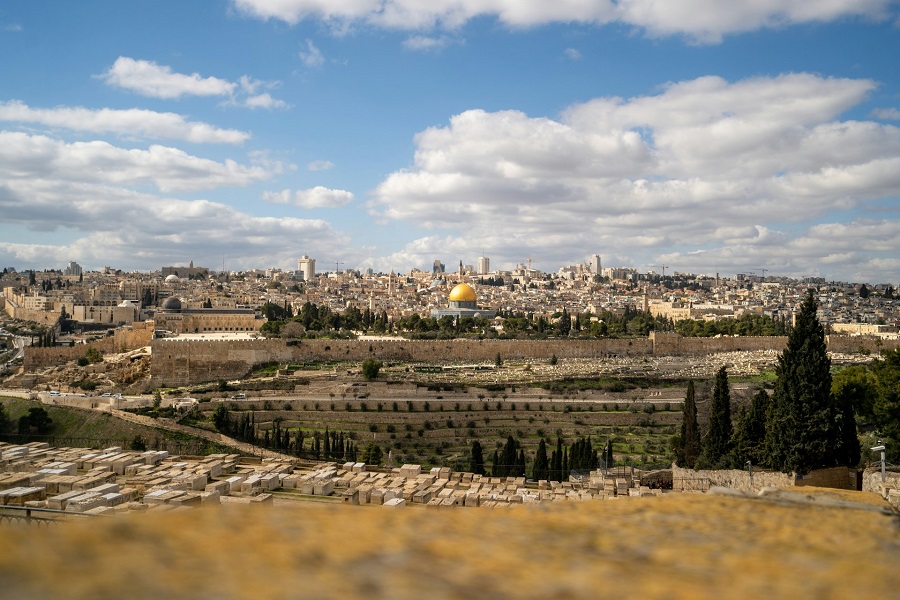
Jerusalem
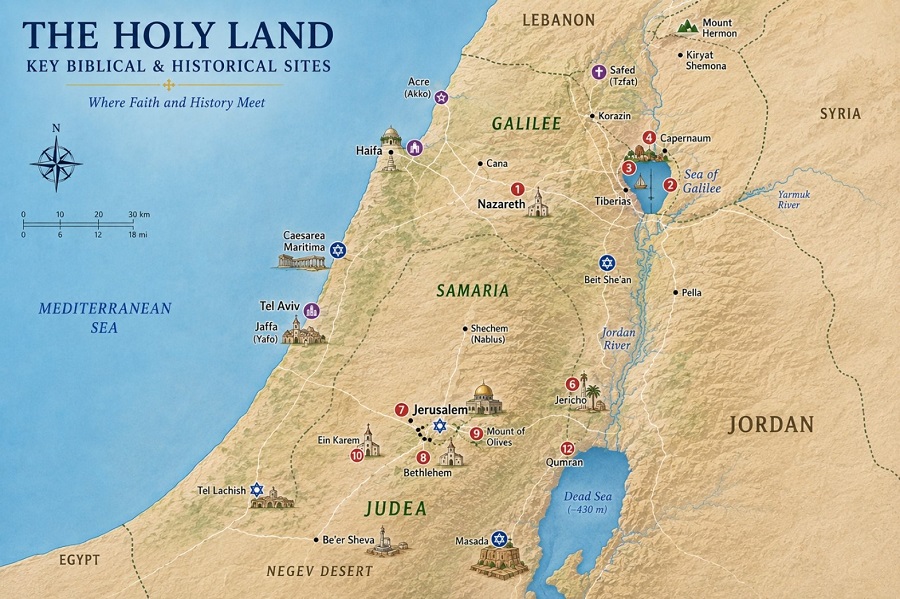
The Mediterranean Sea lies to the west, while the Jordan Valley and Jordan River form an important geographical corridor to the east.
For visitors, the Holy Land can feel surprisingly compact. Many places known from Scripture and religious history are located within relatively short geographical distances of one another, although terrain, modern roads, border arrangements, and traffic all affect actual travel times.
Map of the Holy Land
What Countries and Territories Are Considered Part of the Holy Land?
There is no official list of countries that make up the Holy Land, because the Holy Land is not a political organization or formally defined territory.
In most modern religious and travel contexts, the term centers on Israel and the Palestinian territories, where the largest concentration of biblical and pilgrimage sites is found.
In broader historical, biblical, or religious usage, the idea of the Holy Land may extend beyond this core region. Depending on the period and context being discussed, references can include areas that are today part of Jordan and, more broadly, neighboring lands connected with biblical history.
This is why asking "What countries are in the Holy Land?" does not have the same kind of answer as asking which countries are in a modern geographical region such as Scandinavia.
The boundaries depend on whether the subject is biblical geography, Christian pilgrimage, Jewish history, medieval history, archaeology, or modern travel.
Why Is It Called the Holy Land?
It is called the Holy Land because generations of believers have regarded places within this region as sacred.
The holiness is connected not simply to the landscape but to the events, people, religious traditions, and places associated with it.
For Judaism, the land is inseparable from the biblical story of the people of Israel and the central religious importance of Jerusalem.
For Christianity, the geography of the Holy Land provides the setting for the life and ministry of Jesus and many events described in the Old and New Testaments.
For Islam, Jerusalem became an important sacred center with deep religious significance.
The phrase "Holy Land" therefore describes a relationship between faith and geography: religious events are remembered not only as stories but as events associated with real towns, hills, valleys, roads, bodies of water, and cities.
Why Is the Holy Land Important to Christianity?
For Christians, the Holy Land is important because it is the geographical setting of the life of Jesus and many of the events recorded in the New Testament.
Bethlehem is traditionally identified as the birthplace of Jesus, as described in the Gospels of Matthew and Luke.
Nazareth is associated with his childhood and early life. According to Luke 1:26, Nazareth is also connected with the Annunciation to Mary.
The Sea of Galilee and the surrounding region form the setting for a large part of Jesus' public ministry. The Gospels describe teaching, healings, the calling of disciples, and other events taking place in Galilee.
The Jordan River is associated in the New Testament with the baptism of Jesus by John the Baptist.
Above all, Jerusalem is central to the Christian story of Jesus' final days. The New Testament connects the city with his entry into Jerusalem, the Last Supper, arrest, crucifixion, burial, and resurrection.
For this reason, a Christian pilgrimage to the Holy Land is different from simply visiting a collection of historical monuments. Geography helps pilgrims understand how the places mentioned in Scripture relate to one another.
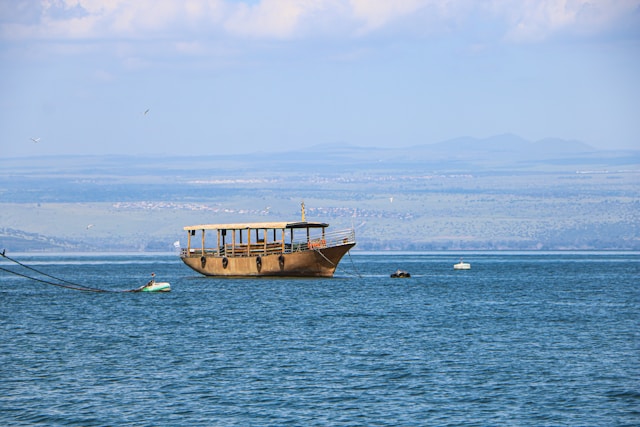
The Sea of Galilee
At the same time, it is important to distinguish between what the biblical text states and the later identification of particular churches, tombs, caves, or other locations. Some Christian holy sites have ancient traditions associated with them, while the precise historical location of certain events remains debated.
Why Is the Holy Land Important to Judaism?
The land has a central place in Jewish history, Scripture, religious identity, and tradition.
Biblical narratives connect the region with Abraham, Isaac, Jacob, the tribes of Israel, the kingdoms of Israel and Judah, the prophets, and many other figures and events in the Hebrew Bible.
Jerusalem holds particular importance.
According to the biblical account, King David established Jerusalem as his capital, and the First Temple was later built there under King Solomon. The Second Temple subsequently stood in Jerusalem until its destruction by the Romans in 70 CE.
The Western Wall in Jerusalem is one of Judaism's most sacred places of prayer. It forms part of the retaining structures surrounding the Temple Mount complex from the Second Temple period.
The Jewish connection with the land therefore combines biblical tradition, documented history, religious practice, collective memory, and an ongoing relationship with Jerusalem and the Land of Israel.
Why Is the Holy Land Important to Islam?
The Holy Land, and Jerusalem in particular, also has profound importance in Islam.
Jerusalem is home to the Al-Aqsa Mosque and the Dome of the Rock, located within the sacred compound known to Muslims as Al-Haram al-Sharif.
In Islamic tradition, Jerusalem is associated with the Prophet Muhammad's Night Journey and Ascension. The religious importance of the city developed as a major part of Islamic tradition and history.
Jerusalem has consequently been a significant Muslim religious center for more than a millennium.
Its Islamic heritage is another reason why understanding the Holy Land requires looking beyond a single faith tradition. The same city can contain places of enormous importance to Jews, Christians, and Muslims, sometimes within only a short walk of one another.
Why Is Jerusalem So Important?
Jerusalem is not itself the entire Holy Land, but it is its most important religious city.
Few places demonstrate the meaning of the term "Holy Land" as clearly as Jerusalem.
For Judaism, Jerusalem is connected with the ancient Temples and has held a central place in Jewish religious life for thousands of years.
For Christianity, the city is associated with the final period of Jesus' ministry, his crucifixion, and the resurrection described in the New Testament. The Church of the Holy Sepulchre is traditionally identified with the site of Jesus' crucifixion and burial.
For Islam, Jerusalem contains Al-Aqsa Mosque and the Dome of the Rock and is deeply connected with Islamic religious tradition.
Inside Jerusalem's Old City, sacred places belonging to these traditions exist remarkably close to one another.
This religious concentration helps explain not only Jerusalem's spiritual importance but also its extraordinary historical complexity.
What Was the Holy Land Historically?
When people ask, "What was the Holy Land?", they are usually looking for the historical meaning of the term.
The answer depends heavily on the period.
In the Bible, the region is referred to by different geographical and political names at different times, including Canaan, Israel, Judah, and the Land of Israel. The English expression "Holy Land" is therefore a later conventional way of describing the sacred geography associated with these biblical lands.
Over the centuries, political control changed repeatedly. The region formed part of different kingdoms and empires, and its borders did not remain fixed.
The concept of the Holy Land became especially important in Christian pilgrimage. Christians traveled to biblical sites from the early centuries of Christianity, and the term became deeply associated with the places connected with the life of Jesus and the biblical story.
During the medieval period, European Christian use of the term became particularly widespread in connection with pilgrimage and the Crusades.
This historical background is why it can be misleading to take a modern political map and use it as an exact definition of the ancient Holy Land. Biblical geography, historical borders, religious tradition, and present-day political boundaries are different things.
Visiting the Holy Land Today
Today, travelers can visit many places that they may previously have known only from the Bible, religious tradition, history books, or archaeology.
A typical Christian-focused journey may begin in Jerusalem and Bethlehem, continue north to Nazareth and the Sea of Galilee, and include sites along the Jordan Valley.
Other travelers may approach the region through archaeology, Jewish heritage, ancient history, architecture, or the cultures and communities that live here today.
The most rewarding itineraries usually connect places geographically instead of treating each site in isolation.
In Jerusalem, for example, travelers can explore places associated with the biblical period, the Second Temple era, early Christianity, Islamic history, the Crusader period, and later centuries within the same city.
In the Galilee, understanding the relationship between Nazareth, Capernaum, the Sea of Galilee, and surrounding landscapes adds context to New Testament accounts.
For Christian pilgrims in particular, a customized itinerary can also be adjusted according to denomination and interests. Catholic travelers may wish to include particular churches and opportunities for worship, while Protestant or Evangelical groups may place greater emphasis on biblical landscapes, Scripture readings, and different traditional sites.
 Certificate of Excellence
 Guaranteed Departure
 Low Prices Guaranteed
 24/7 Support


