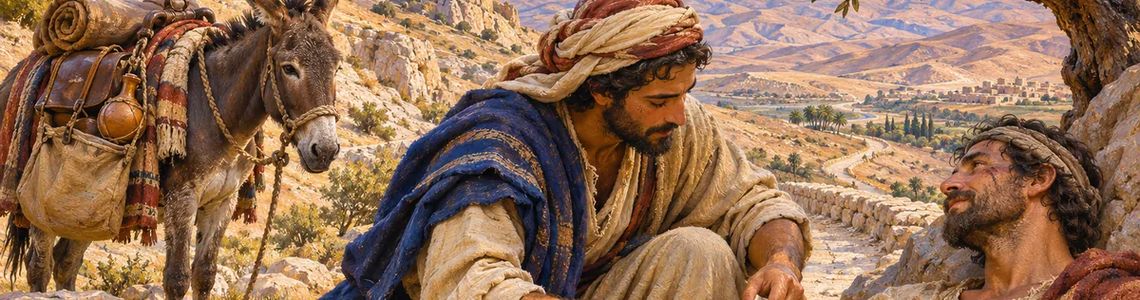
A traveler lies wounded beside the road. Two people see him and continue on their way. A third stops, tends his injuries, and pays for his care. The Good Samaritan is a short story with a question that reaches far beyond its setting: what does it mean to be a neighbor? Along the road between Jerusalem and Jericho, the landscape and a later pilgrimage tradition give visitors a way to explore the world of this enduring parable.
The Good Samaritan is a parable Jesus tells in Luke 10:25–37 about a man who helps a wounded stranger after others pass him by. Its central concern is mercy expressed through action, even across social and religious boundaries.
The expression “good Samaritan” is now commonly used for someone who helps a person in need. In the Gospel, however, the Samaritan’s role carries a particular force. The helper comes from a community distinct from the priest and Levite who have already appeared in the story.
Is the Good Samaritan a true story? Luke presents it as a teaching story within a conversation with Jesus, rather than as a report about named historical individuals. Its setting is a real journey between two cities, but that does not identify the characters or establish a particular roadside incident.
The conversation begins when an expert in the Law asks Jesus what he must do to inherit eternal life. Jesus responds by asking what the Law says. The man answers with the commandments to love God and to love one’s neighbor as oneself, drawing on Deuteronomy 6:5 and Leviticus 19:18.
Jesus affirms the answer. Then comes the question that leads to the parable:
“And who is my neighbour?” (Luke 10:29, KJV)
Instead of supplying a list of people who qualify, Jesus tells a story. By its end, the discussion has shifted from defining the limits of a neighbor to recognizing the behavior of someone who acts as one.
The parable follows one journey, three encounters, and a rescue. Jesus gives little background about the wounded man. The attention falls on what the travelers do when they see him.
A man is traveling down from Jerusalem to Jericho when robbers attack him. They strip him, beat him, and leave him half dead beside the road.
Luke does not give his name, occupation, or explicitly state his ethnicity. The lack of identifying detail keeps the reader’s attention on his condition: he is badly injured and needs help.
The direction of travel is meaningful. Jerusalem stands in the hill country, while Jericho lies far below in the Jordan Valley. Going down to Jericho is a physical descent as well as a familiar way of describing the journey.
A priest comes along the road and sees the man. He passes on the other side. A Levite also reaches the place, sees him, and continues without helping.
Both figures are associated with religious service. Their presence raises an expectation of care, making their failure to stop especially striking within the story.
Why did the priest and Levite pass by? The text does not say. Explanations involving fear, ritual purity, or urgency are interpretations rather than stated motives. What Jesus makes clear is the contrast between seeing someone’s need and responding to it.
The episode should not be turned into a general claim that Jewish religious practice discouraged compassion. The conversation itself begins with commandments from the Torah, and Jesus affirms the duty to love God and one’s neighbor.
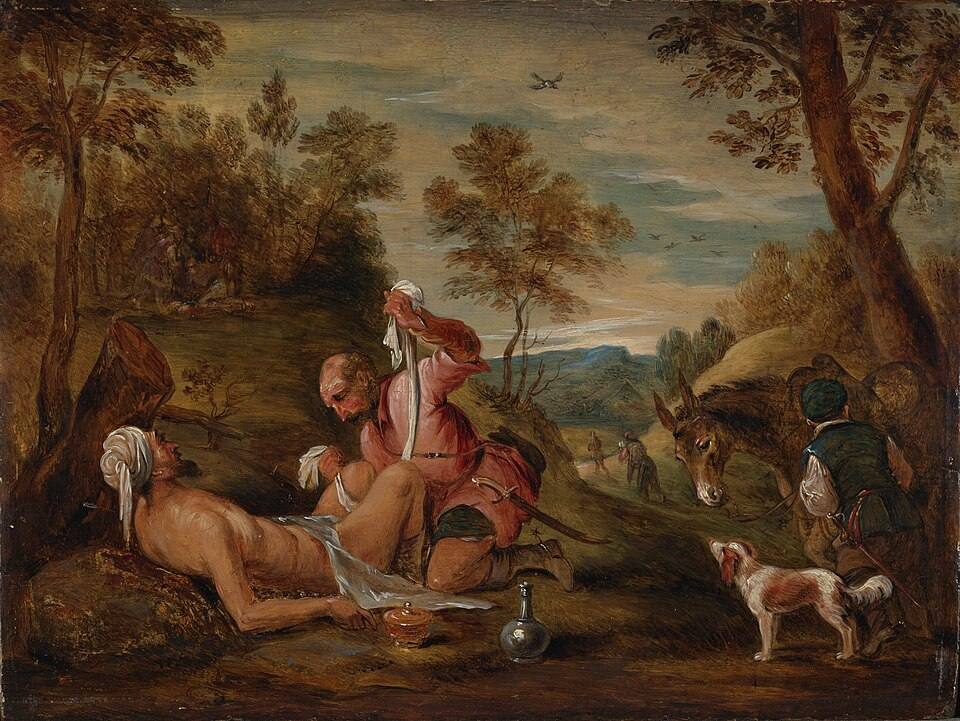
The third traveler is a Samaritan. He too sees the injured man, but this time the response changes.
“And when he saw him, he had compassion on him.” (Luke 10:33, KJV)
He approaches, bandages the wounds, and pours on oil and wine. He places the man on his own animal and takes him to an inn, where he cares for him. Although illustrations often show a donkey, Luke does not specify the animal.
The next day, the Samaritan gives the innkeeper two denarii and asks him to continue caring for the man. He also promises to repay any additional expense when he returns. His assistance includes immediate treatment, transportation, accommodation, and a commitment to further costs.
The practical detail matters. The Samaritan does more than feel sympathy or offer a reassuring word. He changes his journey and uses his own resources so that someone else can recover.
The Good Samaritan is the unnamed traveler who shows mercy in Jesus’ parable. “Good” describes the role by which he became known; Luke introduces him simply as a Samaritan.
The Samaritans were, and remain, a distinct religious community rooted in the history of ancient Israel. Their traditions are connected with Mount Gerizim and the Torah. In the world of the New Testament, differences over worship and community identity could create serious tensions between Jews and Samaritans.
That background gives the choice of rescuer its impact. The person who acts with compassion is someone whom listeners might have regarded as an outsider or rival. The story challenges expectations about who will prove trustworthy when another person needs help.
It does not require the wounded man to demonstrate that he belongs to the Samaritan’s community. His need is enough to prompt a response.
The main lesson is that being a neighbor is shown through mercy. Jesus ends by asking which of the three travelers acted as a neighbor to the man attacked by robbers. The expert in the Law answers that it was the one who showed mercy.
“Go, and do thou likewise.” (Luke 10:37, KJV)
The answer turns the opening question outward. Rather than asking only who belongs within the circle of people deserving care, the listener is asked to become the person who gives it.
The story also gives compassion a cost. The Samaritan spends time and money and accepts an obligation that continues after he leaves the inn. Mercy becomes visible in decisions that make a difference to the injured man.
For Christian readers, the parable is a lasting call to love beyond familiar boundaries. Its influence also reaches beyond religious settings, giving everyday language an expression for help offered to a stranger without an expectation of reward.
The ending leaves the listener with something to do. Understanding the story is a beginning; responding to someone’s need is the action it invites.
The parable is set on the road from Jerusalem to Jericho. It is not set in Samaria simply because the rescuer is a Samaritan. The route descends eastward through the Judean wilderness toward the Jordan Valley.
The contrast between the highlands and the oasis helps make sense of the journey. A traveler leaving Jerusalem enters a very different landscape of dry hills and valleys before reaching Jericho. Seeing that transition gives the opening words of the parable a physical setting.
Luke does not identify a particular bend in the road or name the inn. Nor does he say that Jesus was standing at the later pilgrimage site when he told the story. The route belongs to the narrative; the precise location of its imagined encounters remains unspecified.
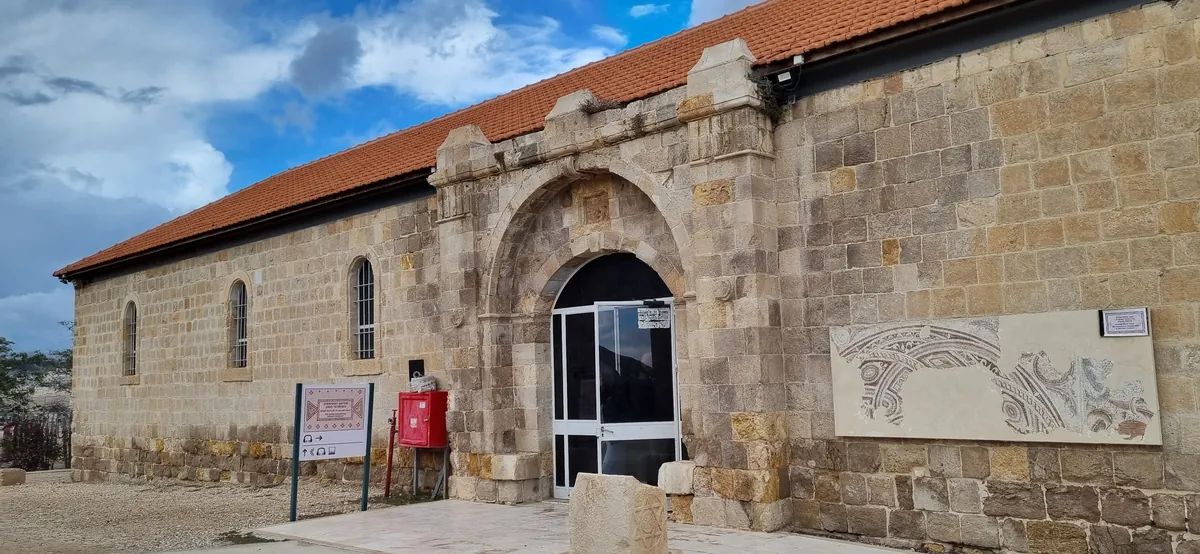
The site known as the Inn of the Good Samaritan lies beside the highway east of Jerusalem. Christian tradition connected this location with the inn in the parable during the Byzantine period. Its association is part of the history of remembering the story, rather than proof that its characters stayed here.
Today, the Good Samaritan Museum displays archaeological finds and Byzantine mosaics. The collection includes mosaics from churches and Jewish and Samaritan synagogues, bringing several communities’ religious and artistic heritage into view. The restored inn building used by the museum dates to the Ottoman period.
For visitors, the appeal extends beyond a connection to a familiar biblical story. The museum offers a chance to look closely at ancient craftsmanship and learn about the Samaritan community. The Israel Nature and Parks Authority’s official museum page provides current visitor information.
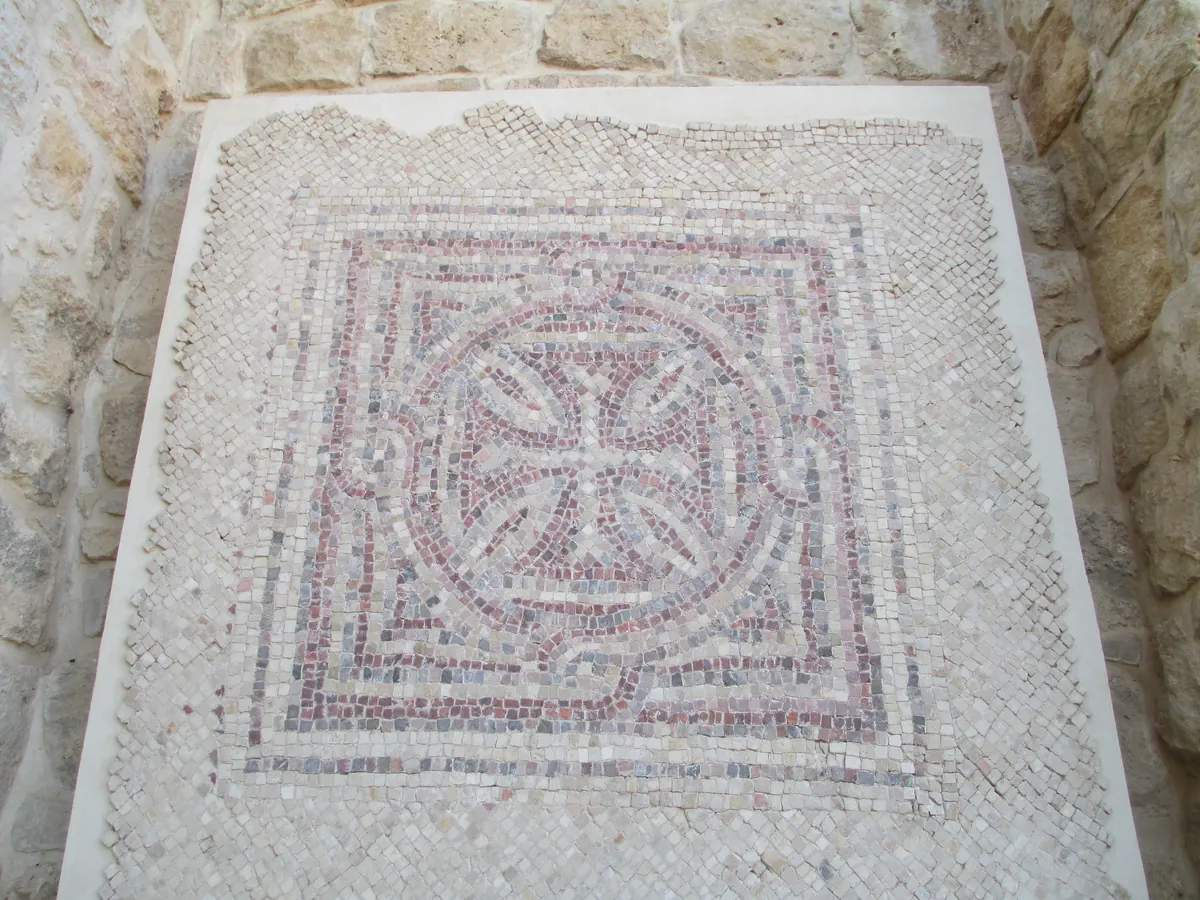
Traveling toward Jericho gives the parable a geographical dimension that is easy to miss on the page. The descent from Jerusalem and the changing desert landscape help place its journey within the Holy Land, while the museum reveals how later generations connected the story with a particular place.
Explore our Jericho tours to discover the city and its surrounding biblical landscape. Itineraries vary, and passing the Inn of the Good Samaritan is different from entering the museum, so check the included stops when choosing your route.
If you would like a dedicated museum visit, our private tours in Israel offer a way to discuss an itinerary around your interests, with time for the places you most want to explore.
Tours You May Like
Join Us
Keep in Touch


 Login / Register
 Contact


 Certificate of Excellence
 Guaranteed Departure
 Low Prices Guaranteed
 24/7 Support