 Login / Register
 Contact
Biblical Israel vs Modern Israel: What's the Difference?
Open the Bible to almost any historical book, and you'll encounter places like Jerusalem, Bethel, Hebron, Samaria, and the Sea of Galilee. Open a modern map, and many of those same names still appear. This often leads to an important question: Is the Israel described in the Bible the same as the modern State of Israel?
The short answer is Yes and No
Modern Israel occupies much of the same geographic region where many of the Bible's most significant events took place. Abraham journeyed through this land, King David established Jerusalem as his capital, Jesus preached throughout Galilee, and the early Church began in Jerusalem. Yet the modern State of Israel, established in 1948, is a contemporary sovereign nation with internationally recognized institutions, while biblical Israel refers to several ancient kingdoms, tribal territories, and historical periods described throughout the Old and New Testaments.
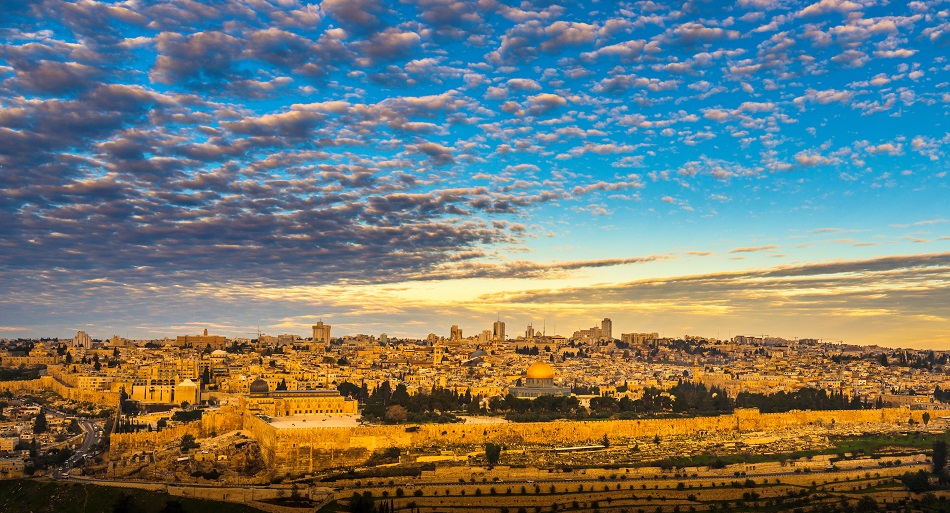
Jerusalem, once the capital of the Kingdom of Judah, today the capital of the State of Israel
Understanding the distinction is essential for anyone studying the Bible or planning a journey through the Holy Land. The names may be familiar, but the political boundaries, governments, and historical context have changed dramatically over more than three thousand years.
In this guide, we'll explore:
- The differences between biblical Israel and modern Israel
- How their borders compare
- Where biblical events took place on today's map
- The history connecting ancient kingdoms to the modern State of Israel
- Common misconceptions about biblical geography
- How visitors can experience biblical sites across modern Israel today
Whether you're preparing for a Christian pilgrimage, studying Scripture, or simply curious about biblical history, understanding the relationship between ancient and modern Israel brings the biblical narrative into sharper focus.
What Is the Difference Between Biblical Israel and Modern Israel?
At first glance, biblical Israel and modern Israel appear closely connected because they share many of the same locations. However, they represent two very different concepts.
Biblical Israel refers to the ancient land and kingdoms described throughout the Bible. Depending on the period being discussed, it may refer to:
The land promised to Abraham and his descendants (Genesis 12:1–7; Genesis 15:18–21).
The territory settled by the Twelve Tribes after the Exodus and the conquest of Canaan.
The united monarchy ruled by Saul, David, and Solomon.
The divided kingdoms of Israel (Northern Kingdom) and Judah (Southern Kingdom) following Solomon's reign.
As Scripture records:
"Unto thy seed have I given this land..." — Genesis 15:18 (KJV)
By contrast, modern Israel is a sovereign nation established on May 14, 1948, following the end of the British Mandate for Palestine and the adoption of the United Nations Partition Plan. It functions as a parliamentary democracy with modern cities, infrastructure, universities, businesses, and a diverse population representing many religions and cultures.
While the modern country occupies much of the historic landscape described in the Bible, its borders have been shaped by twentieth- and twenty-first-century history rather than by the kingdoms of the Old Testament.
This distinction is one of the most common sources of confusion for readers of Scripture. The term "Israel" can refer to:
- Jacob, whose name was changed to Israel (Genesis 32:28)
- The people of Israel
- The united kingdom under David and Solomon
- The Northern Kingdom after the division of the monarchy
- The geographical land associated with the Israelites
- The modern State of Israel
Understanding which meaning is intended depends entirely on the historical context.
Biblical Israel vs Modern Israel at a Glance
| Biblical Israel | Modern Israel |
| Ancient biblical kingdoms and territories | Sovereign nation established in 1948 |
| Described in the Old and New Testaments | Modern parliamentary democracy |
| Governed by judges, kings, and foreign empires during different periods | Governed by elected institutions under Israeli law |
| Borders changed repeatedly throughout biblical history | Borders reflect modern historical and political developments |
| Included tribal territories and later the kingdoms of Israel and Judah | Includes many of the same historic regions, along with modern cities and infrastructure |
| Home to events involving Abraham, Moses, David, Elijah, Jesus, and the apostles | Home to many of Christianity's most important pilgrimage sites |
Although these differences are significant, one remarkable continuity remains: many of the places where biblical history unfolded can still be visited today. Jerusalem, Nazareth, Capernaum, the Sea of Galilee, Megiddo, Caesarea, and the Judean Desert continue to connect visitors with the landscapes of Scripture.
Biblical Israel vs Modern Israel: A Visual Comparison
The comparison below illustrates how the modern State of Israel relates geographically to the two Hebrew kingdoms that existed after the united monarchy divided following Solomon's reign.
Figure 1 compares:
- The modern State of Israel (1948–Present)
- The Kingdom of Israel (Northern Kingdom, c. 930–722 BCE)
- The Kingdom of Judah (Southern Kingdom, c. 930–586 BCE)
Unlike today's nation-state, biblical Israel was not a single political entity throughout history. Following the reign of King Solomon, the united monarchy split into two kingdoms (1 Kings 12). The Northern Kingdom, known as Israel, established its capital at Samaria, while the Southern Kingdom, Judah, continued under the Davidic dynasty with Jerusalem as its capital.
Your comparison map highlights several important points:
- The modern State of Israel occupies much of the same geographic region as the ancient kingdoms but does not share their exact borders.
- Many well-known biblical locations—including Jerusalem, Bethel, Megiddo, Beersheba, and the Sea of Galilee—remain easily identifiable on modern maps.
- The Kingdom of Israel extended across much of today's Galilee and central highlands before its conquest by the Assyrian Empire in 722 BCE (2 Kings 17).
- The Kingdom of Judah survived for more than a century longer before Jerusalem fell to Babylon in 586 BCE (2 Kings 25).
Rather than viewing biblical Israel and modern Israel as identical, it is more accurate to think of them as sharing the same historical landscape while belonging to very different historical eras. This perspective helps readers understand why many biblical sites are found within present-day Israel, even though the ancient kingdoms no longer exist in their original political form.
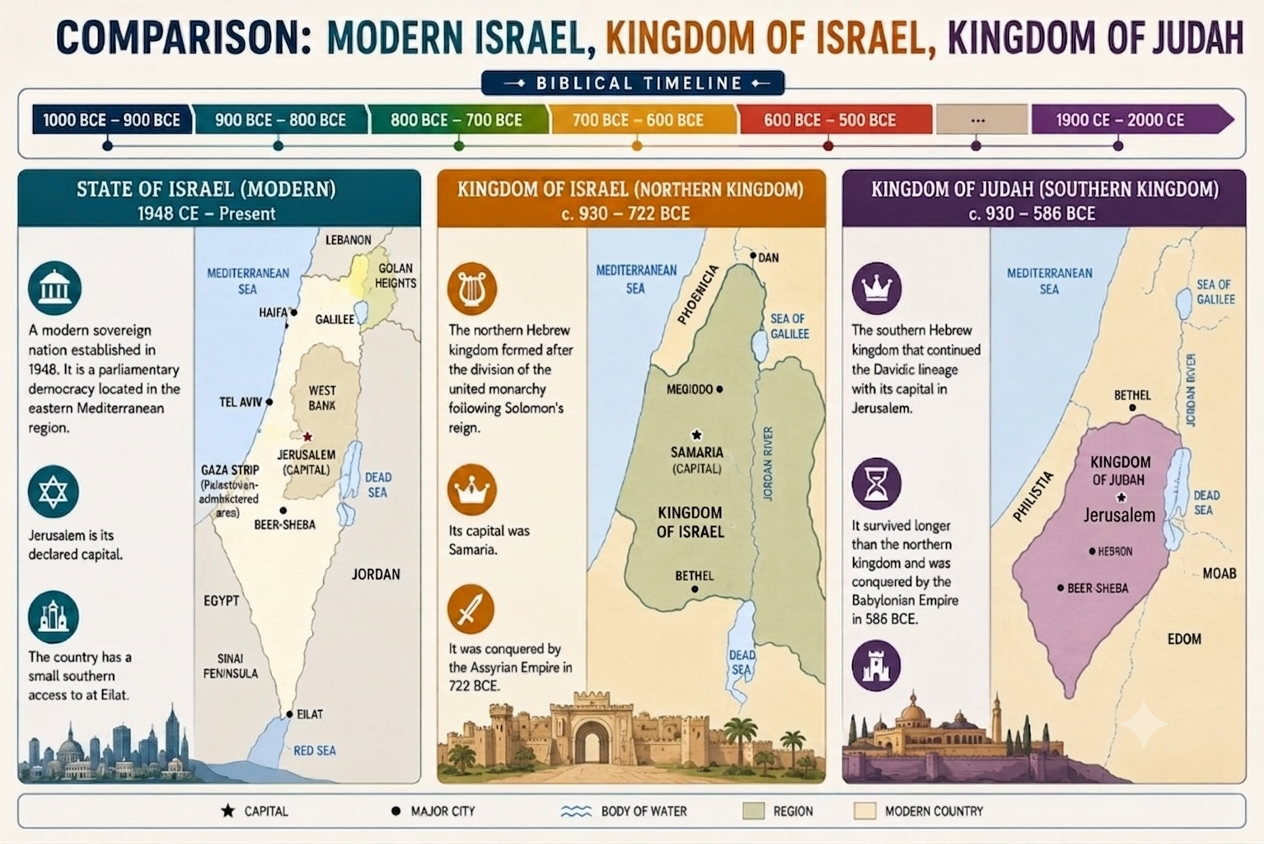
Comparison of the modern State of Israel with the biblical Kingdom of Israel (Northern Kingdom) and the Kingdom of Judah (Southern Kingdom)
Is Modern Israel Located in the Same Place as Biblical Israel?
One of the most common questions asked by Bible readers and first-time visitors is whether the modern State of Israel occupies the same land described in Scripture.
The answer is largely yes, but not entirely.
Modern Israel encompasses much of the region where many of the Bible's most significant events unfolded. Jerusalem, Nazareth, the Sea of Galilee, Mount Carmel, the Jezreel Valley, and much of the Judean Desert are all located within present-day Israel. These landscapes continue to provide the geographical backdrop for the stories of Abraham, King David, the prophets, Jesus, and the apostles.
However, the Bible's geographical references often extend beyond the borders of today's Israel. Many biblical places are now located in neighboring countries or territories, reflecting thousands of years of political and territorial change.
For example:
- Mount Nebo, where Moses viewed the Promised Land (Deuteronomy 34:1–4), is in modern-day Jordan.
- Petra, associated with the ancient kingdom of Edom, is also in Jordan.
- Damascus, frequently mentioned in both the Old and New Testaments, is in present-day Syria.
- Tyre and Sidon, important Phoenician cities referenced throughout Scripture, are located in modern Lebanon.
- Bethlehem, the birthplace of Jesus according to the New Testament (Matthew 2:1), is located in the West Bank.
This means that while many biblical locations are within modern Israel, the biblical world extended well beyond the borders of the modern state.
A Shared Landscape Across Three Thousand Years
Although governments, kingdoms, and borders have changed repeatedly, the physical landscape has remained remarkably consistent.
The hills surrounding Jerusalem still overlook the Judean wilderness. The Sea of Galilee continues to lie nearly 700 feet (about 210 meters) below sea level. Travelers can still stand on Mount Carmel overlooking the Jezreel Valley or walk through the ancient streets of Jerusalem's Old City.
This continuity allows visitors to connect biblical accounts with real places in a way that few destinations in the world can offer.
For many Christian pilgrims, reading passages such as Psalm 122 while overlooking Jerusalem or reflecting on Jesus' ministry along the shores of the Sea of Galilee brings Scripture into a vivid geographical context.
As the psalmist wrote:
"Our feet shall stand within thy gates, O Jerusalem." — Psalm 122:2 (KJV)
How Do the Borders of Biblical Israel Compare with Modern Israel?
Comparing biblical and modern borders is more complex than placing two maps side by side.
Unlike today's internationally recognized state boundaries, the borders of biblical Israel changed repeatedly throughout different periods of biblical history. They expanded during times of political strength and contracted during periods of invasion, division, and exile.
Several different "Israels" appear throughout the Bible:
The Promised Land
God's covenant with Abraham describes a broad territory extending from "the river of Egypt unto the great river, the river Euphrates" (Genesis 15:18, KJV). Scholars have long debated how this promise should be understood historically and theologically, and the passage should not be equated directly with the political borders of any later kingdom.
The Tribal Allotments
Following the conquest of Canaan, the land was divided among the Twelve Tribes of Israel (Joshua 13–21). These tribal territories did not always correspond to effective political control, and some regions remained inhabited by other peoples for generations.
The United Monarchy
Under Kings Saul, David, and Solomon (approximately the 11th–10th centuries BCE), Israel reached its greatest political unity. Jerusalem became the capital, and the kingdom exercised influence over neighboring territories.
After Solomon's death, however, the kingdom divided permanently.
The Divided Kingdoms
Beginning around 930 BCE, two separate kingdoms emerged:
- The Kingdom of Israel (Northern Kingdom) with its capital at Samaria
- The Kingdom of Judah (Southern Kingdom) centered on Jerusalem
These are the kingdoms illustrated in the comparison map earlier in this article.
The Northern Kingdom was conquered by Assyria in 722 BCE, while Judah remained independent until Babylon captured Jerusalem in 586 BCE.
"So was Israel carried away out of their own land to Assyria unto this day." — 2 Kings 17:23 (KJV)
"And he burned the house of the LORD... and all the houses of Jerusalem." — 2 Kings 25:9 (KJV)
Can You See Biblical Israel and Modern Israel on the Same Map?
Absolutely, and doing so is one of the most effective ways to understand the Bible geographically.
Overlaying ancient kingdoms onto a modern map reveals that many of the locations mentioned in Scripture remain easily identifiable today. Jerusalem still sits in the Judean hills. The Sea of Galilee remains in northern Israel. Megiddo overlooks the Jezreel Valley, while Beersheba continues to mark the gateway to the Negev.
At the same time, such maps highlight how political boundaries have changed. The kingdoms of Israel and Judah occupied only part of the wider biblical world, and many places associated with the patriarchs, prophets, and apostles now lie outside the borders of modern Israel.
For Bible students, pilgrims, and history enthusiasts alike, comparing ancient and modern maps provides valuable context that enriches both Scripture study and travel through the Holy Land.
Does Modern-Day Israel Include All the Land of Biblical Israel?
No. Modern Israel includes many of the Bible’s best-known locations, but not all of them.
Jerusalem, Nazareth, Capernaum, Megiddo, Beersheba, the Sea of Galilee, and much of the Judean Desert are within modern Israel. Other important biblical places are now found outside its borders.
For example:
- Bethlehem and Jericho are in the West Bank.
- Mount Nebo is in modern Jordan.
- Tyre and Sidon are in Lebanon.
- Damascus is in Syria.
- Parts of the biblical story also unfold in Egypt, Mesopotamia, and Asia Minor.
This is why the term biblical world is often more accurate than “biblical Israel” when discussing the full geographical setting of Scripture.
Biblical Israel Was Not One Fixed Territory
Another important point is that biblical Israel did not have one permanent border.
Its size and political structure changed over time. The Bible refers to tribal territories, the united kingdom under David and Solomon, the Northern Kingdom of Israel, and the Southern Kingdom of Judah.
These were not identical in size or administration.
The land described in the covenant with Abraham should also be understood in its biblical and theological context rather than treated as a modern political map.
In simple terms:
- Biblical Israel refers to several ancient periods and territories.
- Modern Israel is a contemporary state established in 1948.
- They overlap geographically, but they are not the same political entity.
What Archaeology Adds to the Picture
Archaeology helps connect biblical texts with the physical landscape.
Excavations at places such as Jerusalem, Megiddo, Hazor, Tel Dan, Beersheba, and Caesarea have uncovered city walls, gates, inscriptions, water systems, homes, roads, and places of worship from different historical periods.
These discoveries help scholars understand how people lived, traveled, governed, and worshiped in the ancient world.
Archaeology does not prove every event described in the Bible. It does, however, provide valuable historical context and helps identify many places mentioned in Scripture.
That distinction is important. Biblical text, archaeology, tradition, and historical interpretation each contribute different kinds of evidence.
Common Misconceptions
Biblical Israel and Modern Israel Have the Same Borders
They do not. Ancient borders changed repeatedly, while modern borders developed through much later historical events.
Every Biblical Site Is Inside Modern Israel
Many major sites are, but others are located in the West Bank, Jordan, Lebanon, Syria, Egypt, and beyond.
The Kingdom of Israel and the Kingdom of Judah Were the Same
They were separate kingdoms after the monarchy divided following Solomon’s reign.
The Northern Kingdom was called Israel and had Samaria as its capital. The Southern Kingdom was called Judah and was centered on Jerusalem.
Ancient Borders Can Be Drawn with Complete Precision
Historical maps are reconstructions.
They are based on biblical texts, archaeology, ancient records, and scholarly interpretation. Exact borders are not always known, especially for earlier periods.
Visiting Biblical Sites in Modern Israel Today
For travelers, the most meaningful connection between biblical Israel and modern Israel is found on the ground.
In Jerusalem, visitors can explore the City of David, the Mount of Olives, the Garden of Gethsemane, and the Old City. In northern Israel, the Sea of Galilee, Nazareth, Capernaum, and Mount Carmel bring the settings of both the Old and New Testaments into view.
Travelers interested in biblical kingdoms and archaeology may also include Megiddo, Hazor, Beersheba, and Tel Dan.
A well-planned itinerary should group sites geographically rather than trying to cover too much in one day. Jerusalem deserves dedicated time, while Galilee sites are best explored together from a northern base.
Christian travelers may also prefer an itinerary shaped around a particular theme, such as:
- The life and ministry of Jesus
- Jerusalem and the Passion narratives
- Old Testament kingdoms
- The prophets
- The early Church
- Biblical archaeology
For church groups, families, senior travelers, or visitors with limited time, a private or customized tour can make the route more comfortable and focused.
Biblical Israel and modern Israel share much of the same landscape, but they belong to very different historical periods.
Modern visitors can still stand in Jerusalem, walk beside the Sea of Galilee, explore ancient cities, and see the geography that shaped the biblical narrative. Understanding the difference between ancient kingdoms and the modern state makes those places easier to appreciate.
 Certificate of Excellence
 Guaranteed Departure
 Low Prices Guaranteed
 24/7 Support


