Aqaba is Jordan’s only seaport on the Red Sea, but it is much more than that and definitely worth incorporating a stop here into your tour to Petra. The city is known as the Jewel of the Middle East and is famed for its beautiful beaches, nightlife, and luxury resorts. The historic part of Aqaba has quaint stone buildings and cobbled lanes while the newer sections of the city have luxury resorts and amenities. And let's not forget water sports, museums, and more.
Pro Tip: As Aqaba is a special economic zone you can enjoy duty-free shopping!
 The city of Aqaba, with its giant Jordan flag
Aqaba is on Jordan’s Red Sea coastline, on the northeastern shore, not far from Eilat, the Israeli beach resort city.
Pro Tip: Petra, Wadi Rum, and Aqaba make up a golden triangle of tourist sites. If you’re taking a tour to Petra from Israel you can usually include a stop in Aqaba. The Israel-Jordan border crossing is just 5km from Aqaba. Also, if you're traveling to Jordan, make sure you won't do these common mistakes.
 The Aqaba Fortress (by Tamerlan CC BY-SA 3.0)
Aqaba has several archeological sites including Tal Al-Magass and Tal Hujayrat where there is evidence of human inhabitants going back to 4000 BC. The first port in Aqaba was probably built by the Edomites in about 1500 BC. And since then it has been a major hub of maritime trade thanks to the port’s location, where Asia meets Africa.
From 735 BC the city experienced prosperity under Assyrian, Babylonian, Persian, and Greek rule. The Greeks called Aqaba one of the most important trading cities in the Arab World and they named the city, Bernice. The Nabataeans were a powerful force to the north in their capital city, Petra. Even when Aqaba was ruled by the Romans (and renamed Aela) the Nabataeans had a significant influence on the city.
The city fell to Islamic conquerors in 650 AD. It was ruled by the Umayyads (661-750), the Abbasids (750-970), and the Fatimids (970-1116). They named their city Ayla, and Aqaba Fortress was built surrounded by formidable walls and towers. Pro Tip: if the fortress interests you there are artifacts from this period on display in the Aqaba Archaeological Museum.
The city was conquered yet again, this time by Baldwin I of Jerusalem in 1116. Under him, the Crusader fortress of Helim was built. But by the 12th century, following earthquakes and attacks from Bedouin and Mamluk forces the city began to decline. In 1187 Aqaba was captured by Saladin. He rebuilt the city, and in the 16th century the old fort was rebuilt but the city remained a simple fishing village for the next four hundred years.
 A 17th century map of the Aqaba area
In 1917 the legendary T.E. Lawrence (Lawrence of Arabia) together with Arab forces defeated the Ottoman forces at the Battle of Aqaba. In the 1920s the Arab rulers gave Aqaba to the British protectorate of Transjordan. In 1946 Jordan gained independence from the British and Aqaba grew as a modern city and beach resort. In 1989 excavations uncovered the ancient Muslim city of Ayla.
 The Aqaba south beach (CC BY-SA 4.0 by عباد ديرانية)
The Aqaba Mamluk castle was originally constructed by the Crusaders in the 12th century. When Saladin conquered the city the fort was destroyed, and later in the 16th century the structure was rebuilt under the Mamluk dynasty. A Mamluk inscription on the wall is dated 1514-1515. The fort played an important role in the Arab revolt in 1917 when the Ottomans were ousted. Over the years it offered shelter to pilgrims and travelers. Pro Tip: Spot the Hashemite coat of arms inscribed above the main gate.
 Mamluk Castle, Aqaba
The Red Sea is one of the best diving sites in the world thanks to the incredible coral reefs. There are about 30 designated dive sites off the Aqaba coast, and most of them are within the Aqaba Marine Park.
See shipwrecks, a sunken tank, and the underwater Japanese Gardens. There are numerous businesses along the coast offering snorkeling, diving, and boat excursions as well as water sports such as skiing, and jet skiing.
 Jet ski near the coast
The marine park protects precious coral reefs and the marine biosphere. The reef is home to thousands of colorful fish and 127 types of Insta-worthy coral formations. Pro Tip: Invest in a device that can take underwater photos, you won’t regret it! The park operates about 20 dive sites including the Japanese Garden and Taiyong Wreck.
ProTip: The glass-bottomed boat rides are great, and you'll see amazing aquatic animals without getting wet.
 Red Sea bay marine life
The aquarium is within the Marine Science Station Complex. Water is pumped directly from the Red Sea into the aquarium tanks where you can see a wide variety of local fish and marine life.
Thousands of migrating birds stop in the Gulf of Aqaba each year. Visit the Aqaba Bird Observatory where there are man-made wetlands, to get up close to the feathered friends, and see some of 390 bird species. The observatory is located in Al-Salam Forest, near the Araba border crossing into Israel.
 An Osprey with its prey, both surprised to see you!
Aqaba is a popular golfing destination thanks to the unique 18-hole championship course - Ayla Golf Club and the Ayla Golf Academy, a nine-hole flood-lit course.
See the archaeological remains of a 4th-century Roman church. It is believed to be one of the world’s oldest purpose-built churches.
 The ancient church of Aqaba
This beautiful white mosque stands between the souq and the beach. It is named after the initiator of the Arab Revolt, Sharif and Emir of Mecca (1908 to 1917). It has the largest dome of all Jordan’s mosques as well as stunning glass windows, and manicured gardens. Note that the mosque is closed to tourists during prayer time.
 Hussein Bin Ali Mosque
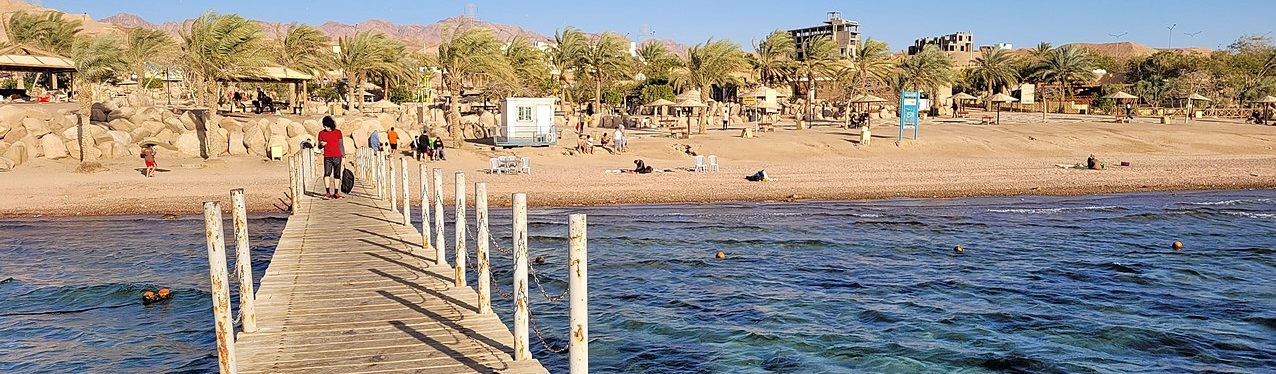
Aqaba has exquisite white sand beaches which are framed by a promenade (Aqaba Corniche) where you’ll find cafes, restaurants, and hubbly bubbly lounges. ProTip: visit Al-Hafayer Beach (Palm Beach) which runs parallel to the corniche, where there are vegetables and fruit orchards cultivated by locals. If you’d like a quieter beach head to Berenice Beach Club.
 Enjoy the beaches of Aqaba
If you want to see a traditional home visit this museum where you can see an intact model of a mud house, with a pine leaf roof, and gravel floor. The house is furnished with authentic traditional furniture and household articles. Pro Tip: This museum has free admission.
The ancient Muslim city Alya was built in 650 AD and surrounded by fortified walls. You can explore the remains of the city and walk within the 2.5-meter-thick walls and through ancient stone gateways.
The museum is housed in the former home of Sharif Hussein bin Ali. It holds a collection of artifacts dating back 6,000 years.
 The Aqaba Museum (by Ana al'ain CC BY-SA 3.0)
Stroll along the picturesque lanes and browse through the market stalls. You’ll find fresh produce, spices piled high, and handicrafts.
 A traditional Souq
Join Us
Keep in Touch


 Login / Register
 Contact


 Show On Map


 Certificate of Excellence
 Guaranteed Departure
 Low Prices Guaranteed
 24/7 Support