Israel for Kids


A Great Outdoors Day Trip around Haifa

The Haifa region is one of the most beautiful in the country; it is blessed with forest covered mountains, valleys, rivers, the sea and vibrant cities. Here is an idea for a fun family outing to get a taste of Israel’s countryside and have an adventure. If you are coming from the Tel Aviv drive up the coastal road (route #2) passed Herzliya, Netanya and Caesarea. All the way you will have gorgeous Mediterranean Sea on your left and farmlands on your right. Turn onto route 70 at the Zichron Yaakov Interchange; at the Fureidis junction connect with route 4 traveling north. After about 20 minutes you will see Nahal Mearot on your right.View of Haifa from the top of Mount Carmel.Photo by Ste Ben8 on UnsplashNahal MearotOnce you reach the end of the cave there is a short film showing the dramatized life of a family of prehistoric cave dwellers. Just outside the Nahal Cave, you can see where one of 84 buried prehistoric skeletons was found. Next to the entrance of each cave, there is an information board with illustrations showing how the caves were formed and explanations in English and Hebrew.When you have enjoyed the fresh mountain air and views from the mountain slopes it is time to continue the day’s adventure. Continue north on route 4 until route 721 takes you east up into the Carmel Mountains. You’ll be surrounded by greenery as you wend your way along narrow roads clinging to the mountainsides.This route takes you through Mount Carmel National Park In 1989 a massive forest fire swept across the Carmel Mountains destroying 790 acres of natural forest. Again in 2010 a forest fire erupted across Mount Carmel and raged for 4 days claiming the lives of 44 people. 17,000 people were evacuated and 9,900 acres of forest were destroyed.Since then major projects have been initiated to replant trees across Carmel. A drive through this area; through the heart of the disaster area will show you that the forests are again thriving. Look out along the way for the mountain top memorial to those who lost their lives in the fire. The monument is a beautiful sculpture that can be seen from far away. Turn onto Route 672 which takes you past the Haifa University campus and make a sharp right onto route 705 which will bring you to the JNF Eagle Park or KKL Nesher Park.Haifa view from the Bahai Gardens' Terrace. Photo by Piotr Musioł on UnsplashNesher Park – The Hanging BridgesKids will love this short hike which takes you down a level footpath through the vegetation along the edge of a wadi (dry river gully). Looking up you can see the tall university building; the tallest building on the Carmel Mountain which looks down over Haifa. The footpath brings you to a 70-meter steel cable suspended bridge crossing the gully of Nahal Katia.The gully flows with water during the winter. Cross the bridge and then decide if you want to descend into the gully for a longer route or make a circular route crossing another suspension bridge a little further along to bring you back to where you started. In the gully, there is a quaint stone bridge that takes you further down to a woodland area where there are benches, picnic spots, and lookout points.The whole route takes about an hour to complete. Continuing on your day trip return to route 672 and wend your way down the mountainside into the city of Haifa. Route 672 reaches a fork in the road where you take the right-hand route 23 along Bikurim Street, HaAsif Street, and then left onto Sderot Kish which becomes Yefe Nof Street. Park your car on Yefe Nof when you see signs to the Ba’ha Gardens and follow the path downwards.Sailboat at Haifa Bay.Photo by Fr. Daniel Ciucci on UnsplashBa’hai Gardens, HaifaThe Ba’hai Gardens were built as a setting for the shrines of the founders of the Ba’hai faith. The Ba’hai faith is a monotheistic religion based on the teachings of the Bab and Bah’a’u’llah; prophets who received revelations from God. The Ba’hai accept the validity of other faiths and have a unique worldview.There are 450 plant species in the gardens which stretch for 1km on the northern slope of Mount Carmel in the heart of Haifa. From the top to the bottom of the 19 garden terraces it is 225 meters and at its widest point, the gardens are 400 meters wide. There are three access points to the Ba’hai Garden – from Yefe Nof Street above the upper gardens and shrine; from Hatzionut Avenue which is on the same level as the Shrine or from the bottom of the gardens at the plaza on the junction of Ben Gurion Ave and Hagefen Street in the German Colony.At 61 Yefe Nof Street, there is a viewing balcony where you can have a panoramic view of the terraced gardens and the bay of Haifa. Descending along paved paths through the gardens from the crest of Mount Carmel towards the Shrine of the Bab you will see the amazing terraces of formal and informal gardens. Halfway down the garden is the Shrine of the Bab a solemn holy site and a symbol of Haifa. The small Grecian-style shrine has a distinctive gold dome and white walls. Below the shrine, the garden terraces continue flanked by twin streams of cascading water, bridges, and steps.The Shrine of the Báb, Haifa. Photo by Ameer Basheer on UnsplashMore Sites along the WayIf that is not enough for one day or if you want to swap one of these sites for another there are many other great attractions in the area. You could visit the former British detainee camp in Atlit; the artists’ village of Ein Hod; the Haifa Science Museum or spend time on one of Haifa’s beaches. You could also follow this itinerary in reverse order.Practical InformationNahal Mearot: Admission: Adult 22 ILS, child 10 ILS, student 19 ILS, senior 11 ILS. Open Hours: Sun-Thurs 8 am-5 pm; Friday and holiday Eves 8 am-4 pm. Closure an hour earlier in winter. Information: 04 9841750/2Nesher Park: Admission: Free. Open Hours: Visit in daylight hours.Ba’hai Gardens: Admission: Free. Open Hours: Outer Gardens 9 am-5 pm daily; Shrine and Inner Gardens 9 am-noon. There are walk-in tours in English at noon every day except Wednesdays and also at 1:30 pm on Saturdays. Other tours in Hebrew, Russian and Arabic are held at 10 am, 11:30 am, 12:30 pm, 1:30 pm, and 2 pm daily except on Wednesdays. The site is closed on the Ba’hai holidays and temporarily in rainy weather. Note: As a religious site please dress modestly and act with respect at the Ba’hai Shrine.For a real taste of local life in Haifa and its surroundings, book a private Haifa tour!Bahai Gardens, Haifa.Photo by David Holifield on Unsplash
Von Petal Mashraki

Watching Meteor Showers in Israel

One of the fun things my family does during August in Israel is to go out into the nearby farmlands, in the middle of the night, and watch the Perseid meteor shower. To get the best possible view of any meteor shower you need to be away from city lights, preferably in an elevated place, in a dark area and of course be in the right place at the right time.Where to See Meteor Showers in IsraelSo if you’re looking for a place away from the city lights to spot meteors in Israel then there are a few well known and popular places where groups gather each year to watch the spectacle. In 2012 about 9,000 Israelis gathered at Mitzpe Ramon in the Negev to watch the Perseid meteor shower.The 914.4m high location makes it even easier to spot the meteors which fall at a rate of one a minute. Club Ramon, in Mitzpe Ramon offers a 3 day program which includes accommodation, entertainment, walking tours and guided sky gazing to see the meteors. The city of Mitzpe Ramon even dims the lights at night to make it possible for the many visitors to get a better look at the meteor shower. If you’d rather have a company handle the logistics of getting to a good viewing spot then there are several options. Astronomy Israel offers Naked Eye and Telescopic Tours of the Night Sky from Mitzpe Ramon. The nearby Arava Desert is another great place to see meteor showers in Israel, mainly because of the intense darkness. In Eilat astronomer Eitan Schwartz takes groups 10km out of the city to a place near Be’er Ora where they can see the shower and even camp under the stars. The Golan Heights and Galilee are also elevated points where the showers can be seen well.The Most Stunning Meteor Showers in Israel From mid-January to mid-April there is no significant show of meteors but after that there are several showers worth seeing. The Lyrids Meteor Shower is in late April (April 16th-25th in 2014) and can reach 100 meteors an hour but averages about 10 – 20 an hour. The Aquarids Shower occurs in early May in Israel (April 19th to May 28th in 2014 with peak on May 5th) this shower can have up to 30 meteors an hour at its peak.Perseid Meteor Shower, this is perhaps the most visible meteor shower in Israel and up to 60 meteors can be seen an hour. The shower runs from July 17th to August 24th with the peak in 2013 on the night of August 11th. 2013 is set to be one of the best years to see the Perseids in Israel as the moon will set not long after midnight leaving a dark sky. The best time to see them is between 11:30pm and 4:30am.Delta Aquarids shower, late July to early August (July 12th to August 23 in 2013 with peak on July 27th) can best be seen after midnight. There can be up to 20 meteors an hour.The Orionids meteor shower in October peaks on October 21st and 22nd and can give a bright show.Draconids meteor shower in 2013 is set to be one of the most spectacular showings ever with up to 750 meteors an hour! The shower runs from October 6th to 10th and peaks on the 8th and 9th.Taurids peaks on November 4th and 5th and is a minor meteor shower and the Leonids gives an average showing peaking on November 16th and 17th but in 2013 will be hard to see because of the light from the full moon.Quadrantids, late December early January (January 1st-5th in 2014), there is usually not a strong showing of this shower in Israel but the shower can reach up to 40 meteors an hour. Look in the direction of the Bootes Constellation.
Von Petal Mashraki

Best Desert Hikes in Israel

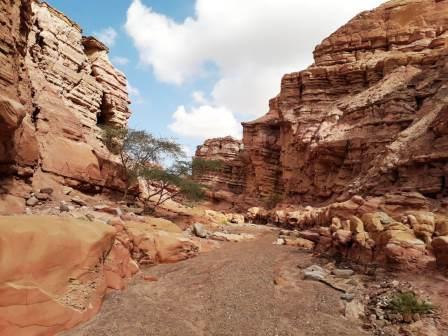
Israel has snow-capped mountains; rolling green meadows; lush valleys and stark desert landscapes. Israel's deserts are concentrated in the southern half of the country and include the Judean Desert, home to the Dead Sea; the Negev Desert covering about 16,000km²; more than half the total land area of the country and the Zin Desert also known as the biblical Wilderness of Zin.There are numerous hike trails in Israel's deserts with various levels of difficulty and different lengths. The deserts offer a unique look at a fascinating ecosystem with spectacular flora and fauna; picturesque waterfalls and endless awe-inspiring views. It is best not to hike in the desert alone and you should always follow the well-marked hike trails. Bring plenty of water and wear a hat when hiking in Israel's deserts. The best way to experience Israel's deserts is to follow one of these exhilarating desert hikes in Israel.Red Canyon HikeThis is one of the most breathtaking desert hikes in Israel. The Red Canyon is part of Wadi Shani which starts in the Sinai Desert in Egypt and crosses into Israel. Over the course of thousands of years, the elements have carved through the red sandstone rocks creating this natural canyon. There are a few places along the trail where you need to use metal wedges and ladders to get through the narrow canyon. The trail is at its best from November to April when the weather is slightly cooler. You can take the 5km route or the easier 2km route from the trailhead parking lot. You'll pass a few dry waterfalls and take some sharp turns in the narrow canyon which is less than 2 meters wide at some points. You'll reach a junction where there are black markers that will take you back to the starting point if you want to take the short hike. Otherwise, continue following the green markers into the Wadi. The loop trail should take about 3 hours to complete.Ein Gedi Nature ReserveA hike through the Ein Gedi Nature Reserve; an oasis in the Judean Desert, is one of the most enjoyable and greenest hikes in Israel. The reserve is home to the Arugot Stream and David Stream. There are several trails of different lengths and levels of difficulty ranging from a family-friendly 2km trail to a challenging 10km hike trail. Much of the shorter route is along wooden walkways or well-trodden paths that are not too challenging. You'll feel like you're taking a hike in northern Israel, surrounded by lush vegetation, trees, and abundant streams and waterfalls. The short Nahal David hike from the park entrance to David's Waterfall takes just 30 minutes. The rest of the hike involves tougher terrain, a twisting route through a narrow canyon, and some steep climbs. You'll also find sections where it is easier to wade through the streams than stay on the path. Continuing through the canyon you'll reach a spot where a natural opening in the rocks creates a "window" overlooking the Dead Sea.Wadi Qelt HikeThere are plenty of hikes near Jerusalem but if you want to experience the desert then Wadi Kelt (also known as Ein Prat or Nahal Kelt) is an excellent choice less than an hour from the capital. Starting at the trailhead in Ein Prat Nature Reserve parking lot the scenic route has a total length of about 9km but there are shorter versions of 1-5km. The best time to hike through Wadi Qelt is December to March. Most of the hike is through rocky terrain and there are some parts where metal handles have been hammered into the rock to help you. You'll go through a gorge with steep cliff sides and find natural pools you can swim in. Stop at Ein Prat, the biggest spring in the valley; enjoy small waterfalls; ancient aqueducts, and the 330AD hanging Faran Monastery on the southern cliffs. The highlight of this hike is at the end of the trail when you can look up at the Greek Orthodox Monastery of St. George that was built precariously clinging to the cliffs. End the hike by returning the way you came or taking a shortcut along the top of the canyon where you can look down on the famous monastery on the opposite cliff.The Nekarot Horseshoe Hike Trail through the Ramon CraterMakhtesh Ramon (Ramon Crater) is a phenomenal massive crater formed by erosion. It is 40km long, 500m deep, and 2-10km wide. Enter the Makhtesh Ramon Nature Reserve for the best experience of the crater on the southern edge of the Negev Desert. This huge natural indentation in the landscape has vibrant colored rocks, a variety of plant life, and unusual geographical formations. Take the Nekarot Horseshoe Trail loop through the crater. At a little over 6km, this trail should take about 3 hours and is suitable for families. The trail takes you past the Saharonim Spring where pools of water bubble up from the ground; past families of agile ibexes on the rocks and steel white chalk cliffs. Depending on the season you may have to swim, wade or walk through water-filled canyons. See Ardon Mountain in the distance and enjoy the deafening silence of the desert.Ein Avdat National Park Hike TrailsEin Avdat is part of the Zin Wadi or the Biblical Zin Wilderness in the Negev Desert. It is home to the largest natural spring in the Negev and a stunning 2km-long hike trail. This short hike takes you from the Ein Avdat National Park entrance to the beautiful natural pools and back again. If you are looking for something a little longer then hike to the spring water pools and instead of doubling back climb to the top of the cliffs and return via Marl Wadi of Havarim. This 10km hike is for moderately fit hikers and is best followed from December to March. The highlight of both the short and long hikes is the chain of three Ein Avdat spring pools. The first pool (Ein Ma'arif) has cascading waterfalls; the second, Ein Avdat has a 15m-high waterfall and an 8m-deep pool; the final pool is beautiful Ein Mor. When you leave the pools you can take the vertical ladder up the cliff and head back to the starting point through gentle hills that have multiple shades of golden brown.
Von Petal Mashraki

International Festival of Puppet Theatre Jerusalem

For four days in August the Train Theatre presents puppet shows and performances from Israel and around the world. The performances range from modern to traditional puppet theatre and from internationally acclaimed puppet troupes to relatively unknown performers. The aim of the festival is to introduce the public to the many facets of puppetry and show the artistic complexity, communicative power and sophisticated aspects of puppetry for all ages and tastes. Performances take place both at indoor venues across Jerusalem and in the theatre courtyard so that many of the events are free. The festival promotes multi-cultural interaction and a chance to learn about the world of puppetry and have some fun at the same time. The event is geared towards adults and children alike, in fact there are even puppet shows for adults only. The festival is a major platform for up-and-coming puppet artists and the performances are unique, professional and of exceptional quality.In addition to the puppet performances there are puptrpetry workshops and a chance to meet the artists. Performances take place throughout the day from 10am to 11pm and are listed according to the ideal age of the audience. There are shows suited for 2-4 year olds, 4-9 year olds, 3-9 year olds, 3-8 year olds, 3-7 year olds, 5-12 year olds, over 8s, all ages and for adults only. Among the international performers at the festival this year there are artists from Germany, France, Switzerland, Spain and China represented by master puppeteer Yeung Fai.Special Festival Eventsfish puppetZoooo-There is no Animal like It – This event has been specially created for the festival; it will take place in the Jerusalem Liberty Bell Park. At this multidisciplinary event visitors can meet all kinds of “animals” created by master puppeteers. See puppet monkeys, giraffes, tigers and go on a safari. There will be live musical performances and activities for the whole family a the park becomes a zoo of puppets.a puppet showStory time – There will be story time for kids using puppets to act out the stories.Coffee with Puppets – Visitors are invited to enjoy a cup of coffee with the puppets while joining in the puppet technique workshop. There will also be puppet making and mask making workshops.Sing-along – There will be a public sing-along of well known songs using puppets.Animal Band – See a musical performance where the performers are puppet animals.Every evening at 10pm there will be musical performances, cabarets and parties for adults only in the courtyard Khan.Practical Details:Where: Train Theatre, Khan Theatre, Gerard Behar Center, The First Station and Beit Shmuel, JerusalemWhen: 15-18 August 2016Admission: 10ILS-100ILS depending on the performance.Contact: For more information call 02 5618514 or see the Train Theatre website.
Von Petal Mashraki

Knights of the Night Festival in the Jerusalem Old City 2013

Once a year the Old City of Jerusalem reverts to the Middle Ages and visitors can wander the narrow cobbled lanes and encounter scenes with knights doing gallant and valiant acts! The theme of this year’s Knights of the Night Festival is “Knights and Dragons” and entrance to the fun family event is free!As you stroll through the streets of the Old City you may see musicians performing medieval music; dancers in medieval costume; magicians who look remarkably like Merlin and Jesters offering comic relief. Knights and dragons also feature prominently, with re-enacted jousting, sword fights and duels. Town criers ring their bells to beckon pedestrians to the various stages set up for performers and above the streets flags fly. In previous years there have even been performances by costumed “knights” battling as they hang from wires and fly through the air with the ancient city walls as their background.You may see medieval blacksmiths or the local executioner with his big axe waiting in the shadows! In previous years performers from other countries have joined Israelis in the many street shows and in 2013 artists from the Venice Festival will be participating in the event. Peddlers in medieval costume and fire eaters perform as the medieval music permeates the air. You may even see a performance from Shakespeare’s Romeo and Juliet performed from a real balcony or a knight in shining armor rescuing a princess. Get your fortune told by a soothsayer and cheer for the troubadours!For the 2013 Knights Festival some of the stations planned include a knight’s banquet at the Jaffa Gate; a victory parade; a battle between knights and dragons where the audience will be invited to join in; a treasure hunt with audience participation and a half-man-half-dragon chasing after a maiden in distress along St. Peter Street. Adults can purchase a wooden goblet and enter the Knights Bar to quench their thirst.To experience this slice of living history enter the Old City of Jerusalem through the Jaffa Gate and follow the circular route to the Muristan Square and back again to the Jaffa Gate. The fun and games will occur from 6pm to 11pm in the Christian Quarter of Jerusalem’s Old City and will be held on the 31st October and 7th, 14th and 21st of November 2013 (consecutive Thursdays). Entrance is free and the event is suitable for the whole family.
Von Petal Mashraki

Food and Drink Festivals in Israel

Food is always a highlight of any trip to Israel; the country has delicious locally created dishes and many international imports brought to the Holy Land by immigrants. Wine has been produced in Israel since Biblical times and the rich soil and varied terrains provide nourishing earth for the local vineyards. If you are lucky enough to be in Israel during one of these food and beverage festivals then you will have the opportunity to sample some of the country’s best cuisine.Chefs for Peace Food EventThis festival was established by a group of Christian, Muslim, and Jewish chefs who want to promote peace by bringing people together over a meal. Using food as a common language they hold events throughout the country and sometimes internationally. At these events, you can taste dishes prepared by the chefs and help support their worthy cause. The aim of the Chefs for Peace is to promote understanding and coexistence between the different cultures in the region and hopefully reduce conflict. The chefs see food as the universal means of encountering new cultures. In the past Chefs for Peace events have been held in many countries like Norway, Canada, Italy and most often in Israel. Check out their list of upcoming events on the Chefs for Peace website.So French So Good, FebruaryFor the fourth year running So French, So Good is putting the spotlight on French cuisine with the help of 28 restaurants and 4 bakeries from around the country. This culinary festival is presented by Israeli chefs and bakeries in collaboration with French chefs to create French/Israeli fusion dishes. The festival is run by the French Embassy in Israel and is held at the beginning of February (February 8-10, 2016). For the 2016 festival one of the participants was Chef Laurent Azoulay, a Michelin-star chef from L’Ekrin restaurant in Meribel, ski resort in the French Alps who joined Meir Adoni of the BlueSky restaurant and judge on one of Israel’s cooking reality shows. Other chefs who have joined together for the festival are Chef Michel Sarran (Michelin rated) from Toulouse who worked together with Israeli Chef Moran Yanai who has his restaurant in Hotel Montefiore. By pairing up French chefs with Israeli chefs many amazing new creations are produced. The ideas and culinary customs of the French and Israeli culture come together to create a unique food. In the 2016 festival chefs came from Acre, Tiberias, Beer Sheva and Tel Aviv. While the international side of the equation was filled in by chefs like Ridha Khadher of the Au Paradis du Gourmand in Paris, Guillaume Gomez, head chef of the Presidential Palace Elysee and Stephane Leger of Archange restaurant in Saint Raphael. The festival will be held in restaurants across the country where the specially created menus will be on offer. In addition to the French culinary delights there are also screenings of food-related films at the French Institute in Tel Aviv, cookery classes at the Sheraton Tel Aviv and French alcohol tasting.Shokoland Chocolate Festival, FebruaryTel Aviv’s chocolate festival is held for three days at the historic Old Station complex – HaTachana. The country’s top chocolatiers come together to present a huge range of chocolates At the festival there are also cooking demonstrations, chocolate making demonstrations, chocolate displays, chocolate tastings, chocolate ice-creams, chocolate sculptures, chocolate fondue and even chocolate beer. The countries chocolate boutique stores will treating you to delicious chocolate in all shapes, flavors and colors.Diner en Blanc , Junehe concept behind this culinary event is to bring people together across a table to share a meal. The dinner is held the night before Tel Aviv’s famous Tel Aviv White Nights when the city’s restaurants, clubs and some stores stay open until the early hours of the morning. 2016 will be the 3rd annual Diner en Blanc event and about 500 people will take part. The location of this pop-up event is only announced an hour before the dinner to people who have previously registered online. Participants need to bring their own white table, white chairs and picnic basket full of delicious food. Dinner in White is an elegant and sophisticated event held in up to 60 locations around the world. The whole event is decorated in white with white table cloths, decorations and balloons. The participants are asked to attend wearing only white clothes. While eating their dinner there is live entertainment and dancing. The event is quiet exclusive with “friends bring friends” so you can’t really get an invitation unless you know someone who is already involved. There are also quite a lot of rules about etiquette and decorum at the event.Taste of Tel Aviv Food Festival ,JuneTel Aviv has literally thousands of restaurants from gourmet fine dining establishments to hole-in-the-wall humus places. You won’t be able to sample all that the city’s restaurants have to offer but you can do pretty well if you attend this festival held in the spring. Some of Israel’s most renowned chefs participate as well as many restaurants from the city. Each restaurant sets up a stall in the festival and offers a selection of food from their menu all at a drastically reduced price. The idea is to bring gourmet food to the general public at affordable prices. The festival is the largest food festival in the country and is visited by over a million people each year (making a profit of over a million dollars). Restaurants offer a tasting menu for a set discount price. Dates for the next festival have yet to be announced but it is usually held in Ganei Yehoshua (HaYarkon Park), Tel Aviv.Herzliya Marina Beer Festival ,JulyThe Herzliya Marina is a great place to visit even if you miss the festival; a large up-market mall faces the marina where yachts are docked along the edge of a wide expansive deck and plaza. This is where the festival is held, out in the open on long summer nights. The festival presents a wide variety of beers as well as a beer-brewing competition. While sipping beer and enjoying the sea breeze visitors are entertained by live performances by top Israeli artists.Chef, Eat!JulyUnlike other food festivals this one does not have one location or even one date; it is held in several restaurants across Jerusalem a number of times a year. Participating restaurants offer a two course meal at a discount price. Guests get a starter and main course for under 100ILS plus they can add a few extra shekels for dessert.Jerusalem Wine Festival, August2016 was the 13th year for this annual festival. It is Israel’s largest wine festival and features wine tastings, food stalls, workshops and live musical performances. The Israel Museum hosts this beverage event which feels a lot more cultural because of its surroundings than other alcohol festivals do. The event is held in the grounds of the museum where there are several sculptures and works of art. The festival celebrates Israeli wines and snacks are on offer while live music plays in the background. Approximately 60 Israeli wineries are represented offering over 100 different types of wine. In 2016 20,000 people are expected to attend. At the festival you can buy bottles of the Israeli wines to take home.Jerusalem Beer Festival, AugustThis is perhaps the biggest and most important annual beer event in Israel. Over the course of two days the festival is open from sundown until midnight and sees about 20,000 guests. 2016 will be the 11th year for the annual festival. In the past it has been held in the historic Old Train Station complex and at Gan HaAtzmut. At the event Israeli breweries set up stalls offering a taste of their brew. There are over 150 beers offered each year from large and micro-breweries including international labels. You have the opportunity to sample beer from Germany, Spain, Italy, Belgium, Japan and more. There are even some unusual beers like banana infused beer. In addition to the beer guests will be entertained by live musical performances and the beer is accompanied by a great selection of food. There will also be beer making demonstrations and an arts and craft market. In 2015 tickets cost 40ILS.Around the World in Rishon LeZion, AugustThe world food fair (Yarid Colinari, Ta’am Olami) offers a taste of cuisine from countries around the globe and entrance is free. The festival is held in the 140 dunam Shikma Park along the avenue of palm trees and on the lawns of the park. Ten zones of the world are created featuring large models of the country’s landmarks; the country or region’s traditional foods as well as other cultural elements like national costume, traditional folk dancing and the local music. On the lawns of the park will be a Greek-style tavern selling beers, cocktails and wine from around the world. In the same area here will be a special section for cheeses from around the world and those entering the area where alcohol is sold will have to show ID to prove they are over 18. In the past the countries represented were America, France, Italy, Lebanon, China, Morocco, Greece, Russia and India.The Kosher Taste of the City, AugustIsraeli cuisine faces the unique challenge of contending with kosher law – no mixing of meat and milk; no seafood; no fish without scales and fins; meat must be from specific animals, slaughtered in a specific manner and prepared in a specific way. This is one of the rare festivals where kosher-observant Jews can enjoy the food on offer. The event is held on the Hof Argmon promenade in Natanya where kosher restaurants present their dishes for a small price (usually under 80ILS). Kitchenware is sold at the festival and there are a number of activities including kid’s entertainment and life musical performances. The festival lasts 10 days and about 50 kosher gourmet restaurants participate.Taste of the Galilee Food Festival, September/OctoberThis annual event is held in the Galilee region of northern Israel at Montfort Lake Park and select locations in the region usually during the Sukkot holidays. The festival features music, workshops, shows, children’s activities and foods produced and grown in the Galilee region. Cafes, restaurants and kibbutzim will be participating and presenting themed menus. The festival highlights the culinary world of northern Israel, the rich farm produce and cottage industry food products as well as the Galilee’s famous wines. Entrance is free to Montfort Lake Park where you can relax on the lawns between meals, rent pedal boats on the lake and enjoy the live performances in the evening. The festival opens in the park at noon and continues until sundown when the shows begin.Taybeh Oktoberfest, OctoberTaybeh is a small Christian village in Palestine’s West Bank surrounded by the majority Muslim communities. Although the Muslim majority prohibits alcohol for religious reasons the Christians of Taybeh have managed to keep one of the oldest trades in the Holy Land alive. Here the municipality has collaborated with the local brewery since 2005 in holding the West Banks only beer festival. The festival has gone from strength to strength and draws in approximately 16,000 visitors each year for the two day festival. The event boosts the local economy and has put the small village of Taybeh on the international map. The Taybeh Brewing Company’s beer is drunk in countries around the world and they have recently added wine to their product list. The wine is called “Nadim” and is produced in the company’s new winery which is beneath a boutique hotel built specifically to accommodate visitors to the brewery, winery and festival.Visiting the festival supports local businesses and helps to bring stability to this area of the country where life always seems to be in flux. The festival is usually held on the first Saturday and Sunday of October but exact dates for 2016 have not yet been announced. At the festival local music groups perform as well as international guest artists. Performances are in several venues and there are also local arts and crafts on sale as well as village tours, a small museum, a Taybeh beer tour and exhibitions held at the Society for the Preservation of Christian Heritage Historical Center of Taybeh. At past festivals there have been street hockey games, Henna body painting, prayer services in the three local churches, folklore dancing performances, stand-up comedy performances, a children’s program, karate demonstrations and a lottery. You can also buy local products like olive oil and honey. The festival helps to promote a different side of Palestine to that perceived on the international news.A-Sham - Arab Food Festival of Haifa, December2016 was the first year for Israel’s Arab Food Festival. The festival looks to become an annual event and features 25 chefs, Jewish, Christian and Muslim from across the country. Arabic delicacies are created by chefs of all faiths in Israel, there are no borders or political conflict when it comes to Israel’s culinary community. Haifa is the perfect city to host this festival as citizens of all faiths share the city and mostly live in harmony side-by-side. The Holiday of Holidays is an annual event when Hanukah, Christmas and Eid al-Fitr are celebrated together by events held throughout the city. The Arab Food Festival is now a part of the annual Holiday of Holidays events. The festival was the idea of Arab Israeli chef Nof Atamna-Ismaeel, the winner of Israel’s 2014 reality show Master Chef (and also a microbiologist). The festival highlights traditional Arabic cuisine which is fast disappearing from the local culinary landscape. The Levantine kitchen is presented in a number of variations to show the cultural context of these dishes and the traditional lifestyles. Many of the traditional Arabic dishes are very labor intensive and many are associated with specific events like religious festivals, weddings and celebrating a new born. Among the traditional Arabic foods on offer there is hilbe, commonly eaten by Yemeni Jews and made out of fenugreek seeds; habisa, a black and white dessert sweetened with carob juice and haroumanieh, eggplant and green lentils prepared in pomegranate juice. Those wanting to enjoy the amazing Arabic foods on offer only need to pay 35ILS (2015 price); you then receive a map of 25 restaurants offering the festival dishes and you can set off to taste them at the various eateries. There are a number of additional festival events including a workshop given by Christian Orthodox Arab women of how to prepare traditional Christmas cookies; tastings of Galilee olive oil, honey, almonds and carob syrup and panel discussions.
Von Petal Mashraki

Guide to Mitzpe Ramon and the Surrounding Negev Desert

The small community of Mitzpe Ramon in southern Israel sits on the edge of Makhtesh Ramon (the Ramon Crater); a 38 km wide crater formed thousands of years ago. Perched on the northern ridge of the crater, overlooking the Negev Desert, Mitzpe Ramon has breathtaking views across the desert and plenty to see and do.The community was founded in 1951 to accommodate workers constructing the road to Eilat. Immigrants from Romania and North Africa settled here and the town grew to be a thriving community and the gateway to the Negev. Although Mitzpe Ramon is in the desert it enjoys relatively cool weather thanks to the winds which blow in across the crater to the elevated town. Mitzpe Ramon even experiences snow several times a year. In recent years the area has become a center for organic farming, homemade food products, spiritual retreats, and natural living. A visit to Mitzpe Ramon offers a completely fresh and unique experience, unlike anything you could experience in any other part of Israel.Getting to Mitzpe RamonIf arriving from Tel Aviv take the #40 highway south to Mitzpe Ramon; the town is about 85 km south of Be’er Sheva. If setting out in Tel Aviv you can take #660 and from Jerusalem bus #470. Trains travel from Tel Aviv arriving in Be’er Sheva and from there you can continue on to Mitzpe Ramon by bus #65 or #64. Driving from Tel Aviv to Mitzpe Ramon will take you about 1.15 hours and the bus or train and bus combo will take you 1.15-3 hours. Once in Mitzpe Ramon you can explore the town on foot or by car and take organized excursions into the desert.Mitzpe Ramon AccommodationThere are about six hotels in Mitzpe Ramon including the famous Beresheet Hotel, a luxury hotel of the Isrotel chain which overlooks the crater. Each room has views of the crater and there are spa treatments on offer as well as gourmet food. Chez Eugene is a recommended chic boutique hotel and there is also the Ramon Suites Hotel and Ramon Inn. In the surrounding areas, there are many B&Bs and small inns as well as campgrounds. Try the ibex Unique Desert Inn or Khan Be’erotayim for a desert experience. Budget accommodation can be found at the Green Backpackers Hostel, Mitzpe Ramon Hostel, or the basic Succah in the Desert.Mitzpe Ramon EateriesThe region is known for its organic farms and traditionally edible products like honey, wine, cheese, yogurt, and olive oil. Among the top-rated restaurants in Mitzpe Ramon, there is Hahavit (the Barrel) a bar/restaurant with standard pub food; Beresheet Dairy Restaurant in the Beresheet Hotel has stunning views and Hakatze serves hearty Israeli food in simple surroundings. At Hadassar Natural Living Restaurant you can enjoy locally sourced, organic, vegetarian fare in bohemian-style surroundings. Other dining options are the generic Café Neto, an Israeli coffee house chain, and fine dining at Chez Eugene.Attractions in Mitzpe Ramon & the Negev1. Ramon Crater and Makhtesh Ramon Visitor CenterThe crater (makhtesh) is 38 km long, 6 km wide, and 450 meters deep; this natural wonder looks like something out of a space odyssey. At the Makhtesh Visitor Center, you can get a bird’s eye view across the crater and learn about the history, facts, and figures of the site. To really experience the crater take one of the themed excursions by jeep or on foot into the heart of the makhtesh.2. Ein Avdat National ParkNestled in the Zin Valley this national park centers on the Ein Avdat Spring which flows to a beautiful 8-meter high waterfall and pour into a pool below. The water attracts local wildlife and allows vegetation and trees to grow around the oasis. There are several streams in the park and hike trails through the canyon and along the water’s edge. If you like this attraction you should also visit Ein Gedi by the Dead Sea.3. Alpaca FarmThis fun attraction is home to a herd of alpacas and lamas; the farm also offers accommodation and light meals. A visit includes feeding the alpacas and getting an informative talk from one of the guides.4. Nabatean Avdat AcropolisThe ancient Nabatean civilization set up rest points along the spice route which ran from the Arabian peninsula north to Syria and the Mediterranean. The remains of some of these Nabatean cities include the khan or roadside motel where they had a wine cellar and mud-brick structures. Another Nabatean site in the area is the Ramalia Cisterns, huge wells which were dug out by the ancient civilization to preserve water.5. Desert Jeep TourA desert jeep excursion is a perfect way to discover the crater and the surrounding desert. The thrill of bumping and jumping over rough terrain is unforgettable. Jeep tours can take you to nearby Zin Valley or into the crater and you can see stunning scenery, camels grazing, local Bedouin, and shepherds herding their goats. Many of the tours combine the jeep trip with a stop for coffee in the desert, a dip in a desert spring, or to show you geological wonders.6. Mitzpe Ramon “north”The old industrial zone of Mitzpe Ramon has been gentrified and turned into a hub of boutique specialty stores and places of entertainment. Check out the bakeries, restaurants, craft workshops, Mitzpe Ramon Jazz Club, and Faran cosmetics factory where the products are inspired by the natural surroundings.7. RappellingRappelling or abseiling down the cliffs of the Ramon Crater is a once-in-a-lifetime experience – not just because of the actual activity but also because of the unique location and views as you descend. Several companies in Mitzpe Ramon lead visitors to the edge of the cliff (literally). You don’t need any prior experience, just the guts to hang yourself over the side of a cliff on a rope!8. StargazingFrom Mitzpe Ramon you can take a stargazing excursion into the desert where there is very little artificial light from cities and the wide-open sky can be seen unhindered by skyscrapers or city pollution. Ira and Pam Machefsky run Astronomy Israel; they take visitors to the rim of the crater and set up telescopes, provide a warm blanket and explain the night sky with enthusiasm and humor.9. Rota WineryNorth of Kibbutz Revivim on route #222 is this organic winery where there are wine and cheese tasting as well as tours of the farm. Erez Rota is an artist who used to live in Tel Aviv before moving south and establishing his farm. His metal sculptured art installations can be seen scattered across the farm.10. Neve MidbarThis mineral water health spa features natural thermal bath waters. It is located off route #222 and offers use of the pools plus the option for spa treatments at an additional fee. Visitors can enjoy the coffee bar and cafe.11. Neot Smadar Goat FarmHere you can get a picnic basket filled with the delicious locally-produced cheeses and yogurts made using milk from the 150 strong herds of goats. At the farm, there is a café and store where you can by goat milk products. The store also sells organic products produced on the kibbutz.12. Bedouin Tent ExperienceVisit a real Bedouin tent in the middle of the desert. Visitors can join the Bedouins of the Negev for some dates and black coffee and have the opportunity to see how Bedouin live. Some of the Bedouin offer tours into the desert where they explain about the foraging of food in the harsh surroundings and about the plants they use for traditional medicine. There are Bedouin tent experiences which include a meal, entertainment, and even an overnight stay in the tent.
Von Petal Mashraki

Free Things for Families to Do in Israel this Summer 2016

During the summer there are always several free events and attractions organized for Israeli families and kids that are on school vacation. There is no reason why tourists shouldn’t join in and take advantage of these great activities – for free!Secondhand Market, Tel AvivThe summertime secondhand market can be found if you follow the Lahat Promenade along Tel Aviv’s coast towards Jaffa. Just as you reach the entrance to Jaffa you’ll find Charles Clore Park. Here there is a secondhand market where stalls are set up and you can buy almost anything for next to nothing. Not only is there plenty to buy but as part of the market there is also free entertainment, live music, stand-up comedy performances, dance, fashion shows, circus acts and food stalls. There are special performances geared towards kids with famous characters from kid’s TV programs.Fairy Tale, Tel AvivAt twilight time when you want to unwind and relax after a long day shopping and sightseeing what better than to sit the kids down in front of a good show and hang out in the park. Each Wednesday there is a children’s play performed (for free) in the peaceful setting of this Tel Aviv park.Yafui Magic, Ed Koch Tennis CourtsThis special evening is geared towards kids although parents are welcome. One of Israel’s top children’s entertainers will keep the crowd happy with performances of much-loved Israeli songs. Expect bright costumes, dance, music, lots of laughs and appearances by well known children’s TV characters.Street Ball, Tel AvivThe Israel Basketball Association is organizing an all night event at basketball courts across the city. There will be competitions, games and demonstrations where everyone can join in. In addition the areas around the courts will hold some activities, food stalls and more – all night long. This is perfect for older kids and teens.Kabbalat Shabbat at the Western Wall, JerusalemJoin locals in welcoming the Shabbat as the sun goes down at the holiest Jewish place of worship, the Western Wall (Kotel or Wailing Wall). You can observe or join in with those chanting the traditional prayers. There is singing, chanting of prayers and dancing by Jews from diverse backgrounds. See the traditional clothing of some of the sectors of the ultra-religious Jews and listen to the different melodies used by different Jewish sectors.BeachesIt goes without saying that you can enjoy the gorgeous Israeli beaches for free during the summer. Visit the beaches along the Mediterranean coast, those in Eilat on the Red Sea or on the Dead Sea or Sea of Galilee.Israeli ParksThere are many parks in Israel but a few stand out as being extra special. In Tel Aviv you have the Yarkon Park with the Yarkon River wending its way through the green lawn. Here there are several attractions including peddle boat and row boat hire, bicycles to hire, a climbing wall, paths, playgrounds and picnic areas. In Raanana (about 20 minutes north of Tel Aviv) there is a great park with a small zoo, a special playground for children with physical disabilities, a skate park, café, lake and playgrounds. In Herzalia (opposite the Sheva Kochavim/Seven Stars Mall) there is a park with a huge climbing apparatus. You can climb up ladders, cross rope bridges and slide down enclosed tubes. There is a café nearby, a regular playground, BBQ areas and a gorgeous wild marsh area with a boardwalk leading through it. This section has been left in its natural state. In Jerusalem the Teddy Park has a great way for kids to cool off, a flat surface will fountains that squirt up as kids run in and out of the water. During the day the fountain “show” takes place at 10am, noon and 4pm and in the evening at 8pm, 9pm and 10pm the water is accompanied by sound and lights.Fountain ShowsThere are several dancing fountains in Israel where music and the movement of the fountains have been synchronized with colored lights and laser effects creating an overall spectacle. The state-of-the-art presentations are all free and performed several times a night.Tel Aviv PortThe port area is great at any time of year but especially in the summer when there are street entertainers, balloon artists and special events. On the northeastern side of the Port boardwalk is a concert venue which stages children’s shows every Tuesday at 6pm for free. In addition there is a huge sandpit and a carousel. On Fridays from 10am-5pm there is Friday Live a special happening with live musical performances, a designer market, art exhibits and an organic food markets.Front Stage Festival, JerusalemThroughout the summer on Friday nights the downtown area of Jerusalem turns into a live concert venue complete with art exhibitions, food stalls, dancing and performances by famous Israeli bands and singers. The event starts at noon and everyone is welcome for free. See the Jerusalem Municipality website for more details.Israel Museum, JerusalemOk this one is not completely free as adults need to pay an entrance fee but throughout July kids enter for free on Tuesdays and entrance is free for kids every day throughout August. At the museum there is a lot to see; families will enjoy the Children’s’ Wing where there are regular activities for families especially in the summer. There is also the sculpture garden, modern art, classic art, Judaica and the Shrine of the Book holding the Dead Sea Scrolls.
Von Petal Mashraki

Jerusalem International Arts and Crafts Fair 2016

The Chutzot Hayotzer Fair (Arts and Crafts Fair) is an exciting annual event held in one of the most magical places in Jerusalem – Sultan’s Pool alongside the walls of the Old City. The fair is a lot more than an exhibition or market it is also a place of entertainment for the whole family with the atmosphere of a European carnival. The event is presented by the Jerusalem Municipality. In the gorgeous setting of Sultan’s Pool artists set up stalls displaying their creations. In addition there is a lineup of top Israeli artists performing well loved songs; children’s entertainment; shows for toddlers; Israeli and international entertainers; street performers; circus performers; a beer garden; design exhibitions and artists workshops.Among the arts and crafts on display and for sale there are works by weavers, hand-made jewelry, cobblers, calligraphers, sculptors, painters and ceramic artists. Visitors can not only see the arts and crafts but they can also meet the artists and in some cases see them at work. Among the Israeli art exhibited there is stained glass, hand-made puppets, textiles, wood work, metal work and sculptures. International artists will be demonstrating their skills. There will be artists from Uzbekistan, Ukraine, Salvador, Uruguay, Ecuador, Argentina, Armenia, Ghana, Germany, South Africa, India, Hungary, Zimbabwe, Turkmenistan, Madagascar, Macedonia, Mexico, China, Sri Lanka, Czech Republic, South Korea, Kyrgyzstan, Kenya, Russia, Bolivia and Brazil. The artists from each of these nations brings with them their own unique style and traditional arts and crafts. And of course no Israeli event is complete without some good food and drink. You’ll be able to get a great cup of coffee, cold drinks, wine or beer as well as a variety of foods.Practical Information:Where: Sultan’s Pool, Hebron Road, JerusalemWhen: 15-27 August 2016 – Sunday-Thursday 10am-5pm; Fridays and holiday eves 10am-2pmContact: 02-6457113Admission: Adults 65ILS; students, youths (13yrs-18yrs), seniors, soldiers, Jerusalem residents, groups 55ILS; children (5yrs-12yrs) 30ILS.
Von Petal Mashraki

History of Israel: From the Stone Age to the Modern State

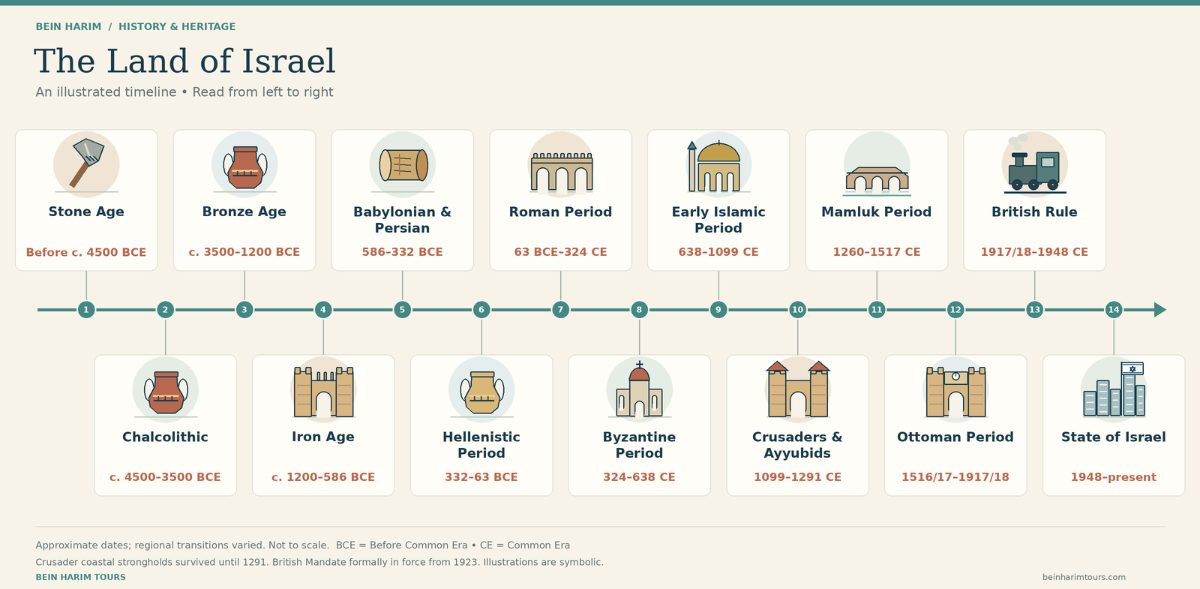
In Jerusalem, a short walk can take you past Roman remains, a medieval church, and Ottoman walls. Along the coast, Crusader halls lie beneath a living city. This Israel history timeline follows the land from its earliest communities to the modern state, connecting each era with something you can recognize on your journey. Here, “the Land of Israel” describes a historical landscape, not one country with fixed borders throughout time. Its boundaries, populations, and names changed repeatedly. Archaeological periods describe material culture, while other period names refer to governments or religious history. That is why some dates overlap. Israel History Timeline at a GlanceIsrael history timeline at a glanceDownload the full-size timeline Dates are approximate, especially in prehistory. Political transitions also occurred at different times in different cities. BCE and CE mean Before the Common Era and Common Era. PeriodApproximate DatesWhat ChangedPlaces to ExploreStone AgeBefore c. 4500 BCEHunting, gathering, then farmingNahal Me'arot; museum collectionsChalcolithicc. 4500–3500 BCECopper working alongside stone toolsIsrael MuseumBronze Agec. 3500–1200 BCECanaanite cities and international tradeMegiddo, HazorIron Agec. 1200–586 BCEIsrael, Judah, and neighboring peoplesJerusalem, Lachish, Tel DanBabylonian and Persian586–332 BCEExile, return, and rebuildingJerusalem; museum collectionsHellenistic and Hasmonean332–63 BCEGreek influence and Jewish independenceBeit Guvrin; museum collectionsRoman63 BCE–c. 324 CEHerodian building, Christianity, revoltsCaesarea, Masada, JerusalemByzantinec. 324–638 CEPilgrimage churches and mosaic artJerusalem, Tzipori, Beit AlphaEarly Islamicc. 638–1099Caliphates and new religious landmarksJerusalem, RamlaCrusader and Ayyubid1099–1291, with regional changesCompeting kingdoms and fortificationsAcre, BelvoirMamlukc. 1260–1517New rulers, trade routes, institutionsJerusalemOttoman1516/17–1917/18Imperial administration and urban growthJerusalem, Acre, JaffaBritish administration and Mandate1917/18–1948New institutions and national movementsTel Aviv, JerusalemModern State of Israel1948–presentStatehood and a changing societyTel Aviv, Jerusalem, museums The Stone Age: The First People and Farming Communities (Before c. 4500 BCE)Stone Age life, as imagined in the 1880s (Photo: Viktor Vasnetsov, Public domain, via Wikimedia Commons) The Stone Age takes its name from the stone tools used by early humans, long before recorded history. Israel's human story begins long before kings, writing, or the biblical kingdoms. During the Paleolithic, or Old Stone Age, people hunted, gathered plants, and made tools from stone. Caves and open settlements preserve evidence of lives stretching back hundreds of thousands of years. The later Natufian culture helps explain the transition toward more settled communities. During the Neolithic, or New Stone Age, farming and animal domestication gradually transformed daily life. Growing food encouraged villages, storage, and new relationships with the landscape. At Nahal Me'arot on Mount Carmel, visitors can explore prehistoric caves and see displays explaining the people who once lived there. The site includes evidence of Natufian life, bringing the long transition toward settled communities into focus. The Chalcolithic Period: Stone Meets Copper (c. 4500–3500 BCE) The Chalcolithic is identified by gradual changes in material culture, including early copperworking. Often called the Copper Age, it brought metalworking into societies that continued using stone tools. Agricultural villages supported craftspeople, exchange networks, and increasingly elaborate ritual objects. At the Israel Museum in Jerusalem, the archaeology collection includes objects from the Nahal Mishmar hoard, discovered in a Judean Desert cave. Its elaborate copper pieces reveal the skill of Chalcolithic craftspeople. Exhibits can change, so check the museum before visiting. The Bronze Age: Canaanite Cities and Egyptian Influence (c. 3500–1200 BCE)Syrian traders in an Egyptian tomb painting (Photo: Nina M. Davies, CC0, via Wikimedia Commons) Changes in settlement and material culture mark the beginning of the Bronze Age. Bronze metallurgy developed gradually, rather than appearing everywhere at once. During this period, the landscape developed networks of towns and fortified cities. Canaan was not one unified kingdom. Its city rulers negotiated, traded, and fought, while larger powers influenced the region. Egyptian domination became particularly important during the Late Bronze Age. Tel Megiddo preserves Canaanite remains, including the foundations of a palace and ancient gates. Hazor is another major site with Bronze Age layers. An archaeological mound, or tel, formed as people repeatedly rebuilt in the same place. Its layers reveal successive cities. A gate, palace, and water system at one site may belong to different periods. Look for their dates as you explore. The Iron Age: Ancient Israel and Judah (c. 1200–586 BCE) The Iron Age begins around the end of the Bronze Age, amid regional upheaval and changing settlements. Iron tools became widespread gradually, not all at once. New communities and political structures emerged. The Iron Age includes the development of ancient Israel and Judah, alongside Philistine, Phoenician, and other neighboring societies. The Bible places Saul, David, and Solomon within this world. Archaeologists study settlements, inscriptions, pottery, and fortifications to understand it; the extent and development of the earliest monarchy remain debated. Biblical narrative and archaeological interpretation should be distinguished, even when they illuminate the same landscape. Assyria conquered the northern kingdom in the eighth century BCE. Babylon destroyed Jerusalem and the First Temple in 586 BCE. At Tel Lachish, visitors can see the Judahite city gate and the Assyrian siege ramp, physical reminders of the campaigns against Judah. Jerusalem and Tel Dan offer other perspectives on the period. For related background, read our guide to biblical Israel and modern Israel. Babylonian and Persian Rule: Exile and Return (586–332 BCE)The Cyrus Cylinder, British Museum (Photo: Mike Peel, CC BY-SA 4.0, via Wikimedia Commons) Babylon's destruction of Jerusalem in 586 BCE marks the start of the Babylonian phase. The conquest ended the kingdom of Judah and brought deportation and major changes to Jerusalem. It did not remove every inhabitant from the land. Rural communities and local life continued amid the upheaval. Persian rule began after Cyrus conquered Babylon in 539 BCE. Returning Judean communities rebuilt religious and civic institutions, including the Second Temple, traditionally dated to 516/515 BCE. Ezra presents the invitation to return with the words “let him go up to Jerusalem” (Ezra 1:3, KJV). The Second Temple period spans Persian, Hellenistic, Hasmonean, and Roman rule until the Temple's destruction in 70 CE. The Israel Museum's collection includes Persian-period finds, including a pottery figurine from Tel Dor. Its model of Jerusalem depicts the city centuries later, around 66 CE. It is a reconstruction, not surviving Temple remains. The Hellenistic Period and the Hasmonean Dynasty (332–63 BCE)Alexander enters Babylon, a 1665 painting (Photo: Charles Le Brun, Public domain, via Wikimedia Commons) Alexander the Great's conquest in 332 BCE marks the beginning of the Hellenistic period. It brought the region into a Greek political and cultural sphere. After his death, rival successor kingdoms competed for control. Greek language, urban institutions, and artistic styles influenced local communities without making their identities uniform. The Hasmonean Dynasty and the Story of Hanukkah (Revolt from 167 BCE; rule until 63 BCE) The Maccabean revolt began in 167 BCE against Seleucid policies and religious persecution. The Temple's rededication became central to Hanukkah. Hasmonean rulers gradually established an independent Jewish state and expanded its territory. The Hasmonean kingdom developed over decades. At Beit Guvrin-Maresha National Park, the painted Sidonian burial caves and underground spaces at Maresha offer a glimpse of life in the Hellenistic period. The Roman Period: Herod, Jesus, and the Jewish Revolts (63 BCE–c. 324 CE)The Roman siege of Jerusalem, 70 CE (Photo: David Roberts, Public domain, via Wikimedia Commons) Roman dominance began with Pompey's capture of Jerusalem in 63 BCE. Rome exercised its power through local rulers and, later, direct administration. Herod the Great, a king supported by Rome, transformed the landscape with ambitious projects, including Caesarea, Masada, and the enlargement of Jerusalem's Temple complex. This is also the world of Jesus and the New Testament. Galilee and Judea formed the setting for his ministry, while Jerusalem became central to the Christian account of his death and resurrection. Identifying a biblical setting does not mean that every church now standing there dates to his lifetime. The Jewish revolt beginning in 66 CE ended with devastating losses, including the destruction of the Second Temple in 70. The later Bar Kokhba revolt began in 132. At Caesarea, the Roman theater and harbor remains reveal another side of this era. In Jerusalem, the lower stones of the Western Wall are part of the retaining wall of Herod's expanded Temple platform, not the Temple building itself. The Byzantine Period: Churches, Synagogues, and Mosaics (c. 324–638 CE)Beit Alpha synagogue mosaic (Photo: Stav Konchtyk, PikiWiki Israel, CC BY 2.5, via Wikimedia Commons) The Byzantine period is commonly dated from 324 CE, when Constantine became sole Roman emperor. The Byzantine Empire was the eastern continuation of the Roman Empire. In the Holy Land, the fourth century marks a major shift as imperial support helped Christianity reshape the religious landscape. Pilgrims traveled to sacred places, and churches developed around traditions associated with Jesus and the Bible. Jewish and Samaritan communities also continued, although their circumstances changed under different rulers. At Beit Alpha in the Jezreel Valley, visitors can see the sixth-century synagogue's mosaic floor, including the Binding of Isaac and a zodiac wheel. Tzipori preserves another remarkable synagogue mosaic. In Jerusalem, the Church of the Holy Sepulchre began as a fourth-century imperial foundation. The building visible today incorporates later rebuilding. Mosaics adorned churches, synagogues, and homes. The Early Islamic Period: A New Religious and Political Landscape (c. 638–1099 CE)The Temple Mount in a 19th-century lithograph (Photo: Louis Haghe after David Roberts, CC BY 4.0, via Wikimedia Commons) Muslim conquests during the 630s marked the beginning of the Early Islamic period. Jerusalem surrendered around 638. Successive caliphates governed a land where Muslim, Christian, Jewish, and Samaritan communities lived through changing conditions. The Umayyad caliph Abd al-Malik commissioned the Dome of the Rock, completed in 691/692 and still visible in Jerusalem today. Its exterior has been altered in later periods. The gold-domed shrine and the neighboring Al-Aqsa Mosque are distinct buildings within the same sacred compound, known to Muslims as al-Haram al-Sharif and to Jews as the Temple Mount. In Jerusalem's Ophel archaeological area, remains of Umayyad buildings south of the Temple Mount reveal another aspect of early Islamic rule. Ramla, founded as a provincial capital in the early eighth century, offers a different urban perspective. Crusaders and Ayyubids: Castles and Changing Kingdoms (1099–1291 CE, with overlapping rule)The Crusader Knights’ Halls in Acre (Photo: Heritage Conservation Accre and Surrounding, PikiWiki Israel, CC BY 2.5, via Wikimedia Commons) The First Crusade's capture of Jerusalem in 1099 began Crusader rule in the city. The Crusaders established a Latin Christian kingdom. Churches, castles, hospitals, and ports served rulers, pilgrims, merchants, and military orders. Saladin's capture of Jerusalem in 1187 brought Ayyubid rule to the city. Crusader rule did not disappear everywhere at once. Acre became the principal center of the later coastal kingdom, surviving until its capture by the Mamluks in 1291. In Acre, the medieval halls beneath the later city make these layers unusually clear. Do not assume every wall is Crusader: the living town above contains substantial Ottoman architecture. The Mamluk Period: Trade Routes and Urban Architecture (c. 1260–1517 CE) The Mamluks' victory over the Mongols at the Battle of Ain Jalut in 1260 marked a turning point in regional rule. Based in Egypt, the Mamluks established control over much of the region and eliminated the remaining major Crusader coastal strongholds by 1291. Their rule lasted until the Ottoman conquest in 1516/17. Jerusalem preserves Mamluk religious schools, gateways, and fountains. The late-fifteenth-century Fountain of Qayt Bay and Madrasa al-Ashrafiyya stand within the Temple Mount compound. Access arrangements can change; ask your guide about the current visiting conditions. The Ottoman Period: Walls, Towns, and New Neighborhoods (1516/17–1917/18 CE)Damascus Gate in Jerusalem’s Ottoman walls The Ottoman conquest of the Mamluk realm in 1516–1517 began roughly four centuries of Ottoman rule. One of its most recognizable legacies is Jerusalem's present Old City wall circuit, rebuilt under Sultan Suleiman the Magnificent in the sixteenth century. These are not the city walls Jesus would have known. In Acre, the Al-Jazzar Mosque, completed in the eighteenth century, and the city's khans and fortifications reveal its Ottoman character. In Jaffa, urban growth and maritime connections shaped a port serving pilgrims, merchants, and local communities. During the nineteenth and early twentieth centuries, new neighborhoods, institutions, and transport links changed the landscape. Jewish immigration and Zionism developed alongside existing Arab communities and other local populations. Tel Aviv began in 1909, before Ottoman rule ended, rather than with Israel's independence. British Rule and the Mandate for Palestine (1917/18–1948 CE)King David Hotel, Jerusalem, 1930s (Photo: American Colony Photo Dept., Public domain, via Wikimedia Commons) British military victories over the Ottomans in 1917–1918 began British administration. Military administration was followed by civilian administration in 1920; the League of Nations Mandate formally entered into force in 1923. “British Mandate, 1917–1948” is therefore convenient shorthand, not a precise description of every year. Government institutions, roads, and cities developed amid intensifying Jewish and Arab national aspirations. Jewish immigration, especially as persecution increased in Europe, and disputes over land, political authority, and immigration helped shape the conflict. In 1947, the United Nations recommended partition into Jewish and Arab states, with a special international arrangement for Jerusalem. Fighting preceded the end of British rule in May 1948. In Tel Aviv, the 1936 Liebling Haus and neighboring International Style buildings offer a visible connection to the Mandate years. Modern Israel: From 1948 to Today (1948–Present)Tel Aviv’s seafront promenade (Photo: Simon Cobb, CC0, via Wikimedia Commons) The modern period in this guide begins with the declaration of the State of Israel on May 14, 1948. David Ben-Gurion proclaimed the state in Tel Aviv. The war surrounding its establishment shaped the new state's institutions and borders and brought mass Palestinian displacement, remembered by Palestinians as the Nakba. Subsequent decades brought major Jewish immigration from Europe, the Middle East, North Africa, the former Soviet Union, and Ethiopia. Towns, universities, and industry grew amid continuing conflict. The 1967 war transformed territorial control; peace treaties with Egypt in 1979 and Jordan in 1994 marked major diplomatic changes. Israel today is a society of Jewish, Muslim, Christian, Druze, and other communities. On Rothschild Boulevard in Tel Aviv, the building known as Independence Hall marks the place where statehood was proclaimed. Check current access before visiting. Nearby streets, Jerusalem's neighborhoods, and museums show how recent history continues to shape everyday life. The Israeli-Palestinian conflict remains unresolved. The October 7, 2023 attacks and ensuing war are also part of this modern chapter, whose consequences continue to unfold. Explore Israel's History with Bein Harim From the ancient streets of Jerusalem to the ruins of Masada, Israel’s historical sites bring the stories of this timeline to life. Explore our Israel day tours to find a journey that matches your interests and discover the people, places, and events that shaped the land. For prehistoric sites, biblical kingdoms, museum collections, or a slower walking pace, consider a custom Israel tour. Tell us your interests, available time, and accessibility needs. Contact us to turn this timeline into a journey through the places themselves.
Von Asaf Ben Ari
  • Anzeigen der Ergebnisse 15 - 24 von 24
  • 1
  • 2